
JD Vance Claims America 'Won Almost None' of Its Wars Until Trump — But Critics Are Pointing to a Glaring Contradiction
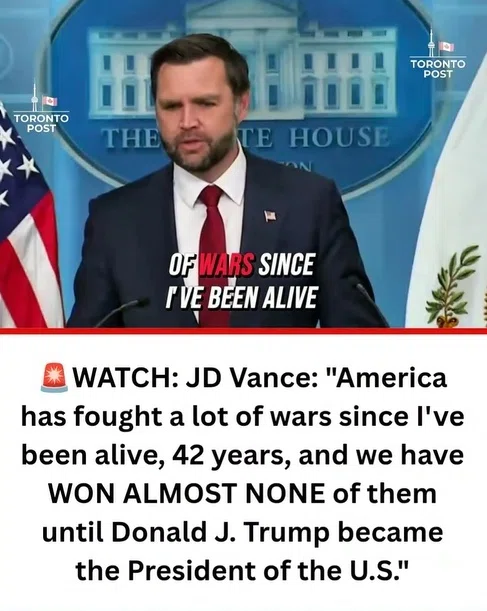
Vice President JD Vance sparked a political firestorm on September 3, 2026, when he declared that the United States had "won almost none" of its wars over the past 42 years — until Donald Trump became president. The remarks, delivered during a White House briefing and a CBS Face the Nation interview, were immediately met with a wave of criticism from historians, political opponents, and commentators who pointed to notable military victories and a striking contradiction in Vance's own messaging about the ongoing conflict with Iran .
WASHINGTON, D.C. – Vice President JD Vance has ignited a fierce debate over U.S. military history after claiming that American forces have been largely unsuccessful in conflicts for decades until President Donald Trump took office.
"America has fought a lot of wars since I've been alive — 42 years — and we have won almost none of them until Donald J. Trump became the president of the United States," Vance told reporters at a White House briefing on September 3 .
The Vice President used the statement to defend the Trump administration's foreign policy record and the leadership of Defense Secretary Pete Hegseth.
"What does that say about the culture of military leadership, the way that we did planning? And what does it say, frankly, about the political leadership that we've had in the White House, at the Department of War, for 40 years of, frankly, military misadventures?" Vance added .
The Critics' Rebuttal: A History of U.S. Victories
Vance's broad claim immediately drew sharp pushback from military historians and political commentators who cited a string of U.S. military successes since 1984.
Critics pointed to Operation Desert Storm (1991), the Gulf War, which saw a U.S.-led coalition decisively liberate Kuwait from Iraqi forces and is widely considered a textbook example of a swift and successful military campaign . Other victories cited include:
-
Operation Praying Mantis (1988): A clear U.S. victory against Iranian naval forces and platforms .
Operation Just Cause (1989-1990): The U.S. invasion of Panama that removed President Manuel Noriega .
Operation Deliberate Force (1995): A NATO air campaign that helped force Bosnian Serbs to negotiate the Dayton Agreement .
Operation Allied Force (1999): The NATO bombing campaign that led to Serbian forces withdrawing from Kosovo .
Destruction of ISIS (2014-2019): An unambiguous U.S. victory in the fight against the Islamic State group .
David Rohde, a senior national security adviser for MSNBC, highlighted the contradiction: "George H. W. Bush would disagree. In terms of no presidents ever winning wars, he successfully drove Iraqi forces out of Kuwait. It's just extraordinary to say we're not in war and to say every president for the past 40 years has been a failure" .
One analyst concluded that the overwhelming U.S. military superiority did not necessarily guarantee strategic successes or political gains, especially in conflicts lacking precise objectives and clear end dates .
'I Wouldn't Call It a War': The Contradiction
Perhaps the most striking contradiction in Vance's messaging came when he addressed the current U.S. military conflict with Iran, which entered its seventh month in September 2026. Despite the ongoing hostilities and exchange of attacks, Vance explicitly refused to label the situation a "war" .
"I wouldn't call it a war," Vance said. "Right now there's no active shooting. I recognize there's been places where this has flared up" .
This refusal to call the ongoing conflict a "war" while simultaneously using it as the primary example of a Trump-era victory was met with widespread criticism and accusations of political gaslighting . Critics pointed out that the administration had deployed more than 50,000 troops and nearly 20 warships to the region, and the conflict had cost over $30 billion and driven up global oil prices .
The war has dragged down Trump's approval ratings and raised the stakes for Republican candidates in the November midterm elections . On September 2, 2026, the U.S. launched airstrikes on Iran, hitting military targets along the coast in retaliation for Iranian attacks on shipping in the Strait of Hormuz, causing a fresh surge in oil prices .
The Trump Administration's Response
Despite the criticism, Vance emphasized that the U.S. had achieved its core objectives in Iran by destroying its nuclear infrastructure . He argued that the current focus was to ensure Tehran could not keep disrupting commercial oil shipping. "When will the Iranians stop shooting at ships? I think the reality is I don't know the answer to that question," Vance admitted, ruling out any negotiations as long as Tehran continued its attacks .
The Bottom Line
| Vance's Claim | Critics' Response |
|---|---|
| America won almost no wars from 1984 to 2026 | U.S. victories in Desert Storm, Panama, Kosovo, and against ISIS |
| Trump is the first president in 40 years to win a war | The current Iran conflict lacks a clear definition of victory and continues with no end in sight |
| The Iran conflict shows the U.S. can win wars | Vance refuses to call the conflict a "war" despite ongoing hostilities |
| The administration has revived the "warrior spirit" | Critics argue the U.S. is stuck in an undeclared forever war |
Vance's remarks come amid a highly tense political backdrop, including the recent resignation of Army Secretary Dan Driscoll and the ongoing U.S. military conflict with Iran, which has reached its seventh month . The Vice President's attempt to use the Iran conflict as evidence of Trump-era success while avoiding the term "war" has created a politically damaging contradiction that critics are seizing upon.
Comments (0)
Loading comments...
May You Like

Jack Smith Defends His Integrity as Trump Investigations Face Renewed Political Firestorm

OBAMA STUNS ON INSTAGRAM: MESSAGE MARKING 34-YEAR MILESTONE SPARKS A BUZZ













