
JD Vance Refuses to Abandon Tucker Carlson: “I’m Not Going to
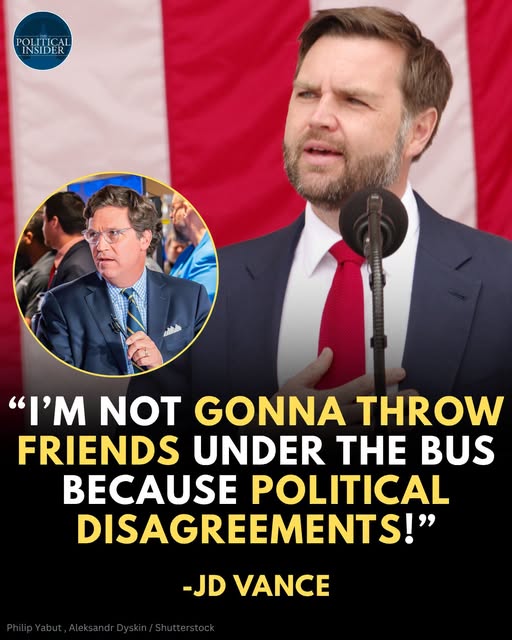
WASHINGTON — Vice President JD Vance is refusing to distance himself from conservative commentator Tucker Carlson despite growing pressure from parts of the Republican Party, arguing that political disagreements should not automatically end personal friendships.
The unusually candid defense came during Vance’s White House briefing on Sept. 3, where he was repeatedly questioned about his relationship with Carlson and the widening divisions within the conservative movement.
Vance acknowledged that he strongly disagrees with Carlson on a number of issues. But he rejected the idea that those disagreements should force him to publicly disavow someone he considers a friend.
“I’m not going to play the game where I throw friends under the bus because I have political disagreements with them.”
The remarks have since become a flashpoint in an increasingly bitter debate over loyalty, political influence and the direction of the MAGA movement.
Vance Draws a Line Between Friendship and Politics
Vance made clear that his relationship with Carlson does not mean he endorses everything the commentator says.
He acknowledged that Carlson has made statements with which he disagrees, while maintaining that the two remain friends. The Associated Press reported that Vance described the disagreement as real but rejected the expectation that political figures must sever personal relationships whenever their views diverge.
That distinction is significant because Carlson has become one of the most prominent conservative critics of President Donald Trump, particularly over the administration's military confrontation with Iran.
Carlson has also challenged other elements of the Republican foreign-policy establishment, putting him increasingly at odds with influential figures inside Trump's coalition.
Vance, however, appears unwilling to turn those disagreements into a personal rupture.
Tucker Carlson Has Become a Major Fault Line on the Right
The controversy surrounding Vance and Carlson is larger than a disagreement between two political personalities.
Carlson remains one of the most influential voices among America's populist and nationalist right. His criticism of the administration's approach to Iran has placed him on the opposite side of a major foreign-policy dispute from Trump and many senior Republicans.
That has created an uncomfortable situation for Vance.
As vice president, he is one of the most senior figures in Trump's administration. At the same time, he has maintained relationships with influential figures across the broader MAGA ecosystem, including people who sometimes criticize the president.
The Wall Street Journal reported that Vance has defended his relationship with Carlson even as pressure has increased from Republicans who want him to distance himself from the former Fox News host.
The Iran Conflict Has Made the Disagreement More Difficult
The timing of Vance's comments is particularly important.
The United States remains involved in a prolonged conflict with Iran, while the administration attempts to portray the situation as a limited military confrontation rather than a conventional war.
At the same Sept. 3 briefing, Vance said the conflict should not be described as a war and declined to provide a timeline for its conclusion. He said major combat operations had ended but that fighting continued, particularly around attacks on commercial shipping in the Strait of Hormuz.
Reuters reported that more than 50,000 U.S. troops remained in the Middle East, alongside nearly 20 warships, as Washington sought to maintain control of maritime traffic and pressure Iran.
Carlson has been sharply critical of the administration's decision to pursue the conflict, making his continued friendship with Vance politically more complicated.
Vance Is Protecting More Than a Friendship
Vance's refusal to break with Carlson also carries implications for his own political future.
The vice president is increasingly viewed as one of the leading potential Republican contenders for 2028. His challenge is to maintain Trump's political coalition while simultaneously establishing an identity of his own.
That requires navigating competing factions inside the Republican Party.
A public break with Carlson could reassure some Republicans who believe the commentator has crossed unacceptable political or ideological lines. But it could also alienate a portion of the populist conservative audience that remains highly receptive to Carlson's message.
Vance's response suggests that, for now, he would rather tolerate political disagreement than participate in what he sees as a demand for ideological conformity.
The Wall Street Journal has described Vance's current political positioning as part of an emerging 2028 audition, in which he is attempting to remain close to Trump while developing his own political coalition.
Pressure From Within the Conservative Movement
The controversy also reflects a deeper struggle over who gets to define the modern Republican Party.
For years, conservative politics has been held together by a broad coalition that includes traditional Republicans, evangelical voters, populist activists, foreign-policy hawks and an increasingly influential ecosystem of online commentators.
Those groups do not always agree.
The Iran conflict has exposed some of those divisions more openly, with prominent conservative voices questioning whether military intervention is compatible with the “America First” philosophy that helped propel Trump and Vance to power.
Carlson's position has placed him at the center of that dispute, while Vance's decision to remain personally close to him demonstrates how difficult it can be for Republican leaders to draw clean ideological boundaries.
Vance's Message: Disagreement Does Not Mean Betrayal
Perhaps the most consequential part of Vance's remarks was not his defense of Carlson specifically, but the principle behind it.
Vance argued that political relationships should not be governed entirely by partisan loyalty.
That is a notable position in an era when Republican politics has become increasingly dominated by questions of allegiance to Trump and the MAGA movement.
Yet Vance is also making a political calculation.
By refusing to publicly abandon Carlson, he signals to the populist right that he does not intend to sever relationships simply because political disagreements become inconvenient.
At the same time, he carefully separated friendship from agreement, making clear that maintaining a personal relationship does not mean accepting every position Carlson takes.
A Potential Preview of Vance's 2028 Strategy
The episode could ultimately prove more important for Vance than for Carlson.
If Vance does pursue the Republican presidential nomination in 2028, he will have to construct a coalition broad enough to unite Trump's loyalists, economic populists, national conservatives and voters increasingly skeptical of foreign military intervention.
That makes relationships across ideological factions potentially valuable.
For now, Vance is choosing not to burn those bridges.
His message is straightforward: political disagreement does not automatically require personal betrayal.
And in a Republican Party increasingly defined by battles over loyalty, foreign policy and the future of MAGA, that stance could become an important part of Vance's political identity.
Comments (0)
Loading comments...
May You Like
Jack Smith Defends His Integrity as Trump Investigations Face Renewed Political Firestorm

South Korea–Ukraine Rift Deepens Over North Korean POW Transfer as PURL Draws New Scrutiny

Shocking news from Ohio: an unexpected development ahead of Trump's rally













