JD Vance Says Trump Will Be Remembered for
WASHINGTON — Vice President JD Vance is making an increasingly ambitious case for President Donald Trump’s economic legacy, arguing that the administration’s efforts to rebuild domestic industry could ultimately become one of the defining achievements of Trump’s presidency.
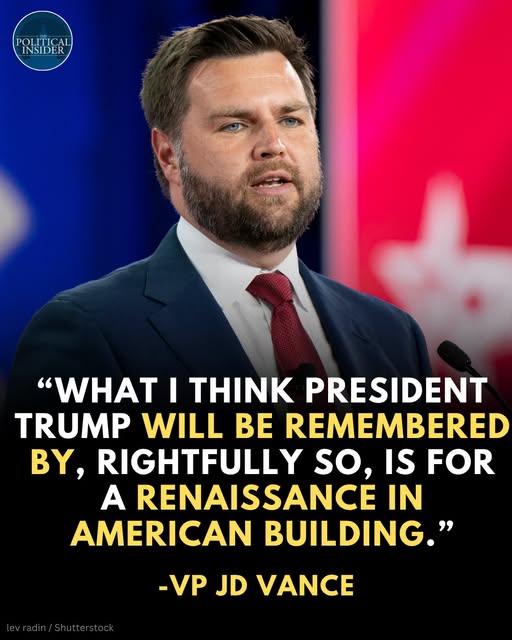
During a White House press briefing on Sept. 3, Vance said Trump should be remembered “rightfully so” for what he called “a renaissance in American building and American manufacturing.”
The comment, highlighted in a widely shared graphic, came as the administration intensified its message that the United States is entering a new era of industrial investment, reshoring and manufacturing growth.
Vance: Trump Rejected Decades of Offshoring
Vance framed Trump’s economic agenda as a direct reversal of decades of bipartisan policies that, in his view, encouraged American companies to move jobs and production overseas.
He argued that Trump had effectively said “enough” to that approach and accused both corporations and foreign governments of benefiting at the expense of American workers.
According to Vance, the administration's combination of tax cuts, trade measures and pressure on companies to invest domestically is beginning to produce the conditions for a manufacturing revival.
The remarks fit closely with the administration’s broader “America First” economic strategy, which places domestic production, supply-chain security and industrial investment at the center of its economic message.
Manufacturing Has Indeed Been Expanding
There is measurable economic data behind Vance's argument, although the numbers do not by themselves establish that Trump's policies caused the entire manufacturing expansion.
The Institute for Supply Management reported that U.S. manufacturing activity expanded for an eighth consecutive month in August, with its Manufacturing PMI reaching 54.6, down from 55.6 in July but still indicating expansion. New orders, production and employment were all in expansion territory.
That represents a significant change from the manufacturing contraction that preceded the current period of expansion.
However, the August figure also showed that momentum moderated. New orders fell from 56.7 in July to 53.7, while the overall PMI declined by one percentage point.
So while the administration can point to sustained manufacturing growth, the data alone cannot prove that the White House's policies are solely responsible for the improvement.
Vance Links the Revival to Trump’s Tax and Trade Policies
At the briefing, Vance argued that businesses are increasingly purchasing machinery and capital equipment that could eventually support additional hiring and production.
He connected that investment to the administration's tax policies, while also emphasizing Trump's willingness to impose costs on companies and foreign countries that the administration believes disadvantage American workers.
“It’s also been the stick,” Vance said, arguing that the manufacturing revival would not have begun without Trump's willingness to penalize corporations and foreign governments.
The argument reflects a central feature of Trump's second-term economic philosophy: using tariffs, trade restrictions and incentives to encourage companies to produce more goods inside the United States.
A Manufacturing Message With an Election Purpose
Vance's comments also had an unmistakable political dimension.
The vice president was speaking just weeks before the November midterm elections, when Republicans are attempting to defend their congressional majorities.
During the same briefing, Vance urged voters to support Republican candidates, arguing that the choice would determine whether the administration could continue its economic agenda.
That makes the manufacturing message more than an economic argument. It is also becoming part of the Republican Party's broader campaign pitch to working-class voters, particularly in industrial regions of the Midwest and Rust Belt.
Michigan Becomes a Showcase for Trump’s Industrial Strategy
The administration has been using Michigan as a prominent example of its manufacturing ambitions.
On Aug. 31, the White House highlighted billions of dollars in announced industrial investments in the state, including General Motors' planned $6 billion investment in U.S. manufacturing and additional investments from Ford and Stellantis.
The White House has portrayed these projects as evidence that Trump's policies are bringing factories, capital and jobs back to American communities.
Critics, however, are likely to question how much of the announced investment represents genuinely new production, how many jobs will ultimately be created, and how much credit should be assigned to federal policy versus broader market conditions and corporate investment decisions.
The “Building” Part of Vance’s Argument
Vance's choice of the word “building” is also significant.
His vision goes beyond traditional factory employment. The administration has increasingly emphasized a wider industrial ecosystem involving construction, engineering, energy, semiconductors, defense production and skilled trades.
On Sept. 3, Vance participated in the launch of the administration's Foundry School, a program designed to train entrepreneurs, engineers, technicians and other workers needed for the manufacturing sector. The initiative is intended to support the administration's broader effort to rebuild domestic industrial capacity.
At the launch, Vance argued that America needs to reinvest in workers and give young people alternatives to traditional four-year college pathways.
He described the country as being at the beginning of what he called a “manufacturing renaissance.”
A Claim That Will Ultimately Be Tested by Results
Vance's prediction about Trump's historical legacy is ultimately a judgment, not an established fact.
Whether Trump is remembered for an industrial renaissance will depend on what happens over the remaining years of his presidency — including whether manufacturing expansion translates into sustained job growth, higher productivity, stronger wages and durable investment.
The current data provide some support for the administration's optimistic narrative: manufacturing has expanded for eight consecutive months, while production and new orders remain above contraction levels.
But the sector also faces significant challenges, including elevated input prices, trade uncertainty and geopolitical disruption.
The Bigger Political Bet
For Vance, however, the argument is already clear.
He is presenting Trump not simply as a president who changed tax or trade policy, but as a leader attempting to change the physical structure of the American economy — from where products are made to how workers are trained and where companies invest.
That vision could become an important part of Trump's historical legacy if the industrial revival proves durable.
For now, Vance is betting that the factories, machinery and American-made products emerging from the administration's policies will eventually tell the story more powerfully than the political battles surrounding them.
“What I think President Trump will be remembered by, rightfully so, is for a renaissance in American building and American manufacturing,” Vance said.
The question now is whether that renaissance will prove to be a lasting transformation — or a political promise that still has years to be tested.
Comments (0)
Loading comments...
May You Like

gfnhgmnghnmfgnbvvvvvvvvv

South Korea–Ukraine Rift Deepens Over North Korean POW Transfer as PURL Draws New Scrutiny

South Korea–Ukraine Rift Deepens Over North Korean POW Transfer as PURL Draws New Scrutiny