
JD Vance Walks Into the White House Briefing Room — But Karoline Leavitt’s Replacement Is Still Nowhere in Sight
WASHINGTON — The White House briefing room has a new face behind the podium — but it is not the permanent replacement for former Press Secretary Karoline Leavitt.
Vice President JD Vance returned to the James S. Brady Press Briefing Room on Sept. 3, becoming the first senior official to conduct a full briefing there since Leavitt left the administration. The appearance immediately attracted intense attention from the White House press corps, but despite the dramatic framing circulating online, the White House has not yet named Leavitt's successor.
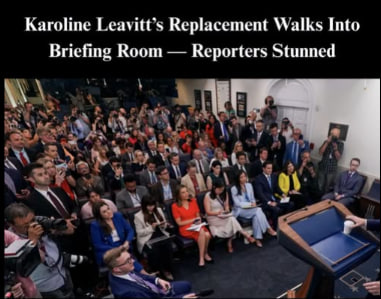
The distinction is important because the viral image accompanying the claim suggests that Trump has already selected a replacement who dramatically “walked into” the briefing room.
That is not what happened.
Instead, Vance temporarily stepped into the role as the administration continues searching for a permanent press secretary.
And the timing could hardly be more politically sensitive.
The administration is facing an increasingly difficult combination of the Iran conflict, rising energy prices, the approaching November midterm elections and growing questions about the future of Trump's communications operation.
The Briefing Room Had Been Without a Regular Press Secretary
Karoline Leavitt officially completed her final day as White House press secretary on Aug. 27.
Her departure marked the end of a highly visible tenure in which she became one of President Donald Trump's most prominent defenders and the youngest person ever to hold the position. The White House praised her tenure as one defined by an aggressive defense of Trump's agenda.
Leavitt announced that she was leaving to spend more time with her family following the birth of her second child.
Trump has said she will remain involved in Republican politics and continue serving as an influential voice outside the formal White House structure.
But her departure left one of the most recognizable positions in the administration vacant.
And with the 2026 midterm elections approaching, the timing is awkward.
Vance Becomes the Stand-In
Rather than immediately appointing a new press secretary, the White House has turned to senior administration officials to handle briefings.
That arrangement had already been used during Leavitt's maternity leave earlier in the year, when Secretary of State Marco Rubio and other senior officials took turns answering questions from reporters.
On Sept. 3, it was Vance's turn.
According to the White House schedule, Vance was scheduled to brief reporters at 1 p.m. in the James S. Brady Press Briefing Room. The White House itself published video of the vice president's briefing.
The briefing lasted approximately 57 minutes, according to White House pool reports.
Vance discussed a wide range of issues before taking questions from reporters, including the Iran conflict, inflation, energy prices, the midterms and other administration policies.
So while the image's dramatic suggestion of a surprise replacement is misleading, the underlying event was significant.
The vice president was effectively serving as the administration's public face from the briefing-room podium at a moment when the communications operation has no permanent press secretary.
Reporters Had Plenty of Questions
The biggest issue waiting for Vance was not personnel.
It was Iran.
The United States has been engaged in a prolonged military confrontation with Iran, and the conflict has become one of the administration's most politically difficult problems heading into the midterms.
Vance was asked directly whether the conflict should be described as a war.
His answer was striking:
“I wouldn't call it a war.”
Vance argued that major combat operations had stopped, although military exchanges and flare-ups continued.
His comments came even as Iran continued retaliatory attacks and the United States maintained a major military presence in the region.
The vice president also refused to give reporters a specific timeline for when the confrontation would end.
That created an uncomfortable political backdrop for the administration.
Trump had previously suggested that the conflict would be relatively short.
Months later, American forces are still heavily engaged in the region.
The White House Has a Bigger Problem Than an Empty Podium
The absence of a permanent press secretary might appear to be a relatively minor personnel issue.
It is not.
The White House press secretary traditionally serves as the administration's most visible daily communicator — the person who explains presidential decisions, responds to controversies and attempts to control the political narrative.
That role becomes even more important when the administration is dealing with multiple crises simultaneously.
Trump's second administration is currently confronting:
- the ongoing conflict with Iran;
- elevated energy prices;
- inflation concerns;
- immigration disputes;
- election-related controversies;
- congressional battles;
- and the upcoming 2026 midterm elections.
The White House therefore needs a communicator capable of defending the president under relentless questioning.
For now, that responsibility is being distributed among senior officials.
Trump Still Has Not Picked Leavitt's Successor
Reports before and after Leavitt's departure indicated that the White House had been considering potential candidates, but there was no final decision.
CBS News reported in late August that Trump had not settled on a replacement and that briefings would rotate among senior administration officials in the meantime.
The Washington Post similarly reported that Trump had not yet decided who would take over the job and that Cabinet officials and other senior figures were expected to continue appearing before reporters.
That means the viral headline claiming that “Karoline Leavitt's replacement walks into the briefing room” gets the central fact wrong.
There was someone new at the podium.
But there was no newly appointed press secretary.
It was JD Vance.
Why Vance Was a Natural Choice
Vance is arguably one of the administration's most politically important figures outside Trump himself.
As vice president, he has increasingly become one of Trump's principal defenders and a key messenger for the administration's domestic and foreign-policy agenda.
He also has experience dealing directly with the White House press corps.
During Leavitt's maternity leave, Vance previously appeared in the briefing room, demonstrating that he was comfortable taking questions from journalists.
His Sept. 3 appearance therefore did not represent an entirely unprecedented move.
But the circumstances were different.
This time, Leavitt was no longer temporarily absent.
The press secretary's office was officially vacant.
The Briefing Also Put Vance's 2028 Future Under a Microscope
There was another reason reporters were watching closely.
Vance is widely regarded as one of the leading potential Republican presidential contenders for 2028.
That makes every high-profile appearance increasingly relevant to his political future.
At the Sept. 3 briefing, Vance was questioned about several issues extending beyond the immediate responsibilities of a vice president, including Republican leadership and his own political future.
Roll Call reported that Vance avoided committing himself on certain 2028 questions while using the briefing to defend the administration's political agenda ahead of the midterms.
The optics were therefore unusual.
The White House press secretary's chair was empty, while the vice president — himself a potential future presidential candidate — stood before reporters and effectively became the administration's chief public defender for nearly an hour.
Maria Bartiromo Rumors Add More Intrigue
The vacancy has generated additional speculation following the sudden departure of longtime Fox News personality Maria Bartiromo from Fox News Media.
Bartiromo left the network in early September after more than 12 years. Fox described the departure as a business decision and did not announce a detailed reason.
Because of her close relationship with Trump, speculation quickly emerged online that she could potentially be considered for a role in his administration.
But Vance pushed back on the idea that Bartiromo was about to become the next White House press secretary.
That speculation therefore remains just that — speculation.
There is currently no confirmed appointment.
The Timing Could Hardly Be More Difficult
The White House does not have the luxury of taking months to solve its communications problem without consequences.
The midterm elections are scheduled for Nov. 3.
Republicans are attempting to defend their congressional majorities, while Democrats are increasingly targeting Trump's handling of the economy and foreign policy.
The Iran conflict presents an especially difficult challenge.
Vance's briefing demonstrated just how quickly reporters can shift from questions about personnel to questions about war, oil prices, casualties and electoral consequences.
A permanent press secretary would have to handle exactly these confrontations on a near-daily basis.
Leavitt's Legacy Still Hangs Over the Briefing Room
Leavitt's departure is also significant because she changed the relationship between the Trump White House and the traditional press corps.
The Washington Post reported that during her tenure, the White House expanded access for influencers and podcasters while changing long-standing arrangements governing the press pool. The administration also restricted access for some traditional wire services while giving greater visibility to outlets and personalities supportive of Trump.
That means whoever eventually replaces her will inherit more than a microphone.
They will inherit a fundamentally transformed White House communications environment.
The next press secretary will have to decide whether to maintain Leavitt's confrontational approach, modify it or attempt to rebuild relationships with traditional journalists.
The “Replacement” Has Not Arrived — Yet
The viral image captures a real and visually striking moment: a packed White House briefing room, cameras rolling and a senior Trump administration official taking the podium after Leavitt's departure.
But the headline attached to the image tells a different story.
There was no confirmed new press secretary walking into the briefing room.
There was JD Vance, filling the vacuum.
And that distinction may ultimately be more revealing than the viral headline itself.
For now, the Trump administration is operating without a permanent occupant of one of the most important communications positions in the White House.
The podium is still there.
The reporters are still there.
The questions are getting harder.
But Karoline Leavitt's replacement has yet to take the seat
Comments (0)
Loading comments...
May You Like

South Korea–Ukraine Rift Deepens Over North Korean POW Transfer as PURL Draws New Scrutiny

Obama Steps Back Into the Political Spotlight as Democrats Target Trump’s Senate Majority













