
JD Vance’s “Tin-Pot Dictator” Remark Backfires as Critics Turn His Gas-Price Argument Against Trump
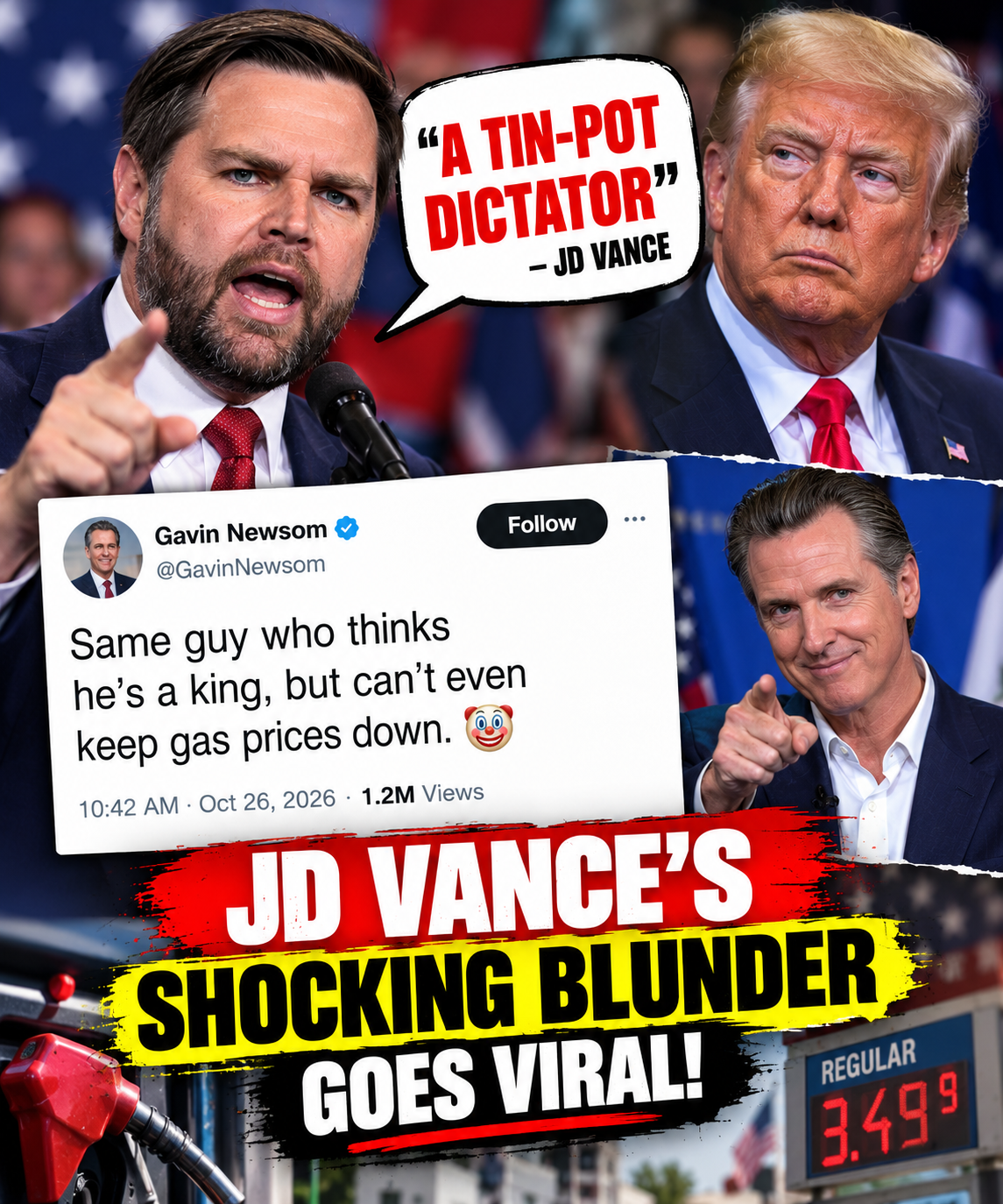
October 27, 2026 — Vice President JD Vance intended to explain why gasoline prices rise during international crises. Instead, one phrase from his remarks at a Republican rally in Montana has become a political headache for the Trump administration, as critics seized on his reference to a “tin-pot dictator” and asked whether the description could also apply to President Donald Trump.
The remark came on October 26 at a midterm campaign event in Belgrade, Montana, where Vance acknowledged voters’ frustration with high fuel prices before arguing that international conflicts have repeatedly driven energy costs upward. He cited price spikes in several earlier years, including 2022, when Russia launched its full-scale invasion of Ukraine. He then said gasoline prices “skyrocket every time some tin pot dictator decides to throw a tantrum.” The rally transcript confirms the wording, although Vance did not name Trump in that passage.
That distinction is central to the story: Vance did not explicitly call Trump a dictator. The controversy arose because opponents connected his general description of leaders who start wars to the current administration’s own foreign policy, particularly the conflict with Iran.

The speech that handed critics an opening
In the same speech, Vance conceded that voters had legitimate concerns about fuel costs. He recalled the surge in gasoline prices following Russia’s invasion of Ukraine and referenced earlier spikes in 1979, 2001 and 2007. He then argued that the answer was to expand domestic energy production, including building more refineries and energy facilities and increasing drilling.
The political problem was the gap between Vance’s general explanation and the current administration’s record. Critics argued that if wars and decisions by authoritarian leaders can push fuel prices higher, the administration should also address the effect of its own foreign-policy choices rather than focusing exclusively on earlier crises or blaming previous presidents.
Reporting by The Independent noted that Vance’s list of historical price spikes did not mention the Iran conflict under the Trump administration—a conspicuous omission for critics who believe the war has contributed to the latest rise in fuel costs. That omission does not, by itself, establish the precise contribution of the conflict to every change in gasoline prices, which can also be affected by crude-oil markets, refining capacity, seasonal demand and other factors.

Gavin Newsom’s office turns the phrase into a viral jab
The response arrived quickly on social media. California Governor Gavin Newsom’s press office shared Vance’s remarks and mocked the apparent contradiction, writing: “Can’t believe he’d talk about Trump like that.” The post reframed the vice president’s words as though he had inadvertently described his own boss.
The image supplied with this story displays a different alleged Newsom post: “Same guy who thinks he’s a king, but can’t even keep gas prices down.” However, the reporting located for this article confirms the press office’s shorter “Can’t believe he’d talk about Trump like that” response; it does not independently authenticate the exact longer post shown in the graphic. The displayed account, timestamp and view count should therefore be verified against the original social-media post before being presented as established facts.
The distinction matters in fast-moving political coverage. A genuine post can be paired with an altered, recreated or otherwise unverified screenshot, and a viral image alone does not establish that every word, timestamp or engagement figure is authentic.
The reaction extended beyond Newsom’s office. Online critics used the phrase to challenge the administration’s explanation for rising fuel prices, while some commentators pointed to Vance’s own history of criticizing Trump before becoming his running mate. These reactions demonstrate how the remark was being interpreted politically, rather than proving that Vance intended it as a personal criticism of the president.
The larger issue: who is responsible for rising fuel costs?

The episode lands at a sensitive moment for Republicans. With the November 3 midterm elections approaching, fuel prices and the cost of living remain prominent political issues. The administration has emphasized domestic energy production and blamed previous Democratic leadership for economic problems, while critics argue that voters will judge the White House on the prices they are paying now, not simply on explanations of earlier inflation. Recent Associated Press reporting has described the competing economic messages from Trump and Vance as Republicans face mounting concerns about affordability.
Vance’s argument rests on a familiar economic point: international conflict can disrupt oil supplies and push up fuel prices. But that explanation also creates a political vulnerability. If the administration invokes wars abroad to explain higher prices, opponents can ask whether its own decisions have contributed to the same pressures.
Gasoline prices are not controlled by any single president. Global crude-oil prices, refining and distribution costs, taxes, seasonal demand and geopolitical risk all play roles. Government decisions can influence some of these factors, but a price increase alone does not prove that one policy or one leader is solely responsible.
The political challenge for Vance is therefore less about the literal meaning of “tin-pot dictator” than about the comparison critics have constructed around it. His remarks were intended to describe leaders whose actions contribute to international instability. Critics have argued that the same reasoning should be applied consistently to the Trump administration’s foreign-policy decisions.
Did Vance accidentally reveal a deeper split with Trump?
The viral reaction has also revived questions about Vance’s political position within the administration and his future ambitions. Some commentators interpreted the moment as an example of how a vice president can create an unexpected problem for his own president even without naming him. Others treated the backlash as an ordinary instance of partisan social-media spin.
There is, however, no verified evidence in the speech that Vance intended to insult Trump, was secretly criticizing him, or was making an admission about the president’s character. The transcript shows that he was discussing historical fuel-price increases and arguing for greater domestic energy production. The comparison with Trump was made by critics after the remarks circulated online.
That does not make the political irony irrelevant. It helps explain why the clip spread: a phrase intended to criticize foreign leaders became a way for opponents to challenge the administration’s own decisions. But virality is not proof of a hidden message, and online interpretations should not be confused with Vance’s documented intent.
What to watch next
The immediate questions are whether the administration can demonstrate progress on fuel affordability, whether its explanation of the relationship between foreign conflicts and energy prices resonates with voters, and whether the controversy persists beyond the news cycle.
For Newsom, the exchange provides a ready-made line of attack against Trump and the Republican administration ahead of the midterms. For Vance, it is a reminder that a message aimed at political opponents can be redirected toward the administration he represents. For voters, the more substantive issue remains whether the government’s energy and foreign policies are delivering the results it has promised.
The verified takeaway is straightforward: Vance did use the phrase “tin pot dictator” while discussing the relationship between international conflicts and gasoline prices. Newsom’s press office then mocked the remarks by linking them to Trump. The claim that Vance directly called the president a dictator—or deliberately revealed a secret disagreement with him—goes beyond what the available evidence establishes.
Comments (0)
Loading comments...
May You Like

WWE BRONSON REED DEAD AT 38, STIMULANTS DETECTED, $10M INSURANCE PAYOUT FROZEN!

1,000+ MILITARY FAMILY RECORDS BREACHED, 200+ MILITARY SITES AT RISK!

EAST COAST STORM CRISIS—5 MILLION AT RISK OF BLACKOUTS, WATER, AND HEATING FAILURES!








Popular Posts




