
Jelly Roll’s Social-Media Drop After ‘Kimmel’ Trump Jokes: What the Viral Graphic Gets Right — and What It Leaves Out
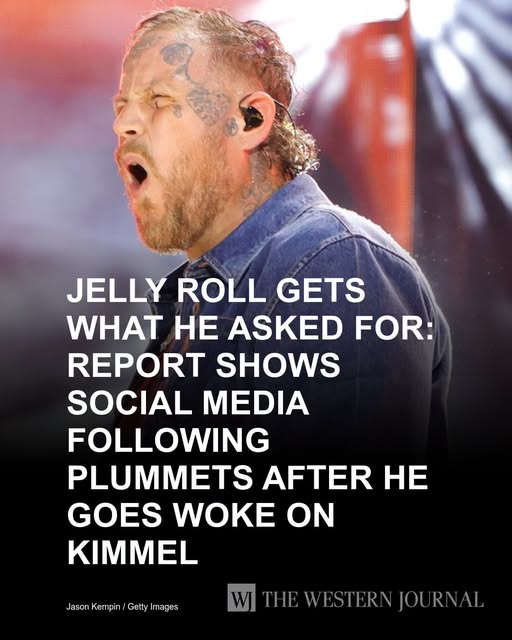
A viral graphic from The Western Journal claims that country star Jelly Roll “gets what he asked for,” alleging that his social-media following “plummets” after he “goes woke” while guest-hosting Jimmy Kimmel Live!
There is a real story behind the graphic. Jelly Roll did spark a backlash after repeatedly joking about President Donald Trump during his Aug. 24–27 guest-hosting stint. He also explicitly told listeners who disliked his political jokes that they could stop listening to his music.
And there is evidence of a significant short-term decline on at least one major platform.
But the stronger claim — that Jelly Roll's social-media following broadly “plummeted” because he “went woke” — goes beyond what the available data can firmly establish.
Jelly Roll really did turn his Kimmel appearance into a political controversy
Jelly Roll, whose real name is Jason DeFord, served as a guest host of Jimmy Kimmel Live! while Kimmel was away.
His opening monologue on Aug. 24 included jokes about Trump, including jokes about the president's weight and approval ratings. The jokes surprised some viewers because Jelly Roll had generally avoided identifying himself with either major political party.
The reaction intensified when Jelly Roll returned for subsequent episodes.
On Aug. 25, he addressed people threatening to stop listening to his music because of the jokes and essentially told them to follow through.
“Go right ahead,” was his message, before he joked that he would continue speaking his truth.
That exchange is important because it provides the basis for the Western Journal headline's “gets what he asked for” framing.
There really was a measurable Instagram decline
The most concrete independent data I found concerns Jelly Roll's Instagram account, @jellyroll615.
DolphinRadar's tracking shows the account at about 5.91 million followers on Aug. 23. By Aug. 27, it had fallen to about 5.899 million. It then declined further:
- Aug. 27: 5,899,089
- Aug. 28: 5,888,370
- Aug. 29: 5,874,252
- Aug. 30: 5,869,231
- Aug. 31: 5,865,687
- Sept. 1: 5,860,253
- Sept. 2: 5,857,264
That represents a loss of roughly 42,000 followers from Aug. 27 to Sept. 2, and roughly 54,000 from Aug. 23 to Sept. 2.
So the graphic is not inventing the existence of a follower decline.
However, “plummets” needs perspective. Losing about 54,000 followers from an audience of roughly 5.9 million represents less than 1% of the account's following.
That's a noticeable change, but it is not evidence by itself of a catastrophic collapse.
Where the “hundreds of thousands” claim comes from
The Western Journal's report appears to trace the larger claim to conservative commentator Benny Johnson.
Johnson said he had analyzed Jelly Roll's social accounts and claimed the singer had lost at least 200,000 subscribers/followers across platforms since beginning his Kimmel hosting stint. Breitbart repeated the claim, while the Western Journal cited Johnson's analysis involving social-media tracking sites and Grok.
Johnson subsequently specified a loss of approximately 44,000 on Instagram and 35,000 on Facebook, while asserting that the total decline across platforms reached hundreds of thousands.
The problem is that I could not independently verify the complete cross-platform figure from sufficiently transparent data.
In fact, one available TikTok analytics service listed Jelly Roll's @officialjellyroll account at 10 million followers with zero growth or decline over the preceding 30 days as of Sept. 1.
That doesn't disprove losses elsewhere. It does demonstrate why the blanket statement that his “social media following plummets” should be treated cautiously.
The timing does line up with the Kimmel controversy
The strongest evidence supporting the graphic is temporal.
Jelly Roll began guest-hosting Jimmy Kimmel Live! on Aug. 24. His Trump jokes generated backlash almost immediately, and his Aug. 25 response effectively invited dissatisfied listeners to leave.
His final guest-hosting episode aired Aug. 27, when he delivered a more serious monologue about politics and his personal beliefs.
The Instagram tracking shows the sharpest losses occurring immediately afterward.
That makes it reasonable to say the social-media decline coincided with the Kimmel controversy.
It is harder to prove that every lost follower left specifically because of the Trump jokes.
Social-media follower counts fluctuate for many reasons, and correlation is not proof of causation.
Jelly Roll rejected the “woke” label
The Western Journal's use of the phrase “goes woke” is commentary rather than a measurable fact.
Jelly Roll's own explanation was considerably more complicated.
During his Aug. 27 closing monologue, he said he had watched people decide what he believed and what political camp he belonged to. He said he leans left on some issues but described himself as “pretty down the middle.”
He also identified himself as a Christian, country musician, farmer and bow hunter and argued that human dignity and compassion should not belong exclusively to one political side.
ABC's own listing for the episode describes the segment as Jelly Roll discussing the backlash, his faith, his ability to vote, human dignity and compassion, and the importance of being a voice for people without representation.
Whether someone considers that “woke” is ultimately a political judgment, not a fact that can be independently measured.
The Trump jokes were real — and unusually sharp
The controversy wasn't based on a single throwaway reference.
Jelly Roll joked about Trump's weight after discussing his own dramatic weight loss. He compared the amount he had lost to the president's weight and continued making jokes about Trump's physical fitness.
He also joked about Trump's appearance at an IndyCar event and his approval ratings.
The reaction went beyond social media.
Florida Republican Rep. Jimmy Patronis, who had previously welcomed the possibility of Jelly Roll performing at a Florida event, declared that the singer was “100% not welcome” in the Florida Panhandle following the Kimmel appearance.
That gives the controversy a significance beyond an ordinary celebrity Twitter fight.
But Jelly Roll's final message was not simply an endorsement of the Democratic Party
This is an important piece of context missing from the graphic.
Jelly Roll acknowledged that some of his views lean left. But he rejected the idea that appearing on Kimmel's show meant he adopted Kimmel's politics.
He also pointed to his previous meeting with Trump and said that meeting the president did not mean he endorsed everything Trump believed or did.
His argument was essentially that a performer can criticize a president without becoming a formal representative of the opposing political party.
That distinction matters when evaluating the Western Journal's “goes woke” characterization.
There was also backlash from within the country-music world
The reaction was not universally hostile.
Country singer John Rich defended Jelly Roll's right to speak his mind, saying artists should be able to express themselves and acknowledging that doing so can carry consequences.
That doesn't establish whether Jelly Roll's career will benefit or suffer from the controversy. It does show that the response within conservative-leaning country music circles was not completely uniform.
The bigger question: Did Jelly Roll actually “get what he asked for”?
Partly — but the headline is stronger than the evidence.
Jelly Roll explicitly told angry listeners they could stop listening to his music. A measurable number of people subsequently unfollowed his Instagram account.
That part is real.
But the available evidence does not establish that his entire social-media audience collapsed, nor does it prove that all of the decline was caused by his Kimmel remarks.
The independent Instagram numbers show a decline of less than 1% over the period examined. TikTok tracking available for Sept. 1 showed no recent decline. The much larger “hundreds of thousands” figure comes primarily from Johnson's analysis and has not been independently documented across all platforms in the sources reviewed.
What the viral graphic gets right — and what it leaves out
| Claim in graphic | Verdict | Why |
|---|---|---|
| Jelly Roll criticized Trump on Kimmel | True | He repeatedly joked about Trump during his guest-host stint. |
| He told unhappy listeners to stop listening | True | He explicitly said they could “go right ahead.” |
| His social-media following declined | True | Independent Instagram tracking shows a substantial short-term decline. |
| His following “plummeted” | Misleading | The Instagram decline was under 1% of his roughly 5.9 million followers. |
| He lost hundreds of thousands across all platforms | Unverified | The figure comes from Benny Johnson's analysis, but the full cross-platform number could not be independently confirmed. |
| He “went woke” | Opinion | Jelly Roll himself described his views as mixed and said he was “pretty down the middle.” |
| The Kimmel controversy caused the losses | Plausible, not proven | The timing strongly coincides, but follower declines cannot establish individual reasons for unfollowing. |
Fact-check verdict: Partly True, but Misleading
The Western Journal graphic is built around a real controversy and a real measurable decline in Jelly Roll's social-media audience. The timing is also compelling: the decline accelerated as the backlash over his Trump jokes spread.
But the graphic presents the most politically charged interpretation as though it were settled fact.
There is evidence for an Instagram drop, but the word “plummets” exaggerates the scale when measured against Jelly Roll's roughly 5.9-million-person Instagram audience. The claim of hundreds of thousands lost across social media rests primarily on a partisan commentator's analysis that I could not independently reproduce from transparent platform-by-platform data. And calling his behavior “going woke” is an ideological characterization rather than an objective measurement.
The more defensible conclusion is this:
Jelly Roll's Trump jokes triggered a genuine backlash, and his Instagram following fell noticeably afterward. But claims of a sweeping social-media collapse — and the assertion that he definitively “went woke” — go beyond what the available evidence proves.
Comments (0)
Loading comments...
May You Like

Shocking news from Ohio: an unexpected development ahead of Trump's rally

Obama Steps Back Into the Political Spotlight as Democrats Target Trump’s

South Korea–Ukraine Rift Deepens Over North Korean POW Transfer as PURL Draws New Scrutiny












