
Jesse Ventura Condemns Trump’s ICE Crackdown, Warns of a Constitutional Crisis
Jesse Ventura Condemns Trump’s ICE Crackdown, Warns of a Constitutional Crisis
The former Minnesota governor has sharply criticized federal immigration enforcement in Minneapolis, comparing ICE tactics to authoritarian policing and arguing that constitutional limits must apply even during immigration operations.
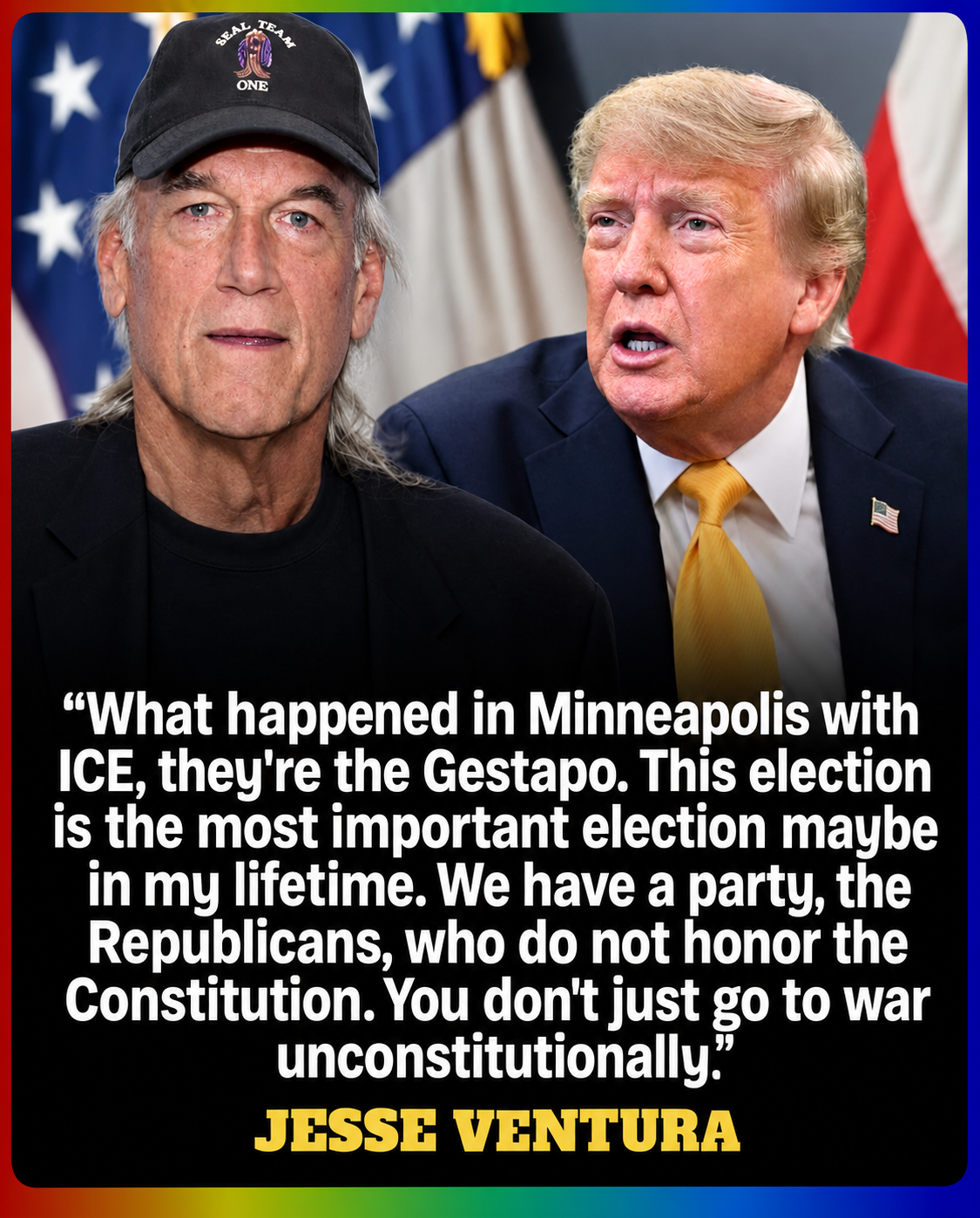
Former Minnesota governor Jesse Ventura has renewed his criticism of President Donald Trump’s immigration enforcement approach following a series of confrontations involving federal agents in Minneapolis.
Ventura’s comments drew attention because he framed the dispute not only as a question of immigration policy, but as a test of constitutional protections, the limits of federal power and the role of law enforcement in American cities.
In remarks to reporters outside Roosevelt High School in Minneapolis in January, Ventura praised students and staff who stood up during an encounter involving federal immigration officers. He argued that the presence of federal agents around schools and neighbourhoods had unsettled local communities.
Ventura, who served as Minnesota governor from 1999 to 2003, said the country must remain governed by law and the Constitution. He criticized the use of federal force in cities and warned against treating constitutional rights as optional during law-enforcement operations.
Why Minneapolis became the flashpoint
The dispute intensified after the fatal shooting of Renee Nicole Good by an ICE agent in Minneapolis on January 7, 2026. The incident prompted protests and renewed scrutiny of federal immigration enforcement in the city.
A day later, Ventura visited Roosevelt High School, his alma mater, following a separate confrontation involving federal officers near the school as students were leaving. Video of the incident circulated widely, while officials disputed some descriptions of the crowd-control measures used.
Ventura said he was there to show support for the school community. He praised people who challenged the federal presence and argued that law enforcement must respect constitutional protections, including rules governing searches and arrests.
The Department of Homeland Security disputed some accounts of the school incident, saying officers used targeted crowd-control measures rather than tear gas. The differing accounts illustrate why video, official statements and independently verified details matter when assessing fast-moving confrontations.

Ventura’s comparison to authoritarian policing
Ventura used stark language to describe ICE, comparing its tactics to those of the Gestapo, Nazi Germany’s secret police. He said his family history shaped his reaction: both of his parents served during World War II, and he argued that the lessons of that era should not be ignored.
The comparison is Ventura’s political judgment, not a formal legal finding. It reflects his view that aggressive federal operations, especially when they involve force around civilians, can threaten civil liberties and normalise authoritarian practices.
Ventura also criticized the Republican Party, saying he believed its response to the January 6, 2021, attack on the U.S. Capitol showed disregard for constitutional obligations. He argued that elected officials have a duty to defend the Constitution against threats, whether foreign or domestic.
His remarks have resonated with critics of the administration’s immigration crackdown, while supporters of the policy argue that federal agents are enforcing immigration law and that confrontations should be judged on the evidence in each case.
That disagreement is central to the political debate: one side emphasizes enforcement and public safety, while the other stresses civil liberties, accountability and the risks of deploying federal officers in ways that local communities view as intimidating.
The Constitution and federal enforcement
Ventura’s comments focus attention on the constitutional rules that govern federal law enforcement. The Fourth Amendment protects against unreasonable searches and seizures, while due-process requirements constrain how the government may deprive people of liberty.
Those protections do not automatically prohibit immigration enforcement or federal officers from operating in cities. Their application depends on the specific conduct, legal authority, warrants where required, and circumstances of each encounter.
Likewise, the Posse Comitatus Act generally limits use of the federal military to execute domestic law, subject to exceptions. Federal immigration agents are civilian law-enforcement officers, so their presence is not identical to deploying the armed forces. The legal questions depend on what authorities are used and what actions officers take.
Ventura has warned against using military forces for domestic policing and criticized threats to invoke the Insurrection Act. Whether a particular deployment would be lawful depends on statutory authority and the facts; political rhetoric alone does not settle that question.

Trump, politics and a possible return to office
Ventura’s appearance also revived speculation about his own political future. He told reporters that he was “owed” a second term as governor, a comment that hinted at interest without amounting to a formal campaign announcement.
He has long presented himself as an outsider to the two major parties. Ventura won Minnesota’s governorship as a Reform Party candidate in 1998 and served one term before choosing not to seek re-election in 2002.
His criticism of both Democrats and Republicans reflects a broader frustration with the two-party system. In Minneapolis, however, his remarks focused especially on the Republican administration’s federal enforcement strategy and what he sees as its implications for constitutional rights.
Ventura’s profile as a former professional wrestler, Navy veteran and independent politician gives his comments a distinctive public voice. But his claims, like those of other political figures, still need to be evaluated against independently established facts.
What is known, and what remains contested
Public reporting confirms that Ventura criticized ICE’s presence in Minneapolis after the January incidents, visited Roosevelt High School and made comparisons to authoritarian policing. His remarks were reported by local and national media.
The exact quotation in the graphic should be read with care. It appears to combine several related comments into one continuous block, and the line about the election being among the most important of his lifetime should not automatically be assumed to have been spoken in the same sentence as every other line shown.
Questions surrounding the shooting, the school confrontation and federal enforcement remain matters of public scrutiny. Claims about what occurred in individual incidents should be assessed through available video, official records, witness accounts and independent investigations rather than political characterisations alone.
The broader issue is unlikely to fade quickly. Immigration enforcement, federal-state tensions and the scope of executive power are likely to remain central themes in the national debate as communities weigh public safety against constitutional rights.
For now, the controversy shows how a local enforcement operation can become a national argument over identity, public safety and the boundaries of government authority. The most useful way to follow it is to separate direct quotations from edited graphics, and verified events from competing interpretations.
Comments (0)
Loading comments...
May You Like

EAST COAST CATASTROPHE — $20 BILLION AT STAKE, 5 MILLION AT RISK OF LOSING POWER, WATER AND HEAT!

WEYMOUTH HORROR — FIRE TRUCK BRAKES TO SAVE DOG, ONE FIREFIGHTER DEAD, TWO CRITICAL!

DAVENPORT AIRBNB HORROR — 40 OF 50 TEENS TEST POSITIVE FOR DRUGS SUPPLIED BY THE HOST'S MOM!









Popular Posts




