Jessica Tarlov Slams SAVE America Act as Democrats Warn of
WASHINGTON — Fox News contributor and Democratic commentator Jessica Tarlov is reigniting the debate over the Republican-backed SAVE America Act, arguing that the legislation should not be characterized simply as a voter ID law and warning that its proof-of-citizenship requirements could make it harder for some eligible Americans to register and vote.
The remarks, which have circulated widely online, come as President Donald Trump and Republican leaders continue pushing Congress to approve the legislation ahead of the 2026 midterm elections.
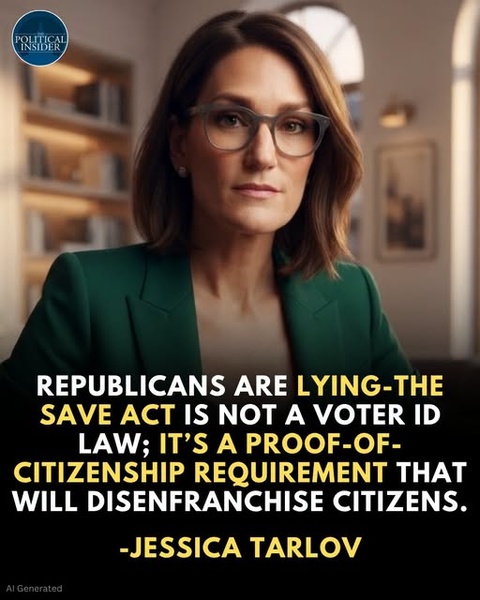
Tarlov has argued that the central issue is not whether voters should prove their identity at the polls, but whether Americans should be required to present specific documentary evidence of citizenship in order to register or update their voter registration. Her position is reflected in a recent post in which she described the measure as a proof-of-citizenship requirement rather than a conventional voter ID law.
The distinction has become one of the central arguments in the increasingly bitter fight over the bill.
What the SAVE America Act Actually Requires
The Safeguard American Voter Eligibility Act, commonly known as the SAVE America Act, would impose new federal requirements for elections.
The legislation would require people registering to vote in federal elections to provide documentary proof of U.S. citizenship. The 2026 version also includes photo-identification requirements for voting.
Republicans argue that the measure simply ensures that only eligible American citizens participate in federal elections.
Trump has repeatedly made the legislation a major political priority, calling for proof of citizenship and voter identification as part of his broader election agenda.
Democrats and voting-rights organizations, however, argue that the requirements could create substantial administrative barriers for citizens who are legally entitled to vote but do not have the required documents readily available.
Tarlov's Central Argument
Tarlov's criticism focuses on the difference between identifying a voter and proving citizenship.
A traditional voter ID requirement generally asks a person to demonstrate their identity when casting a ballot.
The SAVE America Act goes further by requiring documentary evidence of citizenship when registering or making certain changes to voter registration.
Under the legislation, documents such as a valid U.S. passport or qualifying birth and government records could be required.
That means a citizen could potentially be legally eligible to vote but still face difficulties registering if they cannot readily obtain the documentation required under the law.
The Bipartisan Policy Center has estimated that roughly 12% of registered voters lack the types of documentary evidence contemplated by the legislation, highlighting why the documentation requirement has become such a major point of contention.
Republicans Reject the Voter-Suppression Argument
Republicans strongly dispute the characterization that the bill is designed to disenfranchise Americans.
Their argument is that citizenship is already a legal requirement for voting in federal elections, and the legislation simply establishes a more rigorous mechanism for verifying eligibility.
Republican supporters also point out that the bill does not make citizenship a new qualification for voting.
Instead, it changes how voters demonstrate that they meet an existing qualification.
That distinction is at the heart of the Republican defense.
Trump and his allies argue that stronger verification is necessary to protect election integrity, while Democrats argue that the government should be responsible for verifying citizenship without imposing burdensome documentation requirements on individual voters.
Why Democrats Say the Requirements Could Exclude Eligible Voters
Opponents say the practical problem is that not every American has immediate access to a passport, birth certificate or other qualifying documentation.
The Bipartisan Policy Center says millions of eligible citizens could face difficulties under the new requirements and notes that Kansas provides a real-world example of how documentary proof requirements can affect voter registration. Its analysis says approximately 31,000 eligible citizens — about 12% of applicants — were prevented from registering after Kansas implemented such a requirement.
Voting-rights advocates have also highlighted potential problems involving people who have changed their names, older Americans, low-income voters, rural residents and people who have lost documents.
The League of Women Voters estimates that more than 21 million voting-age U.S. citizens do not have ready access to documents such as a passport or birth certificate.
Supporters of the SAVE Act dispute the implication that these people would necessarily be unable to vote. But the possibility of additional paperwork, delays or registration problems is a central reason Democrats oppose the legislation.
The Fight Is Moving Beyond the Bill Itself
The debate has intensified because the Trump administration is simultaneously pursuing broader efforts to verify citizenship through federal databases.
On Sept. 5, a federal appeals court upheld a ruling blocking the administration from using the Department of Homeland Security's SAVE database to verify citizenship information on voter rolls ahead of the Nov. 3 midterm elections.
The majority expressed concerns about the legality of the data-sharing effort, the possibility of inaccurate records and the risk that eligible voters could be wrongly removed or forced to prove their citizenship to remain registered.
That case is legally separate from the SAVE America Act.
But politically, the two issues have become closely connected.
Democrats argue that requiring documentary proof of citizenship while simultaneously expanding federal access to voter data could create a system in which eligible voters are increasingly exposed to government verification errors.
Republicans argue that those checks are precisely what is needed to ensure election rolls contain only eligible voters.
The SAVE Act Has Not Yet Become Law
Despite Trump's aggressive campaign for the legislation, the SAVE America Act has encountered significant resistance in the Senate.
Senators left Washington for the August recess without passing the bill, despite Trump's demand that Republicans remain in session until they completed the legislation. The Senate's failure to advance it represented a major setback for the administration's election agenda.
The House, meanwhile, has continued to advance SAVE America Act provisions through larger pieces of legislation.
In July, the House approved provisions incorporating the measure into the National Defense Authorization Act. That version would require documentary proof of citizenship for registration and photo identification for voting.
As of now, however, the federal SAVE America Act has not become law.
That means the requirements shown in the viral graphic are not currently a nationwide federal voting requirement.
The Timing Could Hardly Be More Important
The dispute is unfolding only weeks before the 2026 midterm elections.
That creates an additional concern for election administrators.
Counties would have to change registration systems, train election workers, educate voters and establish procedures for reviewing documentation if new federal requirements were enacted close to the election.
The National Association of Counties has warned that the legislation could impose major unfunded administrative burdens on local election officials and create risks for eligible voters through documentation problems and administrative delays.
The League of Women Voters similarly warns that implementing the legislation shortly before an election could create confusion for both voters and election officials.
A Political Battle Over What “Election Security” Means
The controversy ultimately reflects two fundamentally different views of election security.
Republicans say: citizenship must be verified, and Americans should have to provide documentation demonstrating that they are eligible to vote.
Democrats and voting-rights groups say: citizenship is already required, and forcing voters to obtain specific documents risks excluding legitimate voters while solving a problem they argue is already extremely rare.
Neither side disputes that noncitizens are prohibited from voting in federal elections.
The disagreement is over how aggressively the government should verify citizenship and who should bear the burden when documentation is missing or records are inaccurate.
Tarlov's Claim Needs Context
The viral quote attributed to Tarlov should therefore be understood as political commentary rather than a neutral description of the legislation.
It is accurate that the SAVE America Act contains a documentary proof-of-citizenship requirement and that this goes beyond simply requiring identification at the polling place.
But saying the law “will disenfranchise citizens” describes a predicted consequence, not an established outcome.
The bill's supporters argue that eligible citizens would remain entitled to vote and that the documentation requirement is intended to prevent ineligible voters from registering.
Its opponents argue that the practical effect could nevertheless be to prevent some eligible citizens from registering or casting ballots.
That distinction is critical as the debate becomes increasingly partisan.
The Bigger Election Fight
The SAVE America Act is now part of a much larger battle over American elections.
The Trump administration is simultaneously facing lawsuits over federal access to voter data, mail-ballot rules and other attempts to increase federal involvement in election administration. A federal appeals court's recent decision blocking the use of the DHS SAVE database has added another major legal obstacle to that agenda.
With the November midterms approaching, both parties have enormous political incentives to frame the issue in the strongest possible terms.
For Republicans, the SAVE America Act represents a test of whether the country can strengthen voter verification and election integrity.
For Democrats such as Tarlov, it represents a potentially dangerous expansion of requirements that could make voting more difficult for citizens who already have the legal right to participate.
The bill's fate remains unresolved.
But the fight over it is rapidly becoming something much larger than a dispute over voter ID.
It is becoming a battle over who should carry the burden of proving eligibility to vote — the government, or the voter — and how much administrative friction Americans should have to overcome to exercise one of their most fundamental democratic rights.
Comments (0)
Loading comments...
May You Like

South Korea–Ukraine Rift Deepens Over North Korean POW Transfer as PURL Draws New Scrutiny
TRUMP’S OHIO WARNING UNDER THE SPOTLIGHT
gfnhgmnghnmfgnbvvvvvvvvv