
Jimmy Kimmel Says the Trump Era Will Be Remembered as a Shameful Chapter
Jimmy Kimmel Says the Trump Era Will Be Remembered as a Shameful Chapter
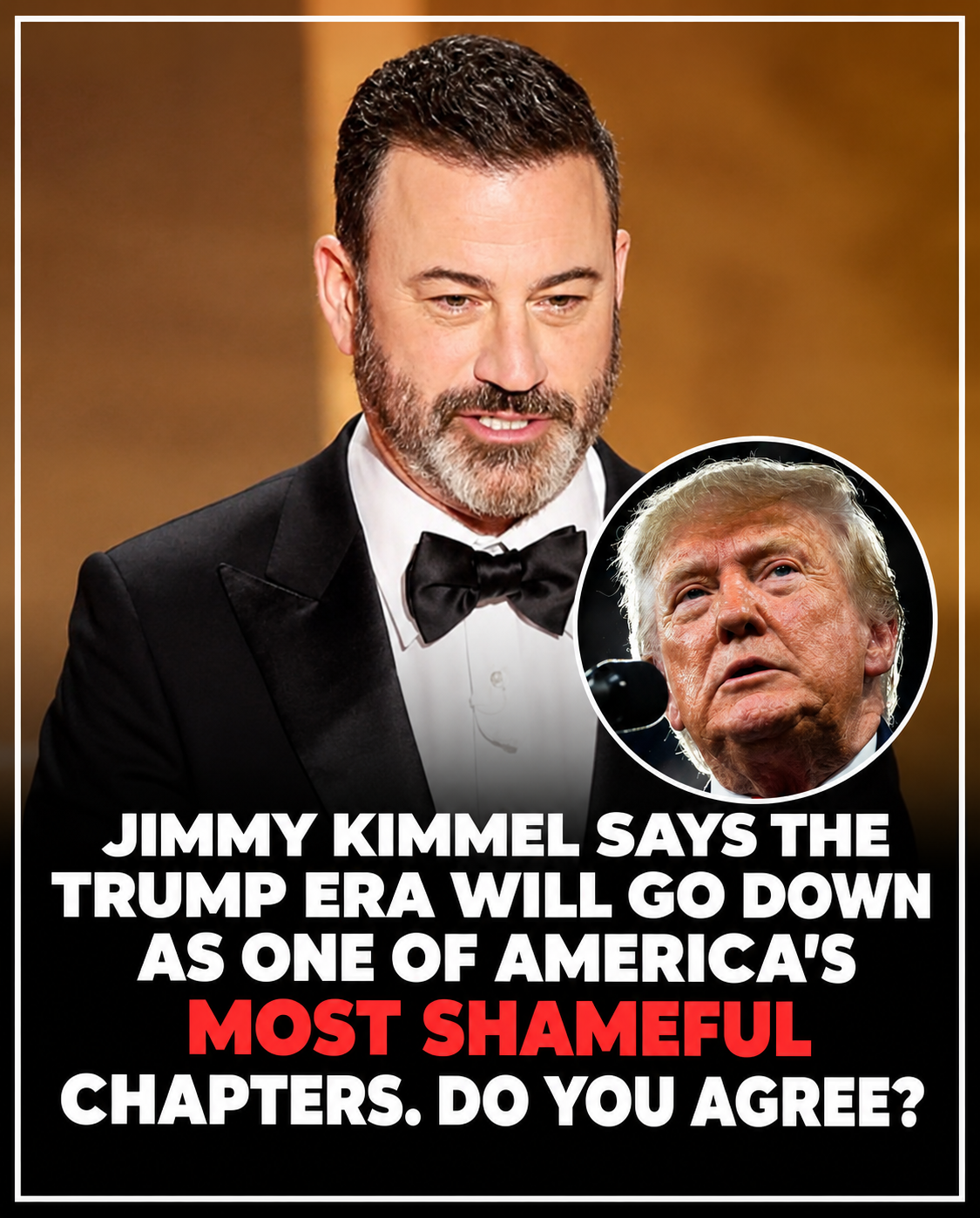
Jimmy Kimmel has become one of the most persistent late-night critics of President Donald Trump, using monologues to challenge the administration’s claims, mock its political theatrics and argue that its actions deserve sustained scrutiny. A viral graphic now frames that criticism as a historical judgment: that the Trump era will be remembered as one of America’s most shameful chapters.
The wording in the image should be treated as a summary of a political viewpoint, not necessarily a verbatim quotation. Kimmel has repeatedly delivered sharp criticism of Trump, but the exact sentence in the graphic needs to be distinguished from comments that can be traced to a specific broadcast or interview.
In recent weeks, Kimmel has focused on Trump’s rhetoric about elections, his attacks on political opponents and the administration’s handling of public controversies. His comedy often turns on the gap between a president’s public claims and the evidence or events that follow them.
One recent theme has been the approaching midterm elections. Kimmel criticized Trump’s comments about whether he would accept election results and mocked the suggestion that results are trustworthy only when Republicans win. The joke was aimed at what Kimmel portrayed as a conditional commitment to democratic norms.
Kimmel’s commentary also comes amid wider concerns about election administration and the role of federal agencies. Debates over who can observe vote counting, how election rules are enforced and whether political leaders accept defeat have become central questions in American public life.
These are not merely entertainment-industry disputes. The peaceful transfer of power, respect for election results and the independence of institutions are fundamental parts of a constitutional system. Satire can draw attention to those questions, although it does not replace reporting, official records or legal analysis.
Kimmel has also targeted Trump’s statements about international affairs and national security. In an October monologue, he mocked a presidential rally comment about Iran and the possibility of attacks affecting major American cities, calling the remark appalling and threatening, sarcastically, to report it to the Federal Communications Commission.
The host’s style relies on exaggeration, punch lines and deliberately blunt language. That is the nature of late-night satire, but it can make exact attribution important: a joke, an opinion and a documented factual allegation are different kinds of statements, even when they appear in the same monologue.
The larger argument behind Kimmel’s criticism is that a president’s conduct should be open to public examination. Supporters of the host see his jokes as a way to puncture official messaging and reach viewers who might not follow political news closely. They argue that comedy can make complex political controversies easier to notice and discuss.
Critics of Kimmel, including many Trump supporters, see his monologues as partisan and believe he gives too little weight to the president’s achievements or the concerns of voters who elected him. They argue that late-night hosts often reinforce the opinions of audiences who already agree with them rather than persuade people across political divides.

That disagreement is part of a wider argument about the role of entertainment media in a polarized society. A comedian does not have the same responsibilities as a straight-news reporter, but influential hosts can shape which issues their audiences see as important and which political figures become the targets of public ridicule.
The phrase “one of America’s most shameful chapters” is ultimately a judgment about history. Historians assessing a presidency generally consider a broad range of evidence: major policy decisions, treatment of constitutional limits, public integrity, domestic and foreign consequences, and the long-term effects on institutions and society.
Such assessments also change with time. Events that dominate daily headlines may look different after records are released, court cases conclude, administrations change and scholars gain perspective. A strong opinion about the present can be meaningful without being a settled historical consensus.
Kimmel’s critics and supporters will likely evaluate the Trump era through very different priorities. Some will emphasize immigration, economic policy, the courts and executive authority; others will focus on institutional norms, rhetoric, ethics, civil rights and the president’s relationship with democratic processes.
A careful assessment should therefore separate the questions that can be checked from the judgments that remain contested. What did the president say? What action did the administration take? What do official records show? Did a court rule on the issue? Which consequences can be measured, and which claims remain allegations or interpretations?

Public figures also have a role in responding to criticism. Trump has frequently attacked Kimmel and other late-night hosts, while Kimmel has answered with further jokes about the president’s reactions. Their exchanges have become a recurring part of the broader political-media spectacle, sometimes generating more attention than the underlying policy dispute.
The cycle can be entertaining, but it can also make political debate feel like a permanent contest of personalities. The substance matters more than the insult: viewers benefit most when satire directs attention toward decisions, evidence and consequences rather than becoming a substitute for understanding them.
Even so, comedy has long played a part in American political culture. From newspaper cartoons to radio satire and television monologues, humor has offered a way to challenge authority, expose contradictions and express dissent. Its influence depends partly on whether audiences use the joke as a starting point for further inquiry.
The viral image asks viewers whether they agree with its harsh assessment. That is a question of political judgment, not a fact that can be settled by the graphic itself. Kimmel has been an outspoken critic of Trump, and his commentary reflects a broader concern among some Americans about the president’s conduct and the direction of the country.
Whether the Trump era will ultimately be remembered as one of the nation’s most shameful chapters will be debated long after today’s headlines fade. The most durable evaluation will depend on the historical record: the decisions made, the institutions that held or failed to hold, the effects on people’s lives and how the country responds. Kimmel’s satire is one voice in that debate—not its final verdict.
Comments (0)
Loading comments...
May You Like

EAST COAST DISASTER—179 THOUSANDS OF HOMES AT RISK, CAUSING $50 BILLION IN DAMAGE!


MINNESOTA NIGHTMARE—UNDERGROUND GAS LEAK, HUNDREDS OF HOMES AT RISK, $300M DAMAGE!










Popular Posts



