
Joe Biden Defends His Economic Legacy, Declaring He Handed Trump “the Strongest Economy in the World”
February 27, 2026 | Columbia, South Carolina, United States | Politics & Economy
Biden Revives the Debate Over America’s Economic Record
Former President Joe Biden has forcefully defended his economic record, declaring that he left Donald Trump an exceptionally strong economy when he departed the White House in January 2025. The statement has reignited debate over which administration deserves credit for the country’s economic performance.
Biden made the remarks on February 27, 2026, during an appearance at an event hosted by the South Carolina Democratic Party in Columbia. The gathering commemorated the anniversary of his decisive victory in the state’s 2020 Democratic presidential primary, which helped propel his campaign toward the White House.
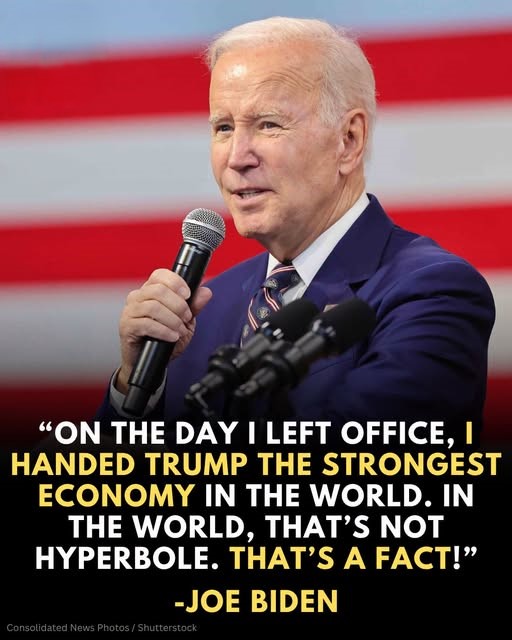
“On the day I left office, I handed Trump the strongest economy in the world,” Biden said, insisting that his assessment was a fact rather than political exaggeration. His comments were part of a broader defense of his presidency and a criticism of Trump’s handling of the country.
The statement quickly became a focal point in the continuing political argument over jobs, inflation, economic growth, and household affordability. While Biden emphasized employment gains and the recovery following the COVID-19 pandemic, critics have pointed to rising consumer prices during his administration.


Joe Biden speaks at a Democratic Party event in South Carolina, where he defended his administration’s economic record.
Jobs and Economic Growth Under Biden
Biden highlighted the number of jobs created during his presidency, arguing that the United States had recovered strongly from the economic disruption caused by the pandemic. He cited more than 16 million jobs created during his term and emphasized the historically low average unemployment rate recorded during those years.
Official economic statistics support the broader picture of a strong labor-market recovery, although the figures require context. Employment growth during Biden’s presidency included millions of jobs returning after pandemic-related losses, alongside additional gains as businesses expanded and workers reentered the labor market.
The economy also recorded real gross domestic product growth of 2.8% in 2024, according to the U.S. Bureau of Economic Analysis. That indicated continued economic expansion during Biden’s final full calendar year in office.
However, strong growth and employment figures do not tell the whole story. Consumer prices rose substantially during Biden’s presidency, putting pressure on household budgets. Inflation peaked at a much higher rate earlier in his term before slowing, but many families continued to feel the effects through elevated prices for groceries, housing, transportation, and other essentials.
The economic record therefore presents competing realities: strong job creation and growth on one hand, and a prolonged affordability challenge on the other.
Inflation Remains a Central Point of Contention
Inflation became one of the most politically damaging issues of Biden’s presidency. Although price increases slowed from their peak, prices generally did not return to their earlier levels. For many households, that meant everyday expenses remained significantly higher than before the pandemic.
The Consumer Price Index rose 3.0% over the 12 months ending January 2025, according to the U.S. Bureau of Labor Statistics. The monthly report also showed increases in food, shelter, and energy costs, illustrating why many Americans remained concerned about living expenses as Biden left office.
Biden’s defenders have argued that inflation resulted from a combination of pandemic-related supply disruptions, surging demand, global energy shocks, and domestic policy decisions. Critics have placed greater emphasis on federal spending and the administration’s economic choices.
Economists continue to debate the relative contributions of these factors. The distinction matters because inflation is influenced by multiple forces, and no single administration has complete control over global markets, supply chains, monetary policy, or consumer demand.


Rising household expenses and employment conditions remain central to public assessments of the American economy.
Trump’s Inherited Economy and His Own Record
Trump returned to the presidency on January 20, 2025, inheriting an economy characterized by continued growth, relatively low unemployment, and inflation that remained above the Federal Reserve’s long-term target.
His administration has offered a different assessment, arguing that Biden left behind serious problems involving prices, immigration, energy policy, and government spending. Trump has repeatedly presented his own policies as necessary to restore economic confidence and improve conditions for American households.
Assessing either president’s record requires examining multiple indicators rather than relying on a single headline. Gross domestic product growth, employment, wage increases, inflation, household purchasing power, and government debt can all provide different perspectives on economic performance.
It is also important to recognize that economic conditions do not change immediately when a new president takes office. Policies can take months or years to influence employment, investment, production, and consumer prices, while decisions made by previous administrations may continue to affect the economy.
A Political Dispute With Broader Implications
Biden’s remarks came as Democrats sought to challenge Trump’s account of the economy and prepare voters for upcoming congressional elections. By emphasizing employment growth and economic expansion, the former president attempted to counter criticism that his administration had left the country in poor financial condition.
The argument also reflects a wider problem in American politics: presidents often receive credit or blame for economic developments that began before they took office or were influenced by factors beyond their control.
For voters, however, the debate is often less about economic models than about daily experience. Whether wages cover rent, groceries, medical bills, and other expenses can matter more than national growth figures. That gap between macroeconomic performance and household perceptions has become a major challenge for both parties.
Ultimately, Biden’s declaration that he handed Trump the world’s strongest economy reflects his defense of an administration that oversaw substantial employment gains and continued economic growth, but also faced significant inflation and affordability concerns.
The statement remains a political judgment rather than an objective ranking that can be settled by one statistic. The strongest assessment of Biden’s legacy must account for both the economy’s resilience and the financial pressures experienced by many Americans.
The central question remains: did the economic progress recorded under Biden outweigh the costs households experienced, and how much responsibility should Trump accept for the conditions that followed? Those questions will continue to shape debate over the two presidents’ records and the direction of the American economy.
Comments (0)
Loading comments...
May You Like

1,000+ MILITARY FAMILY RECORDS BREACHED, 200+ MILITARY SITES AT RISK!

COASTAL DISASTER — 112 KM/H WINDS, SEAWATER FLOODING, 79,000 NEW JERSEY HOMES AT RISK!

WWE BRONSON REED DEAD AT 38, STIMULANTS DETECTED, $10M INSURANCE PAYOUT FROZEN!









Popular Posts




