John Fetterman Rejects “Socialism” at GOP Convention, Deepening Democratic Rift
DALLAS — Sen. John Fetterman, D-Pa., delivered an extraordinary message to Republicans this week, appearing by video at the party’s first-ever midterm convention and declaring that he will “always stand with America” while rejecting what he called “the extremes of socialism” and an “anti-American way of life.”
The appearance immediately fueled speculation about whether the Pennsylvania Democrat is moving closer to the Republican Party. But Fetterman has repeatedly insisted that he remains a Democrat and has no plans to switch parties.
His appearance nevertheless underscored just how far the senator has moved from the progressive wing of his party—and how aggressively Republicans are now using that break to reinforce their own campaign message ahead of the November midterms.
Fetterman Makes a Surprise Appearance at the Republican Convention
Fetterman appeared in a prerecorded video during the Republican midterm convention in Dallas on Sept. 9.
Standing in front of a U.S. Steel facility in Pennsylvania and wearing his familiar hoodie, Fetterman introduced Republican Sen. Dave McCormick, his Pennsylvania colleague and former Senate rival.
The appearance lasted only about a minute, but its political impact was much larger.
Fetterman described himself as a “common-sense Democrat” and emphasized his willingness to work with Republicans and President Donald Trump on issues important to Pennsylvania, particularly the steel industry.
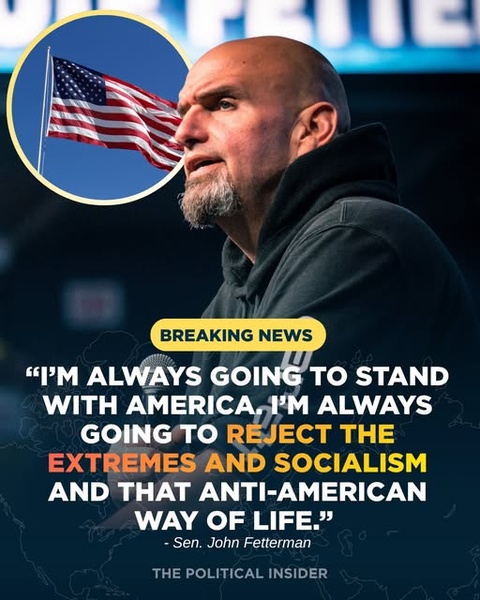
In remarks matching the viral graphic circulating online, Fetterman said he would stand with America and reject what he characterized as political extremes, including socialism.
The message was perfectly suited to the Republican convention's broader effort to portray Democrats as increasingly influenced by socialism and the political left.
“I’m Always Going to Stand With America”
The quote featured in the viral image is based on Fetterman's actual remarks rather than being an entirely fabricated statement.
During the video, Fetterman presented his political identity as one grounded in patriotism and opposition to ideological extremes.
He also praised McCormick as “a great American” before emphasizing the importance of bipartisan cooperation.
The appearance did not amount to an endorsement of the Republican Party as a whole. Fetterman did not announce that he was changing parties, nor did he formally abandon Democratic candidates or policies.
Instead, he used the Republican stage to promote a distinctly independent political identity.
That distinction is important because some online headlines have portrayed the episode as evidence that Fetterman is effectively becoming a Republican.
There is currently no confirmation that he is switching parties.
Fetterman Says He Is Still a Democrat
Despite his increasingly frequent clashes with Democrats, Fetterman has maintained that he remains a member of the Democratic Party.
After the convention appearance generated speculation about his political future, he reiterated that he would continue to support Democrats and said that if Democrats won a narrow Senate majority, he would be prepared to serve as an important vote for the party.
That position makes Fetterman's political identity unusual.
He has increasingly criticized progressive Democrats, while simultaneously maintaining positions associated with the Democratic Party on labor, LGBTQ rights and other domestic issues.
His political message is therefore less a straightforward conversion to conservatism than an increasingly pronounced rejection of the progressive wing of the Democratic coalition.
A Long-Running Break With the Democratic Left
Fetterman's relationship with his party has been deteriorating for years.
He has repeatedly rejected the label of “progressive,” despite having once been identified with the Democratic Party's left flank.
His disagreements with Democrats have become particularly visible over Israel, immigration, crime, border security and the war in Iran.
He has also taken positions that have put him at odds with Democratic activists and progressive organizations.
In July, for example, Fetterman strongly defended the Senate filibuster even as Trump urged Republicans to eliminate it. Fetterman argued that the filibuster could serve as an important protection against one-party government.
That position illustrates the unusual political space Fetterman now occupies: he can oppose Republicans on major issues while simultaneously agreeing with them on selected policies and criticizing the Democratic Party's left flank.
Republicans Are Eager to Highlight the Divide
Republicans quickly seized on Fetterman's appearance.
For a party attempting to persuade voters that Democrats have moved too far left, having a Democratic senator appear at the Republican convention and denounce socialism was politically valuable.
Republicans have increasingly made attacks on socialism and “extremism” central to their 2026 campaign messaging.
The Dallas convention repeatedly portrayed Democratic candidates as radicals, socialists or extremists, with Trump and other Republican speakers attempting to make ideological differences a central issue in the midterm elections.
Fetterman's presence gave that argument an unusual Democratic voice.
It allowed Republicans to point to a sitting Democratic senator as evidence that dissatisfaction with the party's progressive direction exists even within Democratic ranks.
Fetterman Also Wants to Work With Trump
Another striking part of Fetterman's appearance was his willingness to cooperate with Trump.
Fetterman said he was prepared to work with the president on strengthening Pennsylvania's steel industry, an issue of particular importance in his home state.
That is consistent with Fetterman's broader emphasis on economic nationalism and protecting American manufacturing.
The senator has also been willing to break with Democrats on Trump's policies when he believes they conflict with his own political principles.
His approach has increasingly been described as pragmatic rather than conventionally ideological.
Reuters reported that Fetterman's willingness to work with Trump, along with his disagreements with Democrats over issues such as Israel, Iran and immigration, has made him increasingly isolated from parts of his own party.
The Appearance Comes as Fetterman Faces Pressure at Home
The timing is particularly significant because Fetterman has already faced growing criticism from Pennsylvania Democrats.
His independent political style has frustrated some Democrats who believe he is undermining the party's efforts to present a unified message.
At the same time, Republicans have increasingly treated him as a potential ally—or at least as a useful example of Democratic dissatisfaction.
That does not necessarily mean Fetterman is preparing to become a Republican.
Instead, it reflects a broader transformation in his political identity.
He appears increasingly comfortable being a Democrat who openly rejects major parts of the progressive movement.
A Potential Problem for Democrats in 2026
The controversy surrounding Fetterman matters beyond one senator.
Democrats are attempting to regain control of Congress in the November elections, while Republicans are trying to defend their majorities.
In a closely divided Senate, even one Democratic senator who frequently breaks with party leadership can become politically significant.
Fetterman has already demonstrated that he is willing to vote independently when he believes his principles require it.
That makes him both an asset and a headache for Democratic leaders.
His supporters argue that he represents a working-class, pragmatic form of Democratic politics that can appeal to voters who do not identify with either party's ideological extremes.
His critics argue that his increasingly close alignment with Republican rhetoric risks helping the GOP while weakening Democratic unity.
The Viral Graphic Gets the Bigger Story Right—but Can Be Misleading
The image circulating online presents Fetterman's statement as a dramatic declaration against socialism and an “anti-American way of life.”
The underlying quote is real, but the broader context is important.
Fetterman did not announce that he was leaving the Democratic Party, nor did he endorse the Republican Party's entire platform.
Instead, he appeared at a Republican event to introduce a Republican senator, emphasized bipartisan cooperation and rejected what he considers the extremes of both political parties.
That is a significant political development—but it is different from a party switch.
Fetterman’s Future Remains a Question Mark
For now, Fetterman appears determined to maintain his position as an independent-minded Democrat.
His appearance at the Republican convention has nevertheless raised a larger question about where his political career is heading.
If he continues distancing himself from progressive Democrats while cooperating with Republicans, he could become an increasingly unusual figure in the Senate: a Democrat who regularly provides Republicans with political ammunition against his own party.
For Republicans, that is an opportunity.
For Democratic leaders, it is a warning.
And for Fetterman himself, it may be an attempt to carve out a political identity that is neither traditionally progressive nor Republican—but explicitly centered on what he describes as “common sense,” patriotism and bipartisan cooperation.
The immediate question is not whether Fetterman has become a Republican. He has not.
The more consequential question is whether his version of Democratic politics can survive as the two parties become increasingly polarized—and whether voters in Pennsylvania will reward him for standing apart from his own party.
Comments (0)
Loading comments...
May You Like
South Korea–Ukraine Rift Deepens Over North Korean POW Transfer as PURL Draws New Scrutiny
gfnhgmnghnmfgnbvvvvvvvvv
Jack Smith Defends His Integrity as Trump Investigations Face Renewed Political Firestorm