John Pavlovitz Says Trump Will ‘Go to His Grave’ Knowing He Could Never Be Barack Obama
A provocative comment attributed to writer and former pastor John Pavlovitz is drawing attention online as the long-running political rivalry between Donald Trump and Barack Obama continues to shape U.S. political discourse.
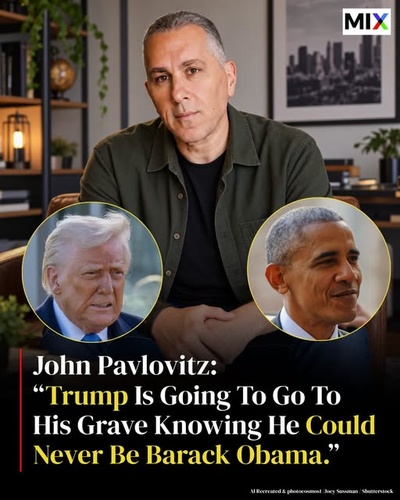
The viral graphic features Pavlovitz alongside photographs of Trump and Obama and quotes him as saying: “Trump is going to go to his grave knowing he could never be Barack Obama.”
However, the quotation should be treated as commentary attributed to Pavlovitz, not as an independently verified news statement. A search of Pavlovitz’s website and recent writings confirms that he has repeatedly criticized Trump and praised Obama, but did not locate a primary-source publication containing this exact sentence. Recent social-media posts have circulated the quote without establishing when or where Pavlovitz said it.
Pavlovitz Has Been a Consistent Trump Critic
Pavlovitz, a former pastor and author, has been an outspoken critic of Trump for years. His recent writing continues that pattern.
In a September 3, 2026 essay, Pavlovitz directly addressed Trump voters, arguing that voting for a candidate represents an endorsement of that candidate's conduct and policies. He criticized the Trump administration over economic conditions, foreign policy and the direction of the country.
In June, Pavlovitz also published a lengthy message addressed to Barack and Michelle Obama, praising what he described as their character, resilience and public service. He argued that the Obamas had maintained their dignity despite years of political attacks.
That background makes the viral quote consistent with Pavlovitz's broader political commentary, even though the exact wording could not be independently confirmed.
Trump and Obama Remain Linked by a Decade-Long Political Rivalry
The relationship between Trump and Obama has been unusually personal and politically consequential.
Trump spent years promoting the false claim that Obama was not born in the United States, a conspiracy that helped elevate Trump as a political figure before his 2016 presidential campaign.
More than a decade later, Trump continues to refer to Obama publicly.
An NPR analysis in June noted that Trump had repeatedly brought up Obama even when discussing unrelated subjects. During a G7 press conference that month, Trump reportedly mentioned Obama eight times.
Obama, meanwhile, has recently acknowledged Trump's continuing attention toward him. In a June interview, the former president described Trump's fixation as unusual and said he noticed a difference between Trump's behavior toward him privately and his public attacks.
The rivalry has also moved into the realm of social media. Trump has posted manipulated or AI-generated material targeting Obama, including a doctored image involving Obama and Michelle Obama that was reported by The Washington Post in July.
Obama Currently Has a Significant Public-Opinion Advantage
The viral claim about Obama's stature also comes at a time when polling shows the former president remains considerably more popular with the American public than Trump.
A CNN/SSRS poll released in June surveyed 2,480 U.S. adults and found that 57% viewed Obama favorably, compared with 34% for Trump and 30% for former President Joe Biden.
The same survey asked Americans an open-ended question about which president in U.S. history they admired most.
Obama received 30%, followed by Trump at 19%. Abraham Lincoln and Ronald Reagan each received 9%, while John F. Kennedy received 6% and George Washington 5%.
The partisan divide was substantial. Among Democrats, 64% named Obama as the president they admired most. Among Republicans, Trump led with 53%, followed by Reagan at 18% and Lincoln at 8%.
That distinction is important: the poll does not establish that Obama is objectively the greatest or most respected president in American history. It measures whom respondents voluntarily named when asked whom they admire most.
What the Viral Graphic Gets Right — and What It Leaves Out
The graphic captures a genuine feature of American politics: Trump and Obama remain deeply intertwined in the country's political conversation, even years after Obama's presidency ended.
It is also accurate that Pavlovitz is an outspoken Trump critic and has recently written very favorably about Obama. His June essay praised the former president and first lady for what he considers their dignity and character under political pressure.
But the strongest part of the graphic — the claim that Trump will literally go to his grave knowing he could never be Obama — is an opinion, not a verifiable prediction or established fact.
More importantly, the exact quotation could not be located in Pavlovitz's publicly indexed writings during this review. It is therefore safer to describe it as a viral quote attributed to Pavlovitz rather than present it as a confirmed recent statement.
A Debate About Legacy, Not Just Popularity
The contrast between Trump and Obama increasingly extends beyond their policies to questions of presidential legacy.
Obama left office in 2017 but continues to have a significant cultural and political presence. The June 2026 CNN/SSRS polling was released as the Obama Presidential Center opened in Chicago, providing another opportunity for discussion of his presidency and historical legacy.
Trump, meanwhile, is attempting to define his own legacy during his second presidency while remaining intensely focused on political opponents, including Obama.
Whether history ultimately judges one president more favorably than the other will depend on events far beyond today's polling or social-media battles.
For now, however, the data show a complicated picture: Trump remains overwhelmingly dominant among Republican respondents in the question of presidential admiration, while Obama has a considerably stronger position among the broader American public.
That reality helps explain why a provocative comparison between the two men continues to attract attention online.
Comments (0)
Loading comments...
May You Like

Russian Drone Strikes Kyiv Bridge as German Chancellor Arrives in Ukraine

OBAMA STUNS ON INSTAGRAM: MESSAGE MARKING 34-YEAR MILESTONE SPARKS A BUZZ