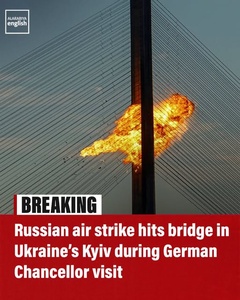
Jordanian Figures Demand Withdrawal of U.S. Forces and Cancellation of Military Agreement
More than 130 Jordanian political, academic, cultural, tribal, and retired military figures have signed an open letter calling for the withdrawal of all foreign forces from Jordanian territory and the cancellation or review of the kingdom's military agreement with the United States. The unprecedented public challenge comes as Iranian missile and drone attacks on U.S. facilities in Jordan have intensified, pulling the country into a regional war it says it wants no part of.
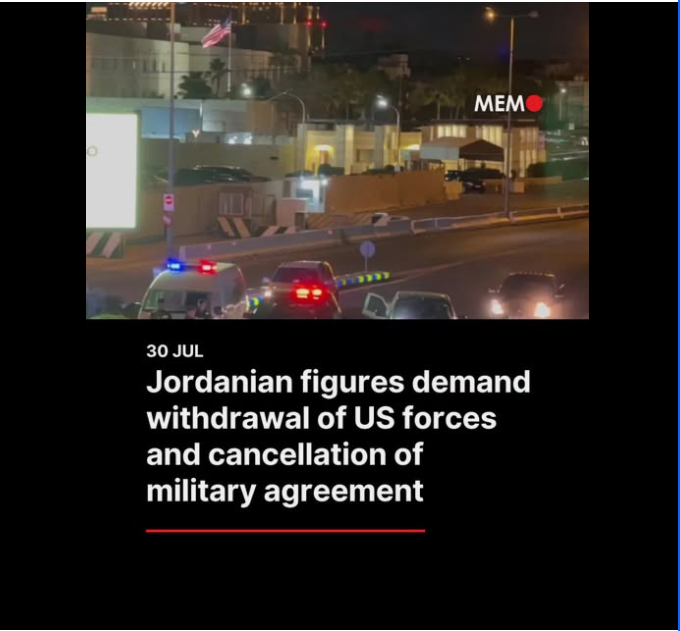
AMMAN – The viral image is stark: "Jordanian figures demand withdrawal of U.S. forces and cancellation of military agreement." It captures a moment of extraordinary political defiance in a kingdom where free speech and dissent have long been tightly controlled.
The letter, published in late July 2026, is a direct challenge to the Jordanian government's close military alliance with Washington—an alliance that has become increasingly costly as the U.S.-Iran war escalates across the region .
The Letter: A Rare Public Challenge
The open letter was signed by a diverse coalition of more than 130 Jordanian figures, including former ministers, academics, lawyers, tribal leaders, retired military officers, and political activists . The signatories span the political spectrum—leftists, Pan-Arabists, Islamists, and establishment insiders all stand together in a rare display of unity .
The letter's demands are unambiguous:
"We demand the withdrawal of all foreign forces from Jordanian territory" .
The signatories argue that the presence of foreign troops exposes Jordan to "security, political and economic risks that serve no national interest" and "increases the likelihood of our country being dragged into a regional conflict to which it is not a party" .
They also called for the Jordanian government to withdraw the 2021 defense agreement with the United States and submit it to parliament for proper scrutiny—a step the government bypassed when it approved the pact by royal decree .
The Military Agreement Under Fire
Jordan's defense cooperation agreement with the United States was signed in 2021. It grants U.S. troops, aircraft, and vehicles broad freedom of entry and movement in Jordan and permits American forces to carry weapons and transport and store military equipment. Critics objected at the time that the government had approved the agreement without submitting it to parliament .
Critics have long argued that this agreement effectively outsources Jordan's strategic independence . As one analysis put it: "A state that allows a foreign power to stock, stage, and launch military operations from its territory has outsourced its strategic independence. It is an occupation hidden behind legal semantics" .
The Trigger: Iran's Retaliatory Strikes
The letter did not emerge in a vacuum. It came amid a dramatic escalation of the U.S.-Iran war that has increasingly drawn Jordan into the crossfire .
In late February 2026, the United States and Israel launched a joint military offensive against Iran. Iran responded with waves of missile and drone attacks on U.S. and Israeli bases across the region—including in Jordan .
Jordan hosts approximately 4,000 U.S. troops and serves as a critical hub for U.S. military operations in the Middle East . But that presence has turned Jordan into a target. Iranian ballistic missiles and drones have repeatedly struck U.S. facilities in Jordan, including the Muwaffaq Salti Air Base in Azraq .
The attacks have caused American casualties and significant damage to military assets. Satellite imagery and ground assessments confirmed devastating damage at the Azraq base, with hangars obliterated and aircraft destroyed . Multiple American soldiers have died, and dozens more were evacuated to military hospitals in Germany .
For Jordanians, the impact has been immediate and terrifying. Air raid sirens have sounded repeatedly across the kingdom. Debris from intercepted projectiles has rained down on residential zones . The war has also devastated Jordan's tourism industry, which accounts for up to 18% of the country's revenue—a critical blow to an economy already struggling with high unemployment and scarce natural resources .
"We as Jordanian people do not accept the politics of the government and its exploitation of Jordan and its capabilities in one way or another to defend Israel," said 90-year-old political activist Sufyan al-Tell, who signed the letter .
A Nation Divided: The Government's Response
The Jordanian government has responded by stressing that Jordan is not a party to the war and that the U.S. personnel in Jordan are there as part of long-standing defense cooperation . Officials have emphasized that military cooperation with Washington does not mean Jordan has entered the war—rather, the U.S. presence is part of the country's broader security and defense arrangements .
But this explanation has not convinced everyone. Inside Jordan's parliament, emotions are running high. When one lawmaker suggested offering condolences to the United States for the deaths of American soldiers on Jordanian soil, he was met with shouts from other members—including one who accused the U.S. military of killing children, women, and the elderly .
Jordanian authorities have also imposed a media blackout on the letter. No Jordanian media outlet has published it, reflecting government directives not to disseminate it as well as self-censorship. Activists face prison under draconian cybercrime laws .
The Economic Stakes
The government's unwavering commitment to the U.S. alliance is driven in large part by economic necessity. Jordan relies heavily on American foreign aid. Last year, the United States gave Jordan $1.65 billion in economic and military assistance .
But critics argue that this aid comes at a steep price. Participating in a regional war has shattered the domestic economy. Tourism has plummeted. Unemployment is soaring. Working-class Jordanians are paying the financial price for the monarchy's foreign policy alignment .
The Bottom Line
| What the graphic says | What actually happened |
|---|---|
| Jordanian figures demand withdrawal of U.S. forces | More than 130 public figures signed an open letter to that effect |
| They demand cancellation of the military agreement | The letter calls for withdrawing the 2021 defense pact and submitting it to parliament |
| The demands are recent | The letter was published in late July 2026 |
| The government has not responded officially | Officials have reiterated that U.S. troops are part of long-standing defense cooperation |
The viral image accurately captures the demands of Jordanian public figures who are breaking a long-standing taboo by publicly challenging the kingdom's military alliance with the United States. The full story reveals a country caught in the crossfire of a regional war it never wanted, a monarchy dependent on American aid, and a public increasingly willing to voice its opposition despite the risks.
Whether this unprecedented letter will force a change in Jordan's policy remains to be seen. But one thing is clear: the cost of hosting U.S. forces has become impossible to ignore.
Comments (0)
Loading comments...
May You Like
OBAMA STUNS ON INSTAGRAM: MESSAGE MARKING 34-YEAR MILESTONE SPARKS A BUZZ
Russian Drone Strikes Kyiv Bridge as German Chancellor Arrives in Ukraine
Shocking news from Ohio: an unexpected development ahead of Trump's rally