Judge Blocks Trump's Order to Cut NPR and PBS Funding — Ruling It Unconstitutional
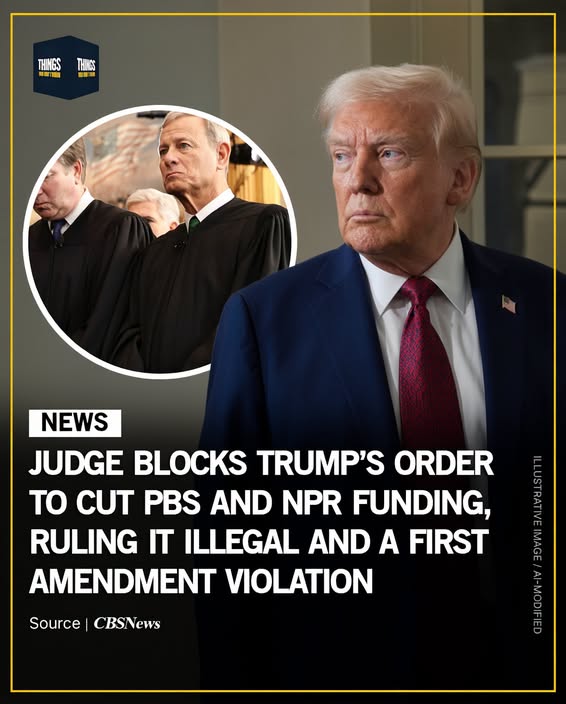
A federal judge has issued a permanent block on President Donald Trump's executive order that sought to terminate federal funding for National Public Radio (NPR) and the Public Broadcasting Service (PBS). The ruling found that the administration's attempt to cut off public media subsidies violated the First Amendment by penalizing broadcasters for their editorial content.
WASHINGTON — U.S. District Judge Randolph D. Moss ruled on March 31, 2026, that President Trump cannot unilaterally defund public media through executive action, declaring that the administration had crossed a "constitutional line" by using financial power to "punish or suppress disfavored speech" .
The ruling permanently blocks the executive order Trump signed on May 1, 2025, which directed the Corporation for Public Broadcasting (CPB) and all federal agencies to cease funding for NPR and PBS . The president had accused the public broadcasters of failing to present "a fair, accurate, or unbiased portrayal of current events" and labeled their coverage as "left-wing propaganda" .
A 'Viewpoint Discrimination' Violation
Judge Moss's ruling was unequivocal: the Constitution's First Amendment draws "an insurmountable line" when it comes to government using its spending power to retaliate against speech it dislikes .
"Government action was directed at viewpoints the president does not like, and it sought to suppress those views," Moss wrote in his decision . While the president has every right to criticize media organizations, Moss found that the executive order "demonstrably aimed to suppress" views he opposed — and the administration could not use executive authority to punish media outlets for expressing content it disapproved of .
The judge noted that the First Amendment does not tolerate "viewpoint discrimination" and that the administration's actions constituted unlawful retaliation against protected speech .
The Administration's Defense and Legal Battle
The White House responded swiftly. Press Secretary Abigail Jackson called the ruling "absurd" and accused Moss of attempting to "undermine the rule of law," signaling that the administration may appeal the decision .
The fight over public media funding began in May 2025 when Trump signed the executive order, prompting immediate backlash. PBS President Paula Kerger called the order "blatantly unlawful" at the time, while NPR CEO Katherine Maher stated that the order represented "retaliatory, viewpoint-based discrimination" .
NPR and three Colorado public radio stations filed suit against the administration in May 2025, naming Trump, White House budget director Russell Vought, Treasury Secretary Scott Bessent, and other federal officials as defendants . The lawsuit argued that the president had usurped Congress's constitutional authority over spending and violated the separation of powers . PBS later joined the legal fight as well .
The administration defended its position by arguing that the government has the right to determine which speech to fund and that withholding subsidies from media organizations does not violate First Amendment rights . Judge Moss firmly rejected that argument.
A Complicated Victory
While the ruling is a significant legal victory for press freedom advocates, its practical impact is complicated .
In July 2025 — after Trump issued the executive order — Congress voted to rescind $1.1 billion in CPB funding that had been allocated for two fiscal years . Additionally, the Corporation for Public Broadcasting itself voted to dissolve in January 2026 . Judge Moss acknowledged that since CPB no longer exists, the parts of the lawsuit involving the corporation are now moot .
Nevertheless, the ruling clears an important legal obstacle that could pave the way for Congress to restore public media funding in the future . "This decision could have implications for any future funding decisions Congress might make," legal observers noted . The ruling also reinforces the principle that "government power cannot be used to penalize speech, even when that speech is critical" .
The Bigger Picture: Press Freedom Under Fire
The case has become a flashpoint in the broader debate over press freedom, government accountability, and the role of public media in American democracy. Public broadcasting, which has been funded through CPB for decades, was designed with structural protections to insulate it from political pressure — Congress appropriates funding two years in advance precisely to shield content from political interference .
Critics of the administration argued that defunding NPR and PBS was not about fiscal responsibility but about silencing voices the president viewed as hostile . The judge's ruling appears to validate those concerns.
The Bottom Line
| What the Graphic Says | The Reality |
|---|---|
| Judge blocked Trump's order to cut NPR/PBS funding | Yes — permanently enjoined by federal court |
| Ruled it illegal and a First Amendment violation | Yes — found unconstitutional viewpoint discrimination |
| The fight is over | The administration may appeal; Congress has already cut funding |
The ruling stands as a powerful affirmation of the First Amendment: even when the government holds the purse strings, it cannot use financial leverage to punish media organizations for the content of their speech. It is a reminder that "an informed, independent judiciary presumes an informed, independent press" .
Comments (0)
Loading comments...
May You Like

TRUMP’S OHIO WARNING UNDER THE SPOTLIGHT

South Korea–Ukraine Rift Deepens Over North Korean POW Transfer as PURL Draws New Scrutiny