Judge Clears Way for Trump to End TPS for Nearly 1,100 Somalis, Opening Door to Deportation
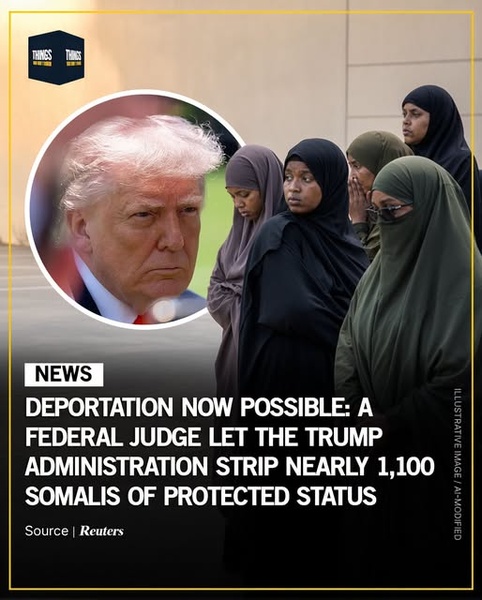
A federal judge in Boston has ruled that the Trump administration may terminate Temporary Protected Status (TPS) for nearly 1,100 Somalis, potentially exposing them to deportation. The decision follows a Supreme Court ruling that sharply curtailed judicial oversight of the administration's efforts to end the humanitarian program for multiple countries.
BOSTON – The image circulating online is accurate: a federal judge has allowed the Trump administration to strip nearly 1,100 Somalis of legal protections against deportation that have allowed them to live and work in the United States.
U.S. District Judge Allison Burroughs, an appointee of President Barack Obama, lifted a stay that had blocked the Department of Homeland Security from terminating Somalia's TPS designation. The judge stated that she was bound by the Supreme Court's June ruling in Mullin v. Doe, which limited the ability of lower courts to review DHS decisions to end TPS for designated countries.
Supreme Court Ruling Clears the Path
The Supreme Court's 6-3 decision, powered by its conservative majority, curtailed the power of judges to review the administration's efforts to end TPS designations for 13 countries that provided humanitarian immigration protection to eligible migrants.
The high court ruling specifically addressed the termination of TPS for Haiti and Syria, concluding that the TPS law generally prevents courts from reviewing DHS decisions to terminate the status, except on constitutional matters.
Judge Burroughs acknowledged the strength of the plaintiffs' arguments, writing that they had made "a convincing showing that they will suffer irreparable harm if the injunction is withheld" and that the balance of hardships favored them. However, she concluded that the Supreme Court's decision bound her to view the case "through the Mullin prism".
Why the Administration Sought to End TPS
Former Homeland Security Secretary Kristi Noem announced plans in January 2026 to terminate TPS for Somalia, arguing that conditions inside the country had improved sufficiently to justify ending the humanitarian protections.
This justification came despite ongoing fighting between Somali government forces and al-Shabaab militants. The conflict in Somalia has persisted for decades, with the country first designated for TPS in 1991.
The Plaintiffs' Case: Allegations of Bias
The lawsuit was brought by four Somali nationals and two advocacy groups, including African Communities Together. The plaintiffs argued that the administration's decision was driven by racial and national-origin bias against non-white immigrants, pointing to past comments from President Trump describing Somalis as "garbage" and "low IQ people".
Judge Burroughs reviewed the arguments and found that while the plaintiffs had "laid out a strong case for why the at-issue statements were racist," the Supreme Court ruling limited the extent to which such disparaging remarks could be considered. She concluded that she could "not discern a path to concluding that Plaintiffs will succeed on the merits of this claim".
Broader Pattern of TPS Terminations
Somalia is not the only country affected by this shift.
| Country | Status |
|---|---|
| Somalia | TPS termination allowed by judge |
| South Sudan | TPS termination allowed by judge |
| Myanmar | TPS termination allowed by judge |
| Ethiopia | TPS termination remains blocked by judge |
Two other judges last week allowed the administration to similarly end TPS for South Sudan and Myanmar. At this point, Ethiopia remains the only country where a judge has managed to keep the protections blocked.
What Happens Next
Following the ruling, DHS may move forward with terminating the protections for Somali nationals. According to U.S. Citizenship and Immigration Services, approximately 2,471 Somali nationals currently hold TPS, with a further 1,383 applications pending. Those without another lawful basis to remain in the United States now face potential deportation.
The case is seen as a crucial test of the scope of the Mullin v. Doe ruling, in the context of the Trump administration's push to shrink the TPS program and strengthen immigration enforcement.
What the Viral Graphic Gets Right
| What the Image Suggests | What Actually Happened |
|---|---|
| Deportation is now possible for Somalis | Yes — the ruling allows DHS to terminate protections |
| A federal judge allowed the administration to strip TPS | Yes — Judge Burroughs lifted the stay |
| Nearly 1,100 Somalis are affected | Yes — the ruling applies to approximately 1,100 TPS holders |
| The decision follows a broader pattern | Yes — similar rulings affected South Sudan and Myanmar |
The Bottom Line
A federal judge's ruling on August 14, 2026, cleared the way for the Trump administration to end Temporary Protected Status for nearly 1,100 Somalis living in the United States. The decision, based on a June Supreme Court ruling that limited judicial review of TPS terminations, represents a significant legal victory for the administration's immigration enforcement agenda.
Judge Burroughs acknowledged the plaintiffs' strong showing of potential harm but concluded that the Supreme Court's decision left her no choice but to lift the stay.
For Somali TPS holders, the ruling could mean the loss of legal protections and the threat of deportation — unless they have another legal basis to remain in the United States.
Comments (0)
Loading comments...
May You Like

South Korea–Ukraine Rift Deepens Over North Korean POW Transfer as PURL Draws New Scrutiny

Shocking news from Ohio: an unexpected development ahead of Trump's rally