
Judge Extends Block on Postal Service's New Trump-Backed Mail-in Ballot Requirements
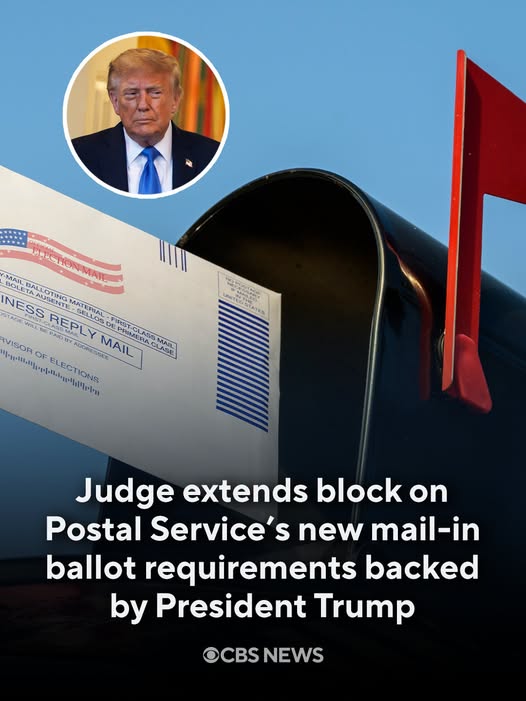
A federal judge in Massachusetts on Friday extended her block on new U.S. Postal Service rules governing mail-in ballots, dealing a significant blow to President Donald Trump's efforts to tighten election procedures just two months before the November midterm elections. The judge ruled the requirements are likely unconstitutional and would cause "inevitable" disenfranchisement of millions of voters.
WASHINGTON – The image circulating online is accurate: U.S. District Judge Indira Talwani has issued a preliminary injunction barring the Postal Service from enforcing new mail-in ballot requirements backed by President Donald Trump . The ruling converts a 14-day temporary block she issued last week into a longer-term freeze while the legal challenge proceeds .
But the story behind the headline is far more complex than a simple win for one side. It is the latest chapter in a fast-moving legal battle that has already reached the Supreme Court once — and is likely to return there again before Election Day .
What the New Postal Service Rules Would Have Required
The Postal Service finalized the rules in August 2026, implementing President Trump's March 2026 executive order titled "Ensuring Citizenship Verification and Integrity in Federal Elections" . The requirements included:
| Provision | Details |
|---|---|
| Ballot design standards | Envelopes must carry individualized barcodes and other information for automated tracking |
| Online voter portal | States must submit names and addresses of intended mail-ballot recipients to a USPS portal |
| Verification requirement | Postal workers would only deliver ballots to voters appearing on state-provided lists |
| Non-compliance penalty | Ballots that didn't meet the new standards would be returned to election offices and not delivered |
The administration argued that the measures were "modest" and designed to "protect election integrity" and prevent voter fraud . Postal workers would simply verify that ballot mail matched state-provided lists of eligible voters .
The Judge's Ruling: Unconstitutional and Unworkable
Judge Talwani, an Obama appointee, issued a 49-page ruling that rejected the administration's arguments on multiple grounds .
Constitutional Violation
The judge found that the Postal Service overstepped its legal authority. Under the Elections Clause of the U.S. Constitution, the power to regulate the "time, place, and manner" of elections is reserved for states and Congress — not the executive branch .
"Throughout its body of election legislation, Congress has never delegated its Elections Clause power to the USPS," Talwani wrote. "Unauthorized by the Elections Clause, the Final Rule clashes with Congress's statutory scheme, and is unconstitutional where it intrudes not only on Congress's Elections Clause powers but also that power left to the States" .
Practical Impossibility
The judge also found that requiring states to implement the new rules with less than 70 days before the election would be practically impossible .
"Imposing these mandates on election officials at present poses greater difficulties than otherwise because election officials are actively administering elections," she wrote .
Key practical concerns included:
-
Unclear readiness: Government lawyers could not confirm to the judge that the Postal Service's new online portal was fully operational . "I don't even have a declaration from the Postal Service saying this is how we're going to work. I have nothing," Talwani said during Thursday's hearing .
Cost and time constraints: Most states have already ordered their mail ballots and are required by state law to begin sending them out as early as September . Redesigning envelopes, updating election management systems, and training staff would require "an overwhelming expenditure" of time and money .
Technology gaps: Many small rural jurisdictions lack the technology to print the required specialized barcodes . The judge noted that complying with the portal requirements could violate state laws protecting confidential voter information .
Whistleblower warning: An anonymous federal whistleblower has warned of "potentially catastrophic problems" with the Postal Service's untested and "rushed" ballot portal system .
No Evidence of Fraud
Talwani emphasized that the administration had not presented "any evidence regarding fraudulent absentee or mail-in voting" to justify the rushed implementation .
"The record includes no evidence relating to fraudulent mail voting to support the rushed implementation of the Final Rule," the judge wrote .
The Trump Administration's Response: Urgent Appeal to Supreme Court
The Justice Department has already filed an urgent appeal to the Supreme Court, seeking permission to implement the rules immediately . The administration had filed the appeal before Talwani issued her Friday ruling, anticipating she would extend the block .
Solicitor General John Sauer argued in the application that the judge's order "risks sowing confusion and chaos because it makes those preparatory steps voluntary, rather than mandatory" . He warned that states may not have taken necessary steps to comply "due to the false sense of latitude created by the court's improper order, potentially depriving those States' citizens of the ability to vote by mail" .
The administration has also argued that the Supreme Court should intervene because the Postal Service's rules are "ultimately a regulation of the U.S. mail — not federal elections — [and] is plainly constitutional" .
The Larger Political Battle
The legal dispute is part of a broader conflict over election integrity and mail voting that has defined American politics for years .
Trump's Position
President Trump has repeatedly argued that tighter controls on mail voting are necessary to protect elections from fraud . His March executive order directed:
-
The Department of Homeland Security to compile state-specific lists of adult U.S. citizens
The Justice Department to prioritize investigations into alleged violations of federal election law
The Postal Service to establish new standards for mail-in and absentee ballots
Trump has dismissed concerns about the timing, arguing that the measures are essential to ensure that "federal ballots are provided only to eligible voters" .
Democratic and State Opposition
Democratic-led states and voting rights groups argue that the administration is improperly asserting federal control over election procedures that are traditionally and constitutionally managed by states .
Massachusetts Attorney General Andrea Joy Campbell, one of the Democratic attorneys general who sued to block the rule, welcomed Talwani's ruling: "This order protects our ability to effectively deliver mail ballots to all residents relying on them to make their voices heard in the November election" .
David Becker, a former Justice Department lawyer now leading the Center for Election Innovation & Research, told CNN that implementing Trump's executive order would be "a sweeping seizure of election power from the states under any circumstances" and "impossible to do that with about 70 days" .
What Happens Next?
Talwani's preliminary injunction keeps the new Postal Service rules blocked while the legal challenge proceeds . But the dispute is far from over:
-
Supreme Court appeal: The Justice Department has already asked the Supreme Court to intervene . The court could rule quickly, given the approaching election.
Ongoing litigation: Even if the Supreme Court rules, the underlying legality of Trump's executive order may continue to be litigated .
Election preparation: States are already preparing to send mail ballots. North Carolina began mailing ballots to military and overseas voters on Friday, September 4 .
What the Viral Graphic Gets Right
| What the Image Suggests | What's Actually Happening |
|---|---|
| Judge extended block on Postal Service's new mail-in ballot requirements | Yes — Judge Talwani issued a preliminary injunction on Friday, September 4 |
| The rules were backed by President Trump | Yes — the rules stem from Trump's March 2026 executive order |
| The block is permanent | No — it's a preliminary injunction while the legal challenge proceeds |
| The legal fight is over | No — the administration has appealed to the Supreme Court |
The Bottom Line
The image captures a real and significant moment in the ongoing battle over election integrity and mail voting: a federal judge's ruling that blocks President Trump's efforts to impose new restrictions on mail ballots just two months before the midterms.
But the story is far from over. With the administration's urgent appeal already before the Supreme Court and the November election approaching, the final chapter of this legal battle has yet to be written .
For election officials across the country, the uncertainty is paralyzing. As Judge Talwani herself said during Thursday's hearing: "We're not playing an intellectual puzzle game. We're talking about people's right to vote" .
Comments (0)
Loading comments...
May You Like

Shocking news from Ohio: an unexpected development ahead of Trump's rally

OBAMA STUNS ON INSTAGRAM: MESSAGE MARKING 34-YEAR MILESTONE SPARKS A BUZZ
TRUMP HIT WITH 26 ARTICLES OF IMPEACHMENT













