Judge Orders DOJ to Name Architects of Trump's $1.8 Billion 'Anti-Weaponization' Fund
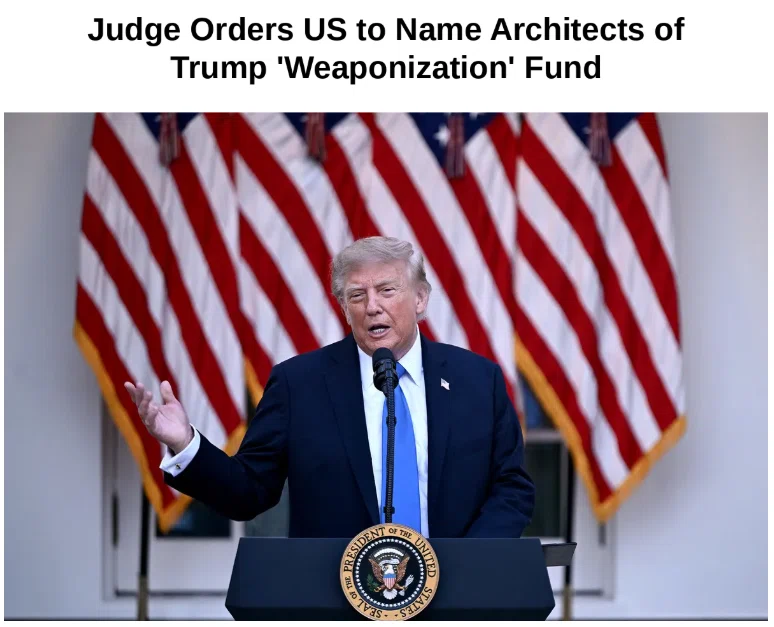
U.S. Magistrate Judge Ivan D. Davis has ordered the Trump administration to identify the individuals who designed the controversial $1.8 billion "anti-weaponization fund" — a proposed taxpayer-funded compensation scheme that critics have branded a "slush fund" for political allies of the president.
ALEXANDRIA, Va. – A federal judge has directed the Justice Department to disclose the architects behind a defunct $1.8 billion fund that would have compensated individuals who claimed they "suffered weaponization and lawfare" from the federal government.
The ruling comes despite Attorney General Todd Blanche's insistence that the fund is now "dead" and was formally rescinded in August.
U.S. Magistrate Judge Ivan D. Davis of the Eastern District of Virginia partially granted a motion from plaintiffs seeking to compel discovery from the federal government, according to a person present in the courtroom when the order was issued.
"Today's order granting discovery is a significant step in getting to the bottom of the slush fund," said Aman George, senior counsel at Democracy Forward, the nonprofit representing the plaintiffs challenging the proposal. "We will continue to meet the government in court until our investigation is complete and the slush fund is permanently halted."
The Justice Department did not immediately respond to requests for comment.
What Was the 'Anti-Weaponization' Fund?
The fund emerged from a settlement agreement involving President Donald Trump, two of his sons, the Trump Organization, and the Internal Revenue Service, resolving Trump's $10 billion lawsuit against the IRS over the disclosure of his tax returns.
Under the proposed arrangement:
-
$1.8 billion in taxpayer funds would have been set aside for payments to individuals who claimed they were victims of government "weaponization" and "lawfare"
The agreement would have shielded Trump and several family members from future IRS audits — a provision that remains a central point of contention
Critics argued that payments could have potentially gone to participants in the January 6, 2021, Capitol riot who were later pardoned by Trump
The Justice Department defended the fund when it was announced in May, describing it as a lawful process for people who believed they were victims of government "weaponization" to seek redress, and pointing to previous federal settlements like Keepseagle as precedent.
Why Was the Fund Blocked?
The proposal faced immediate and intense backlash from both Republicans and Democrats. Two Republican senators — John Cornyn of Texas and Thom Tillis of North Carolina — made ending the fund a condition of their support for Blanche's confirmation as attorney general.
A federal judge temporarily halted the arrangement in May after a lawsuit was filed by Andrew Floyd, a former federal prosecutor fired from the Justice Department after working on January 6-related cases, and a law professor who had been sued by the Trump administration. Career IRS employees later joined the legal challenge.
Blanche issued a written declaration in August stating that the fund "is rescinded" and "there is no fund".
The Legal Loophole
However, the document signed by Blanche did not include the signatures of the other parties to the original settlement — a legal loophole that critics argue leaves open the possibility that the compensation mechanism and the accompanying IRS audit protections could be revived at a later date.
Trump has done little to dispel those concerns. During a Cabinet meeting this summer, the president said the fund "is dead, but you know, I wish it weren't," and reiterated that he believed "people were horribly treated".
The controversy resurfaced this week when Treniss Evans III, a January 6 defendant seeking $1 million from the federal government, posted a photograph of himself inside Blanche's office — though a person familiar with the matter said Evans did not meet the attorney general.
What the Judge's Order Requires
Judge Davis's ruling requires the administration to:
-
Disclose the names of individuals who conceived and developed the fund's structure
Provide information concerning people and documents relevant to claims that are not limited to the administrative record
"Who came up with it? That's what conception means," Davis said during the hearing, according to the Washington Post.
The judge narrowed the scope of discovery, noting that a broader request from plaintiffs risked becoming a "fishing expedition," but determined that the identities of those who designed the fund were relevant to the case.
The information will not necessarily be made public, as Davis directed the parties to treat discovery materials as protected from public disclosure while litigation continues.
| What the Judge Ordered | Why It Matters |
|---|---|
| Disclose architects of the $1.8B fund | Plaintiffs can investigate how the proposal was developed |
| Compel discovery from the federal government | Reveals whether the fund has been truly abandoned |
| Identifies individuals involved in the fund's structure | Could expose internal administration deliberations |
Broader Legal Challenges
The Virginia case is not the only legal battle surrounding the fund. A separate federal judge in Florida is considering an extraordinary request from more than 30 retired federal judges to investigate whether Trump's original $10 billion lawsuit against the IRS amounted to a "fraud on the court".
The former judges, appointed by both Democrat and Republican presidents, argued that the lawsuit was used as a justification for the "looting" of American taxpayers, describing the case as a type of "collusion" between the president's lawyers and the federal government.
The Bottom Line
Despite Blanche's written declaration that the fund is rescinded, the absence of signatures from other parties to the original settlement means the fund could potentially be revived. Meanwhile, the court's discovery order will force the administration to reveal who designed the controversial proposal — potentially exposing the internal deliberations behind one of the most contentious legal battles of Trump's second term.
Comments (0)
Loading comments...
May You Like

Shocking news from Ohio: an unexpected development ahead of Trump's rally

Russian Drone Strikes Kyiv Bridge as German Chancellor Arrives in Ukraine