
Judge Orders Trump Administration to Reveal Architects Behind $1.8 Billion 'Anti-Weaponization' Fund
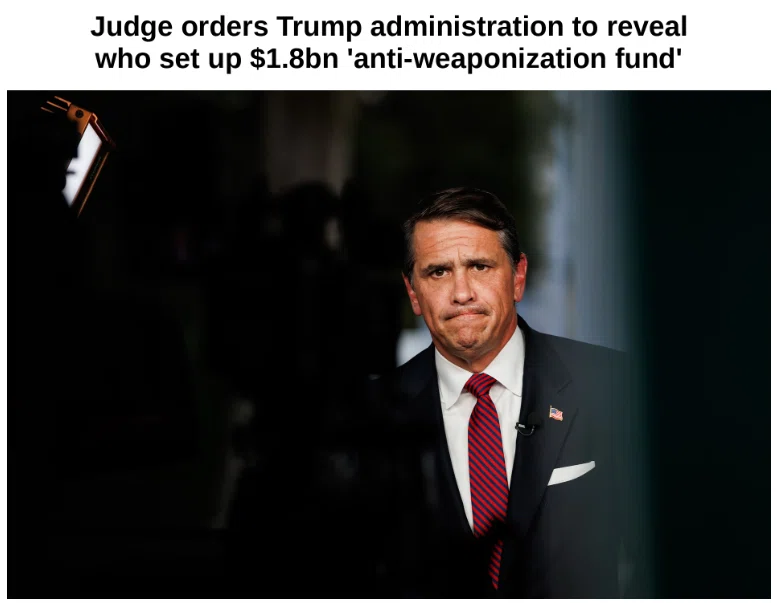
A federal judge has ordered the Trump administration to disclose who designed the controversial $1.8 billion "anti-weaponization fund" — a proposed taxpayer-funded compensation scheme that critics labeled a "slush fund" for pardoned January 6 rioters. The order comes despite Attorney General Todd Blanche's insistence that the fund is "dead" .
ALEXANDRIA, Va. – U.S. Magistrate Judge Ivan D. Davis of the Eastern District of Virginia on Friday partially granted a motion from plaintiffs seeking discovery from the federal government, compelling the administration to identify the individuals involved in developing the fund's structure .
The ruling allows plaintiffs in a lawsuit filed by the non-profit Democracy Forward to investigate how the nearly $1.8 billion fund — which was part of a settlement agreement between President Donald Trump, his sons, his company, and the Internal Revenue Service — came into existence .
"Today's order granting discovery is a significant step in getting to the bottom of the slush fund," said Aman George, senior counsel at Democracy Forward, which is representing the plaintiffs. "We will continue to meet the government in court until our investigation is complete and the slush fund is permanently halted" .
What Was the 'Anti-Weaponization Fund'?
The fund emerged from a settlement agreement involving Trump, two of his sons, the Trump Organization, and the IRS . Under the proposed arrangement:
-
$1.8 billion in taxpayer funds would have been set aside for payments to individuals who claimed they "suffered weaponization and lawfare" from the government
The agreement also would have shielded Trump and his family from future IRS audits — a provision that remains a central point of contention
Payments could have potentially gone to participants in the January 6, 2021, Capitol riot who were later pardoned by Trump
The Justice Department defended the fund when it was announced in May, describing it as a lawful process for people who believed they were victims of government "weaponization" to seek redress .
Why the Fund Was Blocked
The proposal faced immediate and intense backlash from both Republicans and Democrats . Two Republican senators — John Cornyn of Texas and Thom Tillis of North Carolina — made ending the fund a condition of their support for Blanche's confirmation as attorney general .
A federal judge temporarily halted the arrangement in May after a lawsuit was filed by Andrew Floyd, a former federal prosecutor who was fired from the Justice Department after working on January 6-related cases, and a law professor who had been sued by the Trump administration . Career IRS employees later joined the legal challenge .
The bipartisan criticism threatened to complicate Blanche's nomination, leading him to issue a written declaration in August stating that the fund "is rescinded" and that "there is no fund" .
However, the document signed by Blanche did not include the signatures of the other parties to the original settlement — a legal loophole that critics argue leaves open the possibility that the fund and the accompanying IRS audit protections could be revived at a later date .
What the Judge's Order Requires
Judge Davis's ruling specifically requires the administration to:
-
Disclose the names of individuals who conceived and developed the fund's structure
Provide information concerning people and documents relevant to claims that are not limited to the administrative record
The order could shed significant light on how the fund was developed and who participated in the negotiations that produced it .
The Legal Loophole
Critics have pointed to a major loophole in Blanche's written declaration . Because the document was signed only by Blanche — and not by Trump, his lawyers, or the IRS — the fund and its accompanying IRS immunity provisions could potentially be revived at any time .
Trump has done little to dispel those concerns. At a Cabinet meeting this summer, he said the fund "is dead, but you know, I wish it weren't" and reiterated that he believed "people were horribly treated" .
The controversy resurfaced this week when Treniss Evans III, a January 6 defendant seeking a $1 million payout from the government, posted a photograph of himself inside Blanche's office — though a person familiar with the matter said Evans did not meet with the attorney general .
What Comes Next
The court's discovery order gives plaintiffs an opportunity to examine who created the plan and whether it has been conclusively abandoned . Democracy Forward has vowed to "continue to meet the government in court until our investigation is complete and the slush fund is permanently halted" .
Meanwhile, a separate federal judge in Florida is considering an extraordinary request from more than 30 retired federal judges to investigate whether Trump's original $10 billion lawsuit against the IRS — which led to the settlement — amounted to a "fraud on the court" .
The Bottom Line
| What the Judge Ordered | Why It Matters |
|---|---|
| Disclose architects of the $1.8B fund | Plaintiffs can investigate how the proposal was developed |
| Compel discovery from the federal government | Reveals whether the fund has been truly abandoned |
| Identifies individuals involved in the fund's structure | Could expose internal administration deliberations |
The Justice Department has not yet commented on Friday's ruling. But the fight over the $1.8 billion fund — and the questions surrounding its origins — is far from over.
Comments (0)
Loading comments...
May You Like

Russian Drone Strikes Kyiv Bridge as German Chancellor Arrives in Ukraine

Shocking news from Ohio: an unexpected development ahead of Trump's rally
Jack Smith Defends His Integrity as Trump Investigations Face Renewed Political Firestorm













