
Kyle Kulinski Revives the “National Divorce” Debate With a Bold Red-State
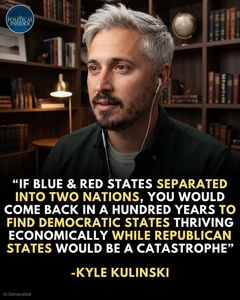
WASHINGTON — Political commentator Kyle Kulinski has reignited debate over the idea of dividing the United States into separate red and blue nations, arguing that the two systems could produce dramatically different results over time.
Kulinski’s “National Divorce” Argument
The claim circulating online presents a hypothetical future in which Democratic-leaning and Republican-leaning states become separate countries, allowing each political coalition to pursue its preferred governing model.
A video from Kulinski’s Secular Talk program in April 2026 shows him discussing what he calls a possible “national divorce,” involving separate “Red States of America” and “Blue States of America.”
Kulinski has previously discussed political polarization and secession. In 2021, his show covered polling showing substantial numbers of both Trump and Biden voters expressing openness to red or blue states separating.
His latest comments have drawn renewed attention because they frame the hypothetical split as a long-term economic comparison, rather than simply a response to political disagreements between Americans.
The graphic circulating online attributes a longer statement to Kulinski, predicting that Democratic-leaning states would prosper while Republican-leaning states would experience severe economic difficulties.
However, the precise wording displayed in the graphic could not be independently verified through reliable reporting. The underlying discussion about separating red and blue states is documented, but viral graphics can alter or paraphrase original remarks.
The Economic Argument
The broader argument rests partly on differences between states in taxation, public spending, labor markets, education, healthcare and economic development, all areas where Democratic and Republican governments frequently pursue different approaches.
Yet the American economy does not divide neatly into two political categories. Democratic-leaning states contain major technology, finance and entertainment industries, while Republican-leaning states include significant energy, manufacturing, agriculture and aerospace sectors.
Federal economic data illustrate that state performance varies considerably regardless of political alignment. The Bureau of Economic Analysis reported real GDP growth in 46 states and Washington, D.C., during the first quarter of 2026.
The latest BEA data also show that economic growth depends heavily on individual industries, meaning political labels alone cannot explain differences in state-level economic performance.
Population trends provide another dimension to the debate. Census estimates show Texas recorded the largest numerical population increase between July 2024 and July 2025, adding more than 390,000 residents.
Florida, North Carolina, Georgia and South Carolina also ranked among the states with the largest population increases during that period, while California was among five states experiencing population declines.
Those migration figures are sometimes incorporated into political arguments about which policies attract residents, but population changes have multiple causes, including housing costs, employment, retirement, family decisions and demographics.
What Would Separation Actually Mean?
A genuine separation would create questions extending far beyond partisan policy. Federal debt, military assets, currency, trade agreements, infrastructure and Social Security would all require new arrangements between the successor governments.
The American economy is also deeply integrated across state borders. Energy produced in one region can supply another, while companies operate factories, offices, suppliers and customer networks across multiple states.
Labor mobility would create another major challenge. Millions of Americans live and work outside their birth states, while metropolitan economies frequently cross political boundaries that do not correspond with partisan identities.
A division could therefore produce complicated questions about citizenship, taxation, property ownership, federal benefits and the status of Americans living in states politically different from their own.
A Longstanding Political Debate
The idea of a “national divorce” is not new. In 2021, polling discussed by Kulinski showed significant shares of both major-party voter groups expressing some support for separating red and blue states.
The concept has also appeared in mainstream political debates. Former Rep. Marjorie Taylor Greene publicly promoted a “national divorce” proposal in 2023, demonstrating that the idea has crossed ideological boundaries.
Legally, however, leaving the United States is fundamentally different from changing state policies. In Texas v. White in 1869, the Supreme Court described the Union as perpetual and rejected unilateral secession.
For now, Kulinski’s comments remain a hypothetical political argument rather than a proposal backed by an established constitutional or governmental process.
The renewed discussion ultimately highlights two competing realities: Americans remain deeply divided over political priorities, while their states remain economically, legally and socially interconnected.
Sources
Reporting and background checked against Secular Talk/Kyle Kulinski, U.S. Census Bureau, U.S. Bureau of Economic Analysis, and the Library of Congress/U.S. Supreme Court historical record.
Comments (0)
Loading comments...
May You Like

TRUMP’S OHIO WARNING UNDER THE SPOTLIGHT

Russian Drone Strikes Kyiv Bridge as German Chancellor Arrives in Ukraine

Jack Smith Defends His Integrity as Trump Investigations Face Renewed Political Firestorm













