Lindsay Clancy Jurors Signal Dramatic Standoff as One Holdout Threatens to Block Verdict
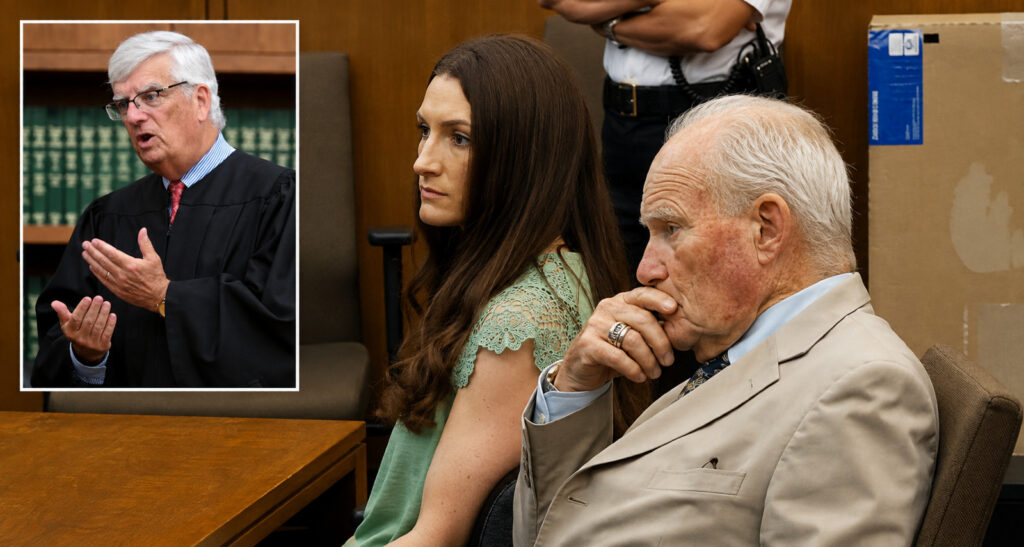
A dramatic development has emerged in the Lindsay Clancy murder trial in Massachusetts: after more than 35 hours of deliberations, the jury remains deadlocked, and Clancy’s defense attorney says one juror may be refusing to follow the judge’s instructions on reasonable doubt.
That development is the apparent “bombshell announcement” referenced in the viral graphic. The jury has now been sent home without a verdict and is scheduled to return Friday for a seventh day of deliberations.
The case concerns the January 2023 deaths of Clancy’s three children. Clancy does not dispute that she killed them. The central question for jurors is whether she was criminally responsible at the time because of her mental state.
What happened inside the courtroom
The extraordinary development came Thursday after the jury delivered a note to Judge William Sullivan.
According to reporting from The Associated Press and Reuters, the foreperson indicated that one juror would not follow the court's instructions concerning reasonable doubt. The contents of the original note were not publicly released, but Clancy's attorney, Kevin Reddington, subsequently asked the judge to remove the juror.
Reddington argued that the juror was holding up the verdict and was refusing to apply the legal standard given by the judge.
The judge declined to remove the juror.
Instead, Sullivan questioned the jurors individually and then brought them together and reiterated the legal definition of reasonable doubt before sending them back to deliberate.
That distinction is important: the court has not determined that the juror actually violated the law. That allegation comes from the defense.
Is the jury really split 11-1?
There appears to be an 11-1 split, according to reporting based on what happened in court and Reddington's statements.
But there is an important caveat: the direction of that split has not been publicly established.
In other words, available reporting indicates that 11 jurors may agree while one disagrees, but it is not officially known whether the 11 favor conviction, acquittal, or another outcome. The New York Times reported that an 11-1 split appeared to exist, while other coverage similarly described a single holdout.
That makes the viral graphic's implication of a decisive breakthrough somewhat premature.
There is no verdict yet.
Why the reasonable-doubt dispute matters
In a criminal case, the prosecution carries the burden of proving guilt beyond a reasonable doubt.
Judge Sullivan reminded the jurors that they must follow the legal instructions provided by the court. He described the standard as requiring an “abiding conviction to a moral certainty” after considering the evidence.
Reddington argued that merely rereading the instruction would not solve the problem if one juror was refusing to apply it.
The prosecution disagreed with removing the juror and supported the judge's handling of the situation. Sullivan emphasized that interfering with deliberations is a sensitive matter and that he could not simply side with one juror against the other 11.
That leaves the jury intact for now.
The central question is not whether Clancy killed her children
One of the most unusual aspects of the case is that the defense does not dispute that Clancy caused the deaths.
Clancy has pleaded not guilty by reason of lack of criminal responsibility. Her lawyers argue that she was suffering from severe postpartum psychosis, along with other mental-health problems, when she strangled her three children in the basement of the family's Duxbury home on Jan. 24, 2023.
The prosecution's position is fundamentally different: prosecutors argue that Clancy was mentally ill but nevertheless understood what she was doing and was legally responsible for her actions.
Thus, the jury's task is largely about criminal responsibility and mental state, rather than establishing who caused the deaths.
The defense presented extensive evidence of mental illness
Clancy's defense spent days presenting evidence about her deteriorating mental health before the killings.
According to trial coverage, she experienced severe anxiety, insomnia, depression and other symptoms following the birth of her third child. Her defense argued that she developed postpartum psychosis and that treatment involving multiple psychiatric medications contributed to her deterioration.
A defense expert testified that Clancy did not appreciate the wrongfulness of killing her children because of her mental illness. Another expert supported the defense's argument that she was experiencing postpartum psychosis at the time.
The defense has portrayed the tragedy as the culmination of a psychiatric crisis in which Clancy repeatedly sought help but did not receive adequate treatment.
Prosecutors acknowledge mental illness — but dispute psychosis
The prosecution has not simply argued that Clancy was perfectly healthy.
Instead, its experts have acknowledged significant mental-health problems while disputing that she was psychotic when the killings occurred.
Prosecution experts testified that Clancy suffered from conditions including depression and bipolar disorder but argued that she understood the nature and wrongfulness of her actions. One forensic psychiatrist also questioned her account of hearing a voice commanding her to kill the children.
That distinction is at the heart of the case.
The defense says psychosis destroyed her criminal responsibility.
The prosecution says mental illness does not necessarily eliminate criminal responsibility, and that Clancy retained awareness of what she was doing.
The jury has already twice said it cannot agree
The current impasse did not come out of nowhere.
The jury first indicated it was deadlocked after four days of deliberation. Judge Sullivan instructed the jurors to continue working.
After another period of deliberation, the jury again reported that it could not reach a unanimous decision. The judge issued a so-called Tuey-Rodriguez or “dynamite” instruction, urging jurors to reconsider their positions and attempt to reach an agreement.
Then came Thursday's revelation about the alleged holdout.
By the end of the sixth day, there was still no verdict.
A mistrial is now a real possibility
If the jury cannot reach unanimity, Judge Sullivan could eventually declare a mistrial because of a hung jury.
That would not mean Clancy had been acquitted.
Instead, the existing trial would end without a verdict, leaving prosecutors to decide whether to bring the case before another jury.
Legal experts cited by news organizations have said a retrial would be possible, and potentially likely given the seriousness of the charges. A mistrial could also open the door to negotiations between prosecutors and the defense.
For now, however, the judge is giving the existing jury another opportunity.
The trial has been unusually long and emotionally charged
The jury has heard weeks of testimony involving Clancy's family, medical providers and psychiatric experts.
WBUR reported that the defense called 10 witnesses concerning Clancy's mental state, while later coverage said the overall trial involved more than 70 witnesses. Reuters subsequently reported that the case included more than 80 witnesses and 300 exhibits.
Clancy's former husband, Patrick Clancy, also testified. He has publicly said that he forgives her and believes mental illness played a role in what happened, adding another deeply emotional dimension to the proceedings.
The case has consequently become about more than one criminal prosecution. It has generated a broader national conversation about postpartum mental illness, access to psychiatric care and how the criminal justice system should treat defendants who commit devastating acts during severe psychiatric episodes.
The viral graphic gets one major thing right
The graphic's wording — “JURORS WALK INTO COURTROOM — is clearly designed to suggest that something extraordinary happened.
In that respect, there really was a dramatic development.
The jury revealed a previously unknown source of its impasse, and Clancy's attorney publicly accused one juror of refusing to follow the judge's instructions. The judge then questioned the jurors and rejected the defense request to remove the alleged holdout.
But the graphic leaves out a crucial fact:
The announcement was not a verdict.
The jury remains deadlocked.
What the viral graphic gets right — and what it leaves out
| Claim/implication | Verdict | What the evidence shows |
|---|---|---|
| The Lindsay Clancy jury made a dramatic announcement | True | The foreperson's note disclosed an apparent dispute involving one juror and reasonable doubt. |
| One juror may be preventing a verdict | Substantially true, but attributed | Clancy's defense attorney says one juror is refusing to follow the court's instructions. That allegation has not been independently established as misconduct. |
| The jury is apparently 11-1 | Reported, but unofficial | Multiple reports describe an apparent 11-1 split, but the direction of the split has not been disclosed. |
| A verdict has been reached | False | There is still no verdict. The jury returns Friday for a seventh day of deliberations. |
| The case could end in a mistrial | True | Continued deadlock could force Judge Sullivan to declare a mistrial. |
| Clancy's guilt is the only issue | Misleading | The defense acknowledges the killings; the central dispute is whether she was criminally responsible because of her mental state. |
What happens next?
The jury is expected back in court Friday for its seventh day of deliberations.
The immediate question is whether the 12 jurors can resolve their disagreement without another intervention from Judge Sullivan.
If they do, the case could finally produce a verdict.
If they do not, the trial could enter one of its most consequential phases yet: a potential mistrial and the possibility of a second trial.
For now, the most accurate description of Thursday's development is not that the jury delivered a “bombshell verdict.”
It is that the jury exposed an extraordinary internal dispute that may be preventing a verdict — and the judge has chosen to let deliberations continue.
Fact-check verdict: Mostly True, but Sensationalized
The graphic is based on a genuine and highly consequential courtroom development. A juror dispute over reasonable doubt has emerged, Clancy's attorney sought the juror's removal, and the judge refused.
But the wording “bombshell announcement” is sensationalized, and it risks making readers think the jury announced a verdict or definitive finding.
There is no verdict. There is an apparent 11-1 split, but its direction has not been publicly established, and the allegation that the holdout is refusing to follow the law comes from the defense.
Comments (0)
Loading comments...
May You Like


South Korea–Ukraine Rift Deepens Over North Korean POW Transfer as PURL Draws New Scrutiny

Russian Drone Strikes Kyiv Bridge as German Chancellor Arrives in Ukraine