
Macron Condemns Trump’s Claims About French Riots as “Unacceptable and Stupid” Amid Unrest and AI Misinformation
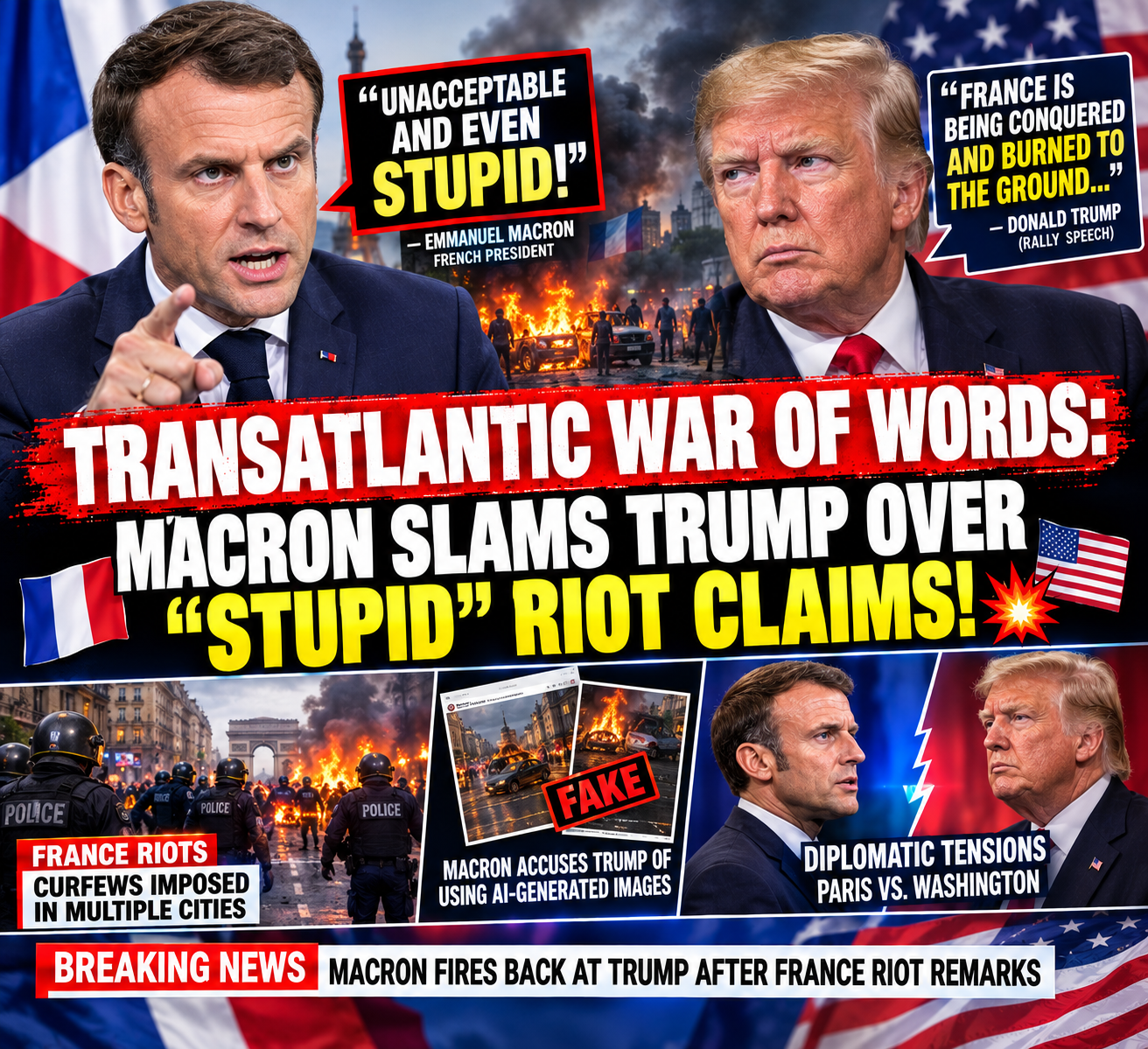
A sharp diplomatic disagreement between French President Emmanuel Macron and U.S. President Donald Trump has emerged as France confronts widespread protests, episodes of violent rioting and a growing wave of misleading online content about the unrest.
Speaking to reporters in Doha, Qatar, on October 21, Macron condemned what he described as “unacceptable and even stupid comments” by foreign leaders who had portrayed the demonstrations as evidence that France was being overrun by migrants and Islamist extremists.
Although Macron initially avoided naming individual leaders, he acknowledged that his criticism included Trump when reporters pressed him on the subject. His comments followed Trump's claims that France was being devastated by migrants, jihadists and communists, allegations that French authorities and independent reporting have not substantiated.
The dispute has unfolded at a particularly sensitive moment for both governments. France is dealing with major public dissatisfaction over living costs, school funding and economic conditions, while Trump is campaigning for Republicans ahead of the November 3 U.S. midterm elections.
The confrontation is therefore about more than a disagreement over the interpretation of street violence. It concerns the accuracy of information circulating internationally, the political use of another country's domestic crisis and the difficulty of distinguishing authentic footage from manipulated or AI-generated images.
Macron's intervention was unusually direct for a leader responding to criticism from a major ally. But his central argument was also carefully framed: he acknowledged that France had experienced serious violence and public disorder while rejecting claims that the unrest amounted to an organized takeover by migrants or religious extremists.
Trump’s remarks turn French unrest into an American campaign issue
The immediate controversy began after Trump used France's demonstrations as a warning to American voters during a campaign rally in Wichita, Kansas, on October 19.
Trump described France as a country being “conquered, looted and burned to the ground” by migrants, jihadists and communists. He argued that the unrest illustrated what could happen in the United States if Democrats gained political power in the midterm elections.
The remarks followed a series of violent incidents during French demonstrations on October 17, when protests over living costs and conditions in public education were accompanied by arson, looting and clashes between police and groups of rioters.
Trump also urged European governments to strengthen border controls and remove people he characterized as threats to their countries. His comments reflected a broader argument he has made about immigration, public order and Western national identity.


CNN reported that footage of the French disturbances was shown to spectators before Trump's Kansas rally, helping make the events in France part of the campaign's political messaging. The president then drew a direct comparison between the disorder abroad and the policies he attributed to his domestic opponents.
The argument was politically significant because it transformed a complex French domestic crisis into an illustration of American partisan differences.
But the evidence does not support Trump's sweeping explanation for the violence.
An Associated Press examination found no substantiation for claims that Muslim migrants were responsible for the widespread rioting. French authorities had not established a connection between immigration status and the violence, while the demonstrations themselves arose from grievances involving the cost of living, public education and economic conditions.
The AP also found that some widely circulated claims about attacks on religious buildings were misleading. That distinction matters because authentic footage of burning vehicles or damaged buildings does not establish the identity, motivations or immigration status of those responsible.
Macron responds from Qatar: France has problems, but the claims are false
Macron delivered his response during a diplomatic trip to the Gulf region, where he had been discussing energy supplies as France faced economic pressure and uncertainty.
He acknowledged the seriousness of the violence and rejected any suggestion that the government was ignoring the disorder.
However, he drew a firm distinction between legitimate reporting on riots and what he described as the international manipulation of information about those events.
Macron said foreign commentary had been influenced by artificial intelligence-generated imagery depicting scenes that had not actually occurred in France.
He specifically rejected assertions that the country had been invaded by migrants and Islamists.
Asked whether his criticism included Trump, Macron responded: “Among others.”


That answer is central to understanding the dispute.
Macron did not simply issue an isolated insult directed at Trump. He criticized several foreign political figures whom he believed had misrepresented events in France, while acknowledging that the American president was among those he had in mind.
The French president also appeared to be referring to Israeli Prime Minister Benjamin Netanyahu, who had linked the disturbances to extremist Islam. Like Trump's broader claims, that characterization lacked supporting evidence establishing that the nationwide unrest was driven by such groups.
Macron accused foreign politicians of using France's difficulties to advance their own electoral arguments. His remarks were especially pointed because both the United States and Israel were approaching important elections.
He suggested that France's internal challenges should not be turned into campaign material by leaders who lacked an accurate understanding of what was happening.
That was a political criticism rather than proof of deliberate deception. The reporting establishes that Trump made the disputed claims and that Macron rejected them, but it does not establish that Trump knowingly circulated a specific fabricated image.
What actually caused the demonstrations?
The protests began with concerns about deteriorating conditions in French schools and developed into a broader movement over purchasing power, energy prices, wages and the cost of living.
Students, trade unions and members of the Yellow Vest movement participated in demonstrations across the country. Many gatherings remained peaceful, but some were accompanied by serious violence.
During the October 17 unrest, shops were looted, vehicles and other property were burned, and police confronted groups involved in disorder. Authorities reported thousands of arrests and imposed emergency security measures in affected areas.
The causes of the violence were not necessarily identical to the motivations of peaceful demonstrators.
Some participants protested economic conditions or public services. Others engaged in criminal acts, including opportunistic looting. French authorities also identified involvement by radical activists in certain incidents.
Treating those different groups as one organized movement risks obscuring the actual sequence of events.


The economic pressures underlying the demonstrations are substantial.
According to the Associated Press, France's annual inflation rate stood at 3.1%, while energy prices had increased 21.3% year over year. Those figures help explain why the demonstrations expanded beyond the original school-related grievances.
Protesters demanded higher wages, improved pensions, increased education funding, repairs to schools and greater financial assistance for students.
These demands were accompanied by frustration over the government's response to economic conditions and the growing cost of essential services.
Macron's administration faced criticism from multiple directions. Opposition parties questioned its ability to maintain public order, while unions and protesters argued that the government's policies had failed to address the pressures facing households.
The French president therefore confronted two simultaneous challenges: restoring security after episodes of violence and responding to the economic grievances behind the broader demonstrations.
France imposes restrictions as demonstrations continue
Following the October 17 disturbances, French authorities introduced curfews in certain locations and restrictions on public gatherings ahead of further demonstrations.
Macron announced plans for an emergency meeting with ministers and intelligence officials to review the violence and the government's response.
The administration said additional security measures were necessary to prevent further destruction while allowing lawful protest to continue.
On October 24, tens of thousands of students and workers again demonstrated across France.
Authorities deployed as many as 70,000 officers nationwide to prevent a repeat of the previous weekend's disorder. Police used tear gas in Lyon and Clermont-Ferrand, while some cities restricted demonstrations and major Paris attractions temporarily closed.
Trade unions criticized certain restrictions as excessive, raising questions about how the government should balance public safety with freedom of assembly.


The continuing demonstrations show why it would be inaccurate to describe the entire situation simply as a migrant-driven riot.
France is experiencing a combination of economic protest, political dissatisfaction and episodes of criminal violence. These developments are related in time, but they are not interchangeable.
The government has a responsibility to investigate the violence and prosecute criminal conduct. At the same time, the grievances raised by peaceful protesters require separate political and economic responses.
AI-generated images become a second front in the dispute
One of the most consequential elements of Macron's criticism was his warning about AI-generated images.
Modern image-generation technology can produce highly realistic depictions of burning buildings, violent crowds, police operations and other dramatic events. When such images circulate without clear identification, they can be mistaken for documentary evidence.
That risk becomes particularly significant during fast-moving crises, when authentic footage, old recordings and fabricated imagery may appear together across social-media platforms.
Macron said that some images circulating internationally showed scenes that had never occurred in France. However, he did not publicly identify every disputed image or demonstrate that Trump personally relied on a particular fabricated visual.
The distinction is essential for responsible reporting.
There is evidence that fabricated or misleading imagery circulated during the unrest. There is also evidence that Trump made unsupported claims about migrants and extremists. But connecting a specific AI-generated image directly to Trump's statements requires evidence of that connection.
The accompanying cover graphic itself is a useful example of why this distinction matters. It combines portraits of Macron and Trump with dramatic scenes of burning vehicles and confrontations. Its design conveys political conflict, but it should not be interpreted as a verified photograph of the leaders responding to the same event.
Washington defends Trump as the disagreement continues
The controversy did not end with Macron's remarks.
On October 23, the U.S. State Department defended Trump's interpretation of the French unrest.
Spokesperson Tommy Pigott told Fox News Digital that the president was “spot on” in his comments concerning the demonstrations and mass migration. The statement indicated that Washington was not retreating from the broader political argument advanced by Trump.
The disagreement therefore developed beyond an exchange between two presidents.
Macron rejected the characterization of the unrest as a migrant or Islamist takeover. The Trump administration defended its concerns about immigration and security.
Those positions reflect differing interpretations of events, but the evidentiary question remains separate from the political disagreement.
Independent reporting has not established that immigrants or religious extremists were collectively responsible for the violence. A government's support for a political claim does not, by itself, verify the underlying allegation.
The French Foreign Ministry also indicated that it could provide foreign governments with clarification to help prevent the spread of inaccurate information about the unrest.


The dispute comes against the backdrop of a longstanding relationship between Washington and Paris.
France and the United States are NATO allies with extensive diplomatic, economic and security ties. Their leaders have disagreed publicly before, including over trade, defense spending, international institutions and foreign policy.
A sharp exchange over domestic unrest does not necessarily indicate a breakdown in the alliance.
Nevertheless, the dispute illustrates how internal political controversies can become international diplomatic issues when foreign leaders use them to advance their own arguments.
For Trump, France's difficulties provided an opportunity to reinforce his warnings about immigration and public order before the American midterms.
For Macron, the challenge was to acknowledge serious domestic disorder while rejecting what he considered inaccurate and politically motivated portrayals of his country.
Neither political objective resolves the underlying problems confronting French citizens.
The protests continue to raise questions about living standards, public education, wages and the government's response to violence. Those issues will remain significant regardless of how the disagreement between Macron and Trump develops.
As of October 24, the clearest conclusion is that the diplomatic dispute is real, Macron's criticism is documented and Trump's remarks about migrants and extremists are not supported by the available evidence.
The French unrest is also real, including serious incidents of arson, looting and confrontation with police. But it cannot accurately be reduced to the sweeping narrative of a country conquered by migrants.
The next test for Macron's government will be whether it can maintain public order while addressing the economic and social pressures driving the demonstrations. For Washington and Paris, the immediate challenge is whether their disagreement over the facts becomes a prolonged diplomatic dispute or remains an episode of public political criticism.
The events demonstrate how rapidly domestic unrest can become an international controversy—and why verified information is especially important when political rhetoric, authentic violence and AI-generated imagery circulate together.
Comments (0)
Loading comments...
May You Like

EAST COAST MEGASTORM—2 MILLION HOUSES DAMAGED, 5 MILLION AT RISK OF BLACKOUTS, WATER FAILURES!

FLORIDA AIRBNB NIGHTMARE — 50 TEENS, 7 SHOOTING VICTIMS LINKED TO “SHOTS AT THE DOOR”!

STAR DIED AT 38, $10M LIFE INSURANCE INCREASED JUST 30 DAYS BEFORE WWE BRONSON REED'S DEATH!









Popular Posts




