
Major TV Networks Suspend White House Pool Coverage of Trump After CNN Ban
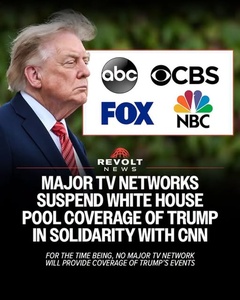
ABC, CBS, NBC and Fox News joined CNN in suspending shared television pool coverage of President Donald Trump, escalating an extraordinary confrontation between the White House and the American press.
WASHINGTON, Sept. 22, 2026 — America’s five major television networks have suspended pooled video coverage of President Donald Trump after the White House prevented CNN from performing its scheduled presidential pool duties.
ABC News, CBS News, CNN, Fox News and NBC News announced the collective action Monday, creating an unusual interruption to the television system that follows presidents wherever they travel.
The networks said the public has a vital interest in receiving accurate and independent information about its government and objected to excluding news organizations because officials dislike their reporting.
Their decision followed Trump’s announcement Friday that CNN, MS NOW and Politico would be barred from the White House because of coverage he repeatedly characterized as “fake news.”
By Saturday, the dispute had moved beyond rhetoric. CBS News reported observing journalists from all three organizations being turned away when they attempted to enter the White House complex.
CNN’s exclusion then created a larger logistical confrontation because the network was scheduled Monday to serve as the designated television pool representative accompanying Trump during his trip to New York.
Instead of allowing another network to replace CNN, the five pool members decided collectively that no replacement television crew would be provided for designated presidential pool events.
Fox News Washington bureau chief Bryan Boughton, who chairs the rotating television pool, informed subscribers that pooled coverage of presidential events would therefore be suspended effective Monday.
The development is particularly notable because Fox News, frequently viewed as editorially friendlier toward Trump than several competitors, joined ABC, CBS and NBC in standing with CNN on the access dispute.
The decision does not amount to a complete television blackout of Trump. Networks remain free to report on the president, use their own independently obtained material and carry video available through other sources.
What has stopped is the specialized White House television pool, in which the five networks rotate responsibility for providing camera coverage that is then distributed to other news organizations.
That system exists partly because many presidential spaces cannot accommodate every television crew, particularly aboard Air Force One, inside the Oval Office or during smaller meetings with foreign leaders.
The designated pool network therefore records the president and provides its footage to competitors, allowing news organizations around the country and world to show events they could not individually attend.
The arrangement has operated in various forms since Franklin D. Roosevelt’s presidency, making the current suspension a highly unusual escalation in relations between a president and the television press corps.
Other pooling arrangements have not stopped. CBS reported that network pool coverage involving officials such as Vice President JD Vance and Secretary of State Marco Rubio continued Monday.
Print, radio and other journalists also continue covering presidential activity, meaning the suspension specifically affects shared network television coverage rather than the entire White House press corps.
The dispute intensified further Monday when CNN, MS NOW and Politico filed a federal lawsuit seeking restoration of their White House credentials and access.
The three organizations argue the administration retaliated against them because Trump objects to their journalism, alleging violations of both First Amendment press protections and Fifth Amendment due-process rights.
They have asked a federal judge to act quickly and restore access while the larger constitutional dispute proceeds through court, according to the complaint and reporting on Monday’s filing.
The White House Correspondents’ Association has also criticized the administration. Its president, Fox News correspondent Jacqui Heinrich, argued White House access cannot be arbitrarily denied based upon reporting officials dislike.
That position invokes an important distinction: the First Amendment does not necessarily require the government to provide every journalist identical physical access to every presidential event.
But once the government creates a credentialing and access system, federal court precedents place restrictions on excluding journalists arbitrarily or because officials object to their coverage.
The lawsuit cites earlier conflicts involving Trump’s first presidency, including cases involving CNN correspondent Jim Acosta and Playboy reporter Brian Karem, both of whom regained access following court challenges.
It also points toward the 1977 Sherrill v. Knight decision, a longstanding precedent concerning procedural protections when White House press credentials are denied.
Trump presents the controversy differently. He argues that the three organizations repeatedly distribute false information and says the government should not continue providing privileged White House access to outlets he considers dishonest.
The banned organizations reject that characterization and argue allowing presidents to exclude journalists based on unfavorable coverage would give administrations enormous power to shape which reporters can directly question government officials.
Other media organizations have now expanded the protest beyond television. The Washington Post announced Monday that it would temporarily withhold photographs of Trump and his presidential events as part of a coordinated action involving photographers.
That included imagery surrounding Trump’s departure from Washington and activities connected with the United Nations General Assembly in New York, although the temporary photo action was scheduled to expire after midnight Tuesday.
The television suspension potentially has more lasting practical consequences because pooled cameras normally produce much of the independent video showing Trump speaking to reporters, meeting foreign leaders or traveling aboard presidential aircraft.
Without that pool, the amount of independently produced television footage from restricted presidential settings could decline significantly, particularly when individual networks cannot place their own crews inside.
The result creates an unusual paradox: the networks are defending journalists’ access by temporarily withholding a system designed specifically to maximize public access to independent images of the president.
Their stated objective is not to stop reporting on Trump but to prevent the White House from selecting which member of the established pool may participate based on objections to its journalism.
The administration, meanwhile, retains its own ability to produce and distribute official video, but government-created footage lacks the independence provided by journalists operating cameras and asking questions on behalf of the press corps.
The confrontation could therefore determine much more than whether three organizations regain their badges. A court ruling may clarify how much discretion presidents possess over established White House press-access systems.
Comments (0)
Loading comments...
May You Like

gfnhgmnghnmfgnbvvvvvvvvv

Obama Steps Back Into the Political Spotlight as Democrats Target Trump’s Senate Majority













