
Majority Support for Trump Impeachment Appears in Multiple Polls — But the Viral Headline Needs Context
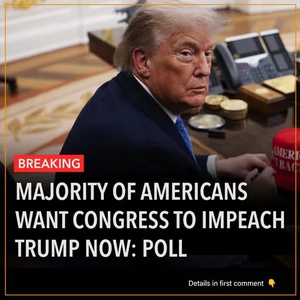
Several national surveys have recorded majority support for impeachment or belief that grounds exist, while question wording, timing and populations surveyed differ significantly.
WASHINGTON — A viral graphic claiming a majority of Americans now want Congress to impeach President Donald Trump is rooted in genuine polling, although the headline omits important details about the surveys involved.
One frequently cited result comes from a Lake Research Partners poll conducted March 26–30, which found 52% of likely 2026 voters supported impeaching Trump and 40% opposed.
The survey included 800 likely general-election voters nationwide and was commissioned by Free Speech For People, an advocacy organization actively campaigning for Trump’s impeachment and removal from office.
That sponsorship does not automatically invalidate the findings, but it is relevant context because readers should know who commissioned political polling when evaluating its design and interpretation.
The wording is equally important. Respondents were told that members of Congress supported impeachment over alleged constitutional and legal violations involving immigration enforcement and the Iran war before answering the question.
After receiving that context, 52% supported impeachment, including 46% who strongly supported it, while 40% opposed impeachment and 8% gave no opinion.
The partisan divide was enormous. Among Democrats, 84% supported impeachment, compared with 55% of independents and just 14% of Republicans.
Those numbers show majority support within that survey but also demonstrate how strongly impeachment attitudes remain connected to partisan identification.
A separate national survey later produced a similar result using different wording. In June, a Strength In Numbers/Verasight poll found 53% believed grounds existed for Congress to impeach Trump.
Another 39% said grounds did not exist, while 40% of all respondents said there were “definitely” grounds for impeachment, according to the published results.
That question is not identical to asking whether Congress should immediately impeach Trump. Someone could believe potentially impeachable conduct exists while still preferring an investigation before a House vote.
The same polling project reported that an April survey found 55% saying Congress should impeach Trump, illustrating how question wording and timing can produce related but distinct measurements.
Together, these surveys provide evidence that majority support for impeachment appeared under several formulations during the spring and early summer of 2026.
What they do not establish by themselves is that a majority of all Americans on September 24 currently want Congress to impeach Trump immediately.
That would require a sufficiently fresh national survey asking that specific question, rather than republishing results collected months earlier under somewhat different formulations.
The distinction matters because political opinion can change rapidly, particularly during a period involving the Iran conflict, economic concerns and an approaching congressional election.
Recent polling does show broader dissatisfaction with Trump, although presidential job approval and support for impeachment should not be treated as interchangeable measurements.
For example, recent surveys have found substantial negative assessments of Trump on issues including corruption, economic management and the cost of living, while producing different overall approval numbers.
Those results may help explain the political environment surrounding impeachment discussions, but disapproving of a president does not necessarily mean supporting the constitutional process of impeachment and removal.
Impeachment itself also involves two distinct constitutional stages that social-media headlines frequently combine: action by the House and a potential trial in the Senate.
The Constitution gives the House the power to impeach. Approval of articles of impeachment requires a simple majority of House members voting.
Impeachment does not automatically remove a president from office. The Senate conducts a separate trial, where conviction and removal require support from two-thirds of senators present.
Trump has already been impeached twice, both during his first presidency. The Senate acquitted him in both proceedings, so neither resulted in removal.
During his second presidency, Democratic Rep. Al Green has introduced additional impeachment efforts, but those attempts have not produced another completed House impeachment.
The political arithmetic is also separate from public polling. Even when a survey finds majority public support, lawmakers make individual decisions about whether to initiate proceedings and what allegations warrant articles of impeachment.
Republican control of the current House makes passage particularly difficult without significant Republican support, regardless of the results produced by individual national polls.
That situation could change after the November midterms depending on the composition of the next Congress, but current polling cannot determine what voters will ultimately decide in individual House districts.
The viral graphic therefore contains an important element of truth: multiple 2026 surveys have produced majority-level support for impeachment or agreement that grounds for impeachment exist.
But the word “now” is where the headline becomes problematic. The widely circulated 52% figure comes from polling conducted in late March rather than a survey taken this week.
It is also more precise to say that survey measured likely 2026 voters, rather than simply describing its sample as every American.
The later June poll does cover Americans more broadly and found 53% saying grounds existed, but again, that question did not directly ask whether Congress should immediately impeach Trump.
Poll sponsorship provides another necessary qualification. Free Speech For People commissioned the Lake Research survey while publicly advocating impeachment, making disclosure of the sponsor especially important when reporting its findings.
None of those qualifications requires dismissing the results. They simply allow readers to understand precisely what respondents were asked and what conclusions the data can reasonably support.
The broader evidence indicates impeachment has substantial public support and has crossed 50% in multiple 2026 surveys using different questions.
Whether that support persists at the same level today would require newer polling specifically measuring impeachment rather than inferring attitudes from presidential approval, congressional preferences or other political questions.
Comments (0)
Loading comments...
May You Like
TRUMP HIT WITH 26 ARTICLES OF IMPEACHMENT

South Korea–Ukraine Rift Deepens Over North Korean POW Transfer as PURL Draws New Scrutiny

FIGHT OVER OBAMA’S IRAN POLICY













