Marco Rubio Warns About Social Security as Retirement Concerns Grow
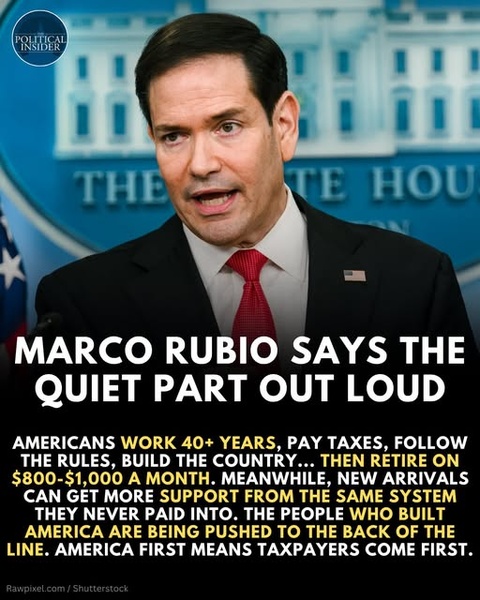
WASHINGTON — A viral graphic featuring Marco Rubio claims Americans can work for decades, pay taxes and retire on only $800 to $1,000 monthly. The underlying remarks are real, but the context is older and more complicated.


A Viral Quote With an Older Origin
The statement circulating online traces back to Rubio remarks that were published and shared in February 2024, rather than a newly announced 2026 retirement policy. Rubio wrote that young refugees could receive more support than retirees who worked and paid taxes.
In the remarks, Rubio described Americans who had worked their entire lives and then retired with Social Security payments of roughly $800, $900 or $1,000 per month.
The viral graphic, however, presents the comments as though Rubio were announcing a current retirement policy or newly confronting the American pension system. That interpretation is misleading.
Rubio’s underlying argument was about the treatment of retirees compared with assistance available to certain refugees and other eligible newcomers, rather than a proposal to reduce every retiree’s Social Security payment.
The distinction matters because Social Security retirement benefits are not uniformly $800 to $1,000 per month. Payments vary substantially according to earnings history and the age at which someone claims benefits.
Today’s Average Benefit Is Much Higher
According to the Social Security Administration, the estimated average monthly retirement benefit for a retired worker was $2,071 in January 2026, following the year’s 2.8% cost-of-living adjustment.
SSA’s July 2026 statistical snapshot put the average monthly retirement benefit at approximately $2,032, while other SSA-based figures show the broader average continuing above $2,000.
That does not mean Rubio’s $800-to-$1,000 example is impossible. Individual benefits can be considerably lower than the national average, depending on lifetime earnings, employment history and claiming decisions.
Conversely, workers with high lifetime earnings can receive substantially more. Someone reaching full retirement age in 2026 could receive a maximum monthly benefit of $4,152 under current rules.
The numbers therefore describe different circumstances: Rubio was highlighting low-benefit retirees, while national statistics show the average recipient receives considerably more.
What Rubio Was Actually Comparing
The other half of Rubio’s argument involved refugees and other humanitarian populations who can qualify for government-funded resettlement assistance after entering the United States legally under refugee programs.
The Office of Refugee Resettlement provides eligible refugees with assistance intended to support economic self-sufficiency, employment, health, housing and integration during the resettlement process.
Certain refugees may also qualify for mainstream federal programs, including Supplemental Security Income, Medicaid, SNAP or Temporary Assistance for Needy Families, depending on eligibility requirements.
However, describing these programs simply as a guaranteed monthly payment for every young refugee would be inaccurate. Eligibility depends on immigration status, income, resources, household circumstances and the specific program involved.
The Social Security Administration specifically says refugees may qualify for SSI under certain conditions, but such eligibility is subject to federal rules and, for some refugees, time limitations.
Social Security Is Not Simply a Welfare Payment
Social Security retirement benefits operate differently from refugee assistance. Retirement benefits are primarily based on a worker’s covered earnings and accumulated work credits over their career.
A person generally needs sufficient work history to qualify for retirement benefits, with benefit calculations based largely on lifetime earnings and the age at which benefits begin.
That distinction makes the comparison politically powerful but economically complicated. Refugee assistance and retirement insurance serve different purposes and are financed through different mechanisms.
Rubio has previously advocated changes to Social Security, including gradually increasing the full retirement age for younger workers and modifying the benefit formula to provide greater support to lower earners.
Those earlier proposals demonstrate that Rubio has long viewed Social Security reform as a legitimate policy issue, although they do not establish that he is currently proposing to cut existing retirees’ checks.


The Bigger Problem: Retirement Security
The controversy comes as Americans face broader concerns about whether Social Security will remain financially sustainable for future generations.
The Social Security Administration warns that without legislative changes, projected tax revenues will eventually cover only part of scheduled benefits after the trust funds become depleted.
That looming financing challenge has produced competing proposals, including higher payroll taxes, changes to benefits, adjustments to retirement ages and policies encouraging additional private retirement savings.
For retirees already receiving benefits, however, the political debate is especially sensitive because Social Security often represents a major source of monthly income.
The average benefit of roughly $2,000 per month may sound substantially larger than Rubio’s example, but many retirees still struggle with housing, medical costs, food, utilities and other expenses.
A Viral Graphic That Needs Context
The viral image therefore contains a kernel of truth but removes important context. Rubio did discuss Americans retiring after decades of work with relatively modest Social Security payments, and he did compare those payments with assistance available to refugees.
What the graphic does not make clear is that the remarks originated in 2024, the $800-to-$1,000 figure was an example rather than the national average, and refugee assistance is governed by separate eligibility rules.
Nor does the image establish that Rubio has introduced a new plan requiring Americans to retire on $800 to $1,000 a month. No such policy follows from the remarks themselves.
The resurfacing of the statement nonetheless reflects a continuing political battle over immigration, government benefits, Social Security and the meaning of fairness for Americans who spend decades paying taxes.
For Republicans, the issue presents a difficult balancing act: defending tighter limits on government assistance while reassuring older voters that their earned retirement benefits will remain protected.
For Democrats and progressive groups, Rubio’s comments can be framed as evidence of a broader Republican debate over entitlement spending and the future structure of Social Security.
But the available evidence does not support treating the viral graphic as a new announcement from Rubio or as proof that current retirees are being targeted for an immediate reduction.
The more consequential question is how Washington will address Social Security’s long-term finances while protecting older Americans who depend heavily on monthly benefits.
As the debate intensifies, Rubio’s resurfaced remarks are likely to remain politically useful to both sides — but the actual numbers and eligibility rules tell a considerably more complicated story.
Comments (0)
Loading comments...
May You Like

South Korea–Ukraine Rift Deepens Over North Korean POW Transfer as PURL Draws New Scrutiny

Obama Steps Back Into the Political Spotlight as Democrats Target Trump’s Senate Majority