
Maria Teresa Kumar Says Many Americans Remember Obama Era as a Time of Unity and Calm
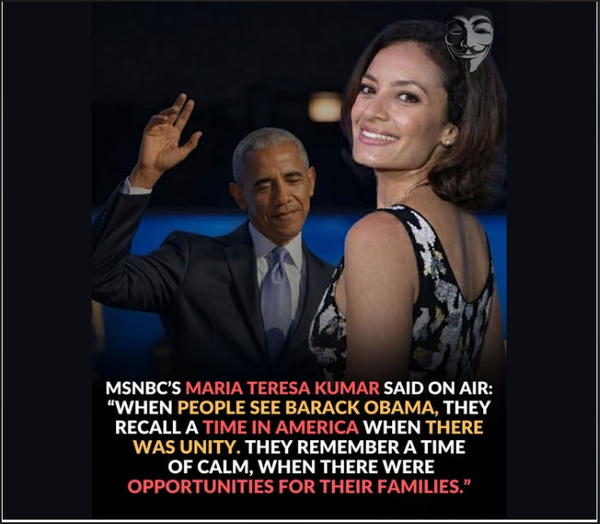
Political commentator Maria Teresa Kumar recently reflected on Barack Obama’s political legacy, arguing that many Americans associate his presidency with unity, calm, and greater opportunities for their families.
Kumar made the remarks while discussing Obama’s communication skills and continuing influence in American politics, particularly among voters who remember his years in the White House.
According to Kumar, Obama remains an unusually effective communicator because he can simplify complicated political issues and explain them in ways ordinary Americans can understand.
She said Obama’s public appearances can trigger memories of an earlier period when people felt the country was more united and political conversations appeared less chaotic.
Kumar described those memories as involving a sense of calm and opportunity, particularly for families who believed they could build better lives during that period.
Her comments have circulated widely online, prompting renewed discussion about how Americans remember Obama’s presidency and how political memories can change as national circumstances evolve.
The remarks also highlight Obama’s continuing presence in American public life more than a decade after he left the White House following two presidential terms.
Obama served as president from 2009 through 2017, becoming the first Black president of the United States and establishing a lasting place in modern political history.
Kumar has appeared frequently as a political commentator on MSNBC and has discussed Obama and national politics on the network for many years.
She is also the founding president and chief executive officer of Voto Latino, an organization focused on civic participation and political engagement among Latino communities.
Her perspective on Obama is shaped partly by years of involvement in national politics, including meetings with the former president during his administration.
The Obama Presidential Library records show that Kumar participated in a 2015 White House meeting with Obama and Latino, Asian American, Pacific Islander, labor, and immigration advocacy leaders.
That history gives additional context to Kumar’s comments about Obama’s communication style and his ability to connect with different communities across the country.
Kumar particularly emphasized Obama’s ability to take complicated subjects and reduce them to concise explanations, a skill she considers important in an increasingly polarized political environment.
Her remarks come as Obama continues to appear publicly, speak about American democracy, and maintain a visible role in political and civic conversations after leaving office.
The opening of the Obama Presidential Center in Chicago in June 2026 has also renewed public attention surrounding his presidency, legacy, and continuing influence.
For supporters, the center represents an opportunity to preserve the history of Obama’s presidency while encouraging future generations to participate in public life.
Kumar’s comments nevertheless reflect a particular political interpretation rather than an objective consensus about the Obama years, and Americans continue to hold sharply different views about his presidency.
Debates surrounding Obama’s legacy frequently involve economic conditions, healthcare, immigration, foreign policy, racial politics, and the broader political polarization that developed during his presidency.
Still, Kumar’s central argument focuses less on individual policies and more on how Obama’s presence makes some Americans remember a period they associate with stability and optimism.
Her comments illustrate how former presidents can remain powerful symbols long after leaving office, particularly when voters compare memories of earlier administrations with the political climate of today.


Overall, Kumar’s remarks have reignited a familiar political debate: whether Americans genuinely experienced greater unity during the Obama era, or whether distance and nostalgia have shaped how that period is remembered.
Comments (0)
Loading comments...
May You Like

OBAMA STUNS ON INSTAGRAM: MESSAGE MARKING 34-YEAR MILESTONE SPARKS A BUZZ
TRUMP HIT WITH 26 ARTICLES OF IMPEACHMENT

Shocking news from Ohio: an unexpected development ahead of Trump's rally













