
“Nobody Will Tell Us”: Mark Carney Draws a Sovereignty Line as Canada Moves Closer to the EU
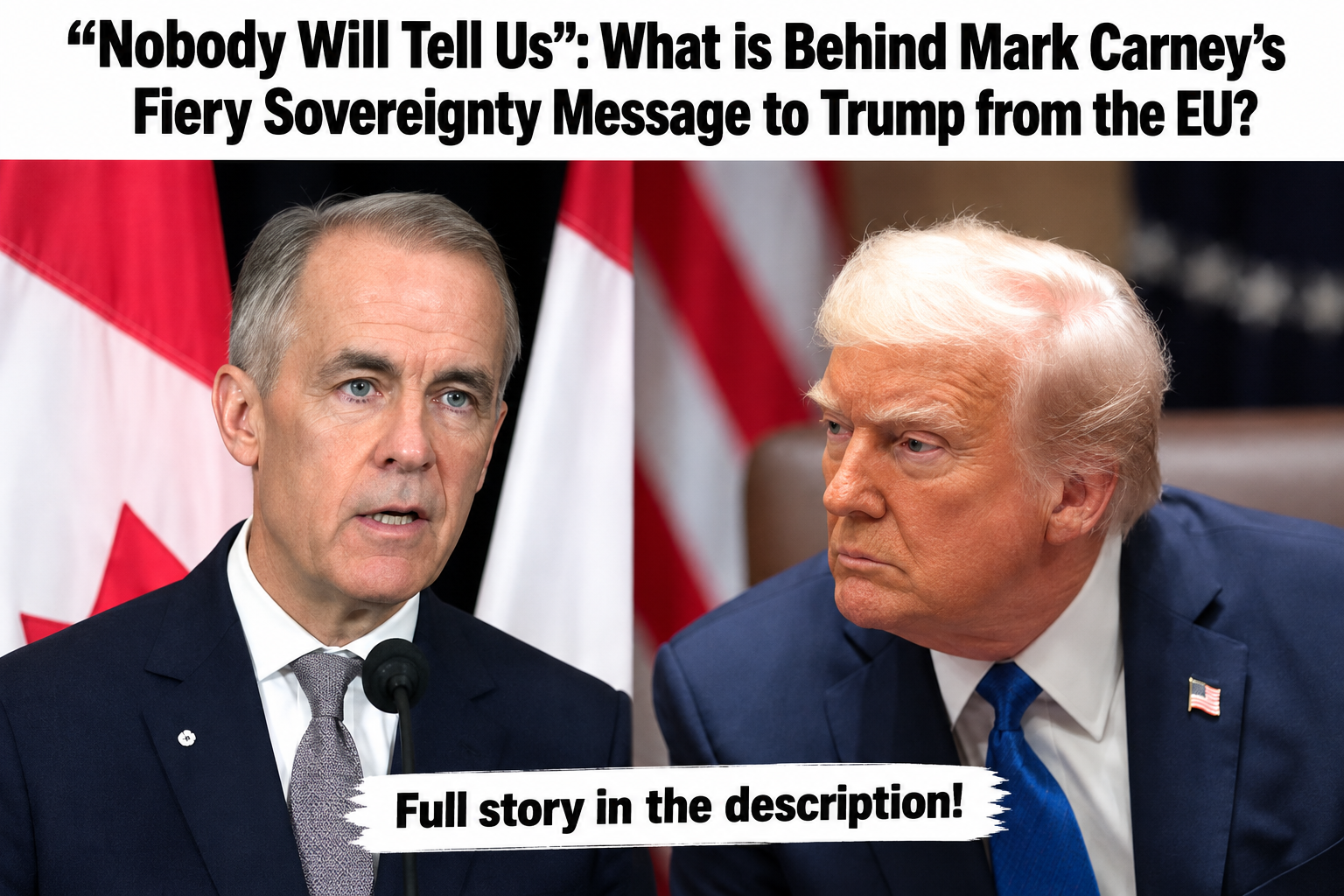
Canadian Prime Minister Mark Carney used a speech at the European Parliament to defend deeper ties with the European Union, insisting that Canada will decide for itself which countries and institutions it partners with. His message came hours after Donald Trump warned that a closer Canada-EU relationship could trigger “very serious tariffs.”
Canadian Prime Minister Mark Carney delivered a forceful defense of Canadian sovereignty in Strasbourg on September 17, as Ottawa embraced a proposed new relationship with the European Union and tensions with U.S. President Donald Trump continued to rise.
Speaking to the European Parliament, Carney welcomed the EU's proposal to explore making Canada its first-ever “associate member.” But he also drew clear limits around what that arrangement could mean, emphasizing that Canada is not seeking full EU membership and would not surrender its sovereignty.
His remarks came less than a day after European Commission President Ursula von der Leyen proposed opening the door to an unprecedented form of EU association for Canada.
Trump responded by warning that the move could constitute a “hostile act” and said Washington could impose heavy tariffs or restrict trade with Europe if he concluded the initiative was directed against the United States.
The result is a rapidly developing three-way diplomatic and economic story involving Canada, Europe and the United States.


What Did Carney Mean by “Nobody Will Tell Us”?
The headline on the viral image compresses a longer statement Carney made during his appearance in Strasbourg.
Carney said Canadians were united around the principle that “nobody is going to tell us what language we speak,” adding that no outside power should dictate Canada's culture or determine with whom Canada can make international agreements.
The comment came in response to questions about Trump's objections to Canada's closer relationship with the EU.
Carney's broader argument was that stronger partnerships with Europe would reinforce, rather than weaken, Canadian sovereignty.
“We are looking for partnerships that are complementary, that reinforce our sovereignty,” Carney said, according to Euronews' account of his remarks.
He also said the proposed arrangement would ultimately be subject to a vote in the Canadian Parliament.
That point is important because the EU's “associate member” proposal currently has no established legal model.
Canada Is Not Applying to Become a Full EU Member
Despite the dramatic wording surrounding the proposal, Carney was explicit that Canada is not seeking full membership in the European Union.
“Canada is not in a position nor seeking to become a full member of the European Union,” he said during his Strasbourg appearance.
Instead, Ottawa is discussing a new framework that could allow much deeper cooperation with the EU without Canada becoming one of the bloc's 27 full member states.
The exact structure remains undecided.
Carney said the terminology itself was ultimately for the Europeans to determine and repeatedly emphasized that the substance of the relationship matters more than its label.
That distinction is especially important because “associate membership” is not currently a standard EU status.


How Did the “Associate Member” Idea Begin?
The proposal came directly from European Commission President Ursula von der Leyen during her annual State of the European Union address on September 16.
Von der Leyen described Canada and Europe as sharing deep historical, cultural and political ties and proposed moving beyond the existing Canada-EU Comprehensive Economic and Trade Agreement, or CETA, toward what she called an “Alliance for the Future.”
Her proposal included cooperation in:
- Defense industries
- Energy
- Critical minerals
- Batteries
- Artificial intelligence
- Quantum technology
- Cybersecurity
- Economic security
- Arctic cooperation
- Technology
- Supply chains
She then proposed working with Carney to open the door for Canada to become the EU's first associate member.
The European Commission's own summary describes the initiative as a new form of partnership and says it would be the first arrangement of its kind.
There Is No Existing “Associate Membership” Template
One of the biggest uncertainties is that the EU has never previously created an associate-member category in the form now being discussed.
The Associated Membership proposal therefore needs to be negotiated and defined.
The Associated Membership proposal therefore needs to be negotiated and defined.
The European Parliament and EU member states would have to determine what rights, obligations and institutional arrangements such a relationship would contain.
The Associated Membership proposal therefore remains a political concept rather than a completed legal status.
AP reported that all 27 EU member states would ultimately have to agree to a formal arrangement, while several European governments have expressed openness to closer cooperation but reservations about the terminology.
That means Wednesday's announcement was the beginning of a negotiation, not the creation of a new EU membership category overnight.
Why Is Carney Looking Toward Europe?
The backdrop is Canada's increasingly difficult relationship with the United States.
Canada and the U.S. remain deeply integrated economically, but trade relations have deteriorated under Trump's tariff policies and repeated disputes with Ottawa.
Carney has responded by seeking to diversify Canada's international trade and strategic partnerships.
In his European Parliament speech, he presented Canada-EU cooperation as part of a broader effort to increase resilience and reduce vulnerability to external pressure.
He argued that modern sovereignty is no longer simply about having national borders and armed forces.
It also requires reliable access to:
- Artificial intelligence
- Semiconductors
- Critical minerals
- Payment systems
- Clean-energy technology
- Vaccines
- Space-based communications
Carney argued that Canada and Europe could address some of those vulnerabilities more effectively by working together.
Canada Still Depends Heavily on the U.S.
At the same time, Canada's economic relationship with the United States remains much larger than its trade relationship with Europe.
In July 2026, approximately 66.35% of Canada's exports went to the United States, according to Reuters' analysis of Canadian trade data. The year-to-date share was about 68%, down from 73% previously.
That means Canada's strategy is better described as diversification than an immediate economic separation from the United States.
Europe is becoming more important, but it cannot quickly replace Canada's enormous existing U.S. market.
That reality is one of the central challenges facing Carney's strategy.
Canada-EU Trade Is Already Significant
The proposed political relationship is being built on an existing economic foundation.
The Canada-EU Comprehensive Economic and Trade Agreement (CETA) has been provisionally applied since September 21, 2017.
Canadian government figures show that bilateral merchandise trade reached approximately C$134 billion in 2025, more than 77% above the 2016 level before CETA's provisional application.
Canadian exports to the EU also rose sharply in 2025, increasing 23.4% from the previous year.
The EU itself describes Canada as its second-largest trading partner in the Americas after the United States and says EU-Canada trade in goods and services reached approximately €130 billion in 2025.
So the new initiative is not starting from zero.
It would build on an established trade relationship and attempt to extend it into areas such as defense, technology, energy and strategic security.


Trump's Response: A “Hostile Act” Warning
The proposal immediately drew a response from Trump.
On September 16, Trump said that if the EU's move toward Canada were intended as a hostile action against the United States, Washington could respond with significant tariffs.
“If they do that, if I think it’s at all a hostile act, I will put very serious tariffs or stop trading with Europe on many things,” Trump told reporters, according to Reuters.
He also described the idea of Canada becoming an EU associate member as “laughable.”
Trump's comments introduced a new potential source of tension between Washington and Brussels at a time when the U.S. and EU are already managing disputes over tariffs and trade.
The European Commission, however, has emphasized that the proposed Canada relationship is not directed against another country.
Von der Leyen explicitly described the proposed partnership as one “not against anyone else, but for our common strength.”
Carney Says the Alliance Is Not an Anti-U.S. Bloc
Carney also sought to distance the proposal from the creation of a new geopolitical bloc aimed at Washington.
During his speech, he said:
“I am not proposing a third bloc in order to become a great-power rival – only with better manners.”
He argued that the goal was resilience rather than domination.
Carney also said stronger Canada-EU ties could ultimately make Canada a better partner for the United States, rather than an adversary.
That is an important part of Ottawa's argument.
Canada is attempting to expand its strategic options without formally abandoning its existing relationship with Washington.
The country remains a member of NATO and is deeply integrated with the U.S. economy and North American defense system.
Europe Also Has Its Own Reasons for Moving Closer to Canada
The initiative is not solely about Canada's relationship with Trump.
Europe is dealing with its own security and economic challenges.
Von der Leyen's September 16 speech described a world in which Europe can no longer assume that existing international arrangements will automatically protect its interests.
She called for stronger partnerships with countries that share European interests and values.
Canada fits into that strategy because of its:
- Large natural-resource base
- Arctic geography
- NATO membership
- Defense capabilities
- Critical minerals
- Energy resources
- Technology sector
- Existing trade relationship with Europe
The proposed cooperation therefore has strategic relevance for both sides.


Defense Is Becoming a Major Part of the Relationship
The discussion is no longer limited to trade.
Canada has already become more involved in European defense initiatives.
Reuters reported that Ottawa has joined the EU's SAFE defense procurement framework and is also seeking deeper cooperation with European countries on military capabilities.
Carney's government has also been exploring closer defense-industrial relationships with European partners.
This matters because the proposal for a closer Canada-EU relationship comes at a time when European governments are reassessing their own defense capabilities and the future role of the United States in European security.
Canada's involvement gives Europe another potential defense and industrial partner while giving Ottawa additional avenues for procurement and cooperation.
But Canada's NATO relationship with the United States remains intact.
The emerging European partnership therefore adds another layer to Canada's existing security relationships rather than formally replacing them.
Could Canada Eventually Gain Easier Access to Europe?
Potentially — but nothing has been finalized.
Carney discussed expanding opportunities for Canadians and Europeans to live, work and study on opposite sides of the Atlantic.
He also identified areas such as digital trade, education and youth mobility as potential elements of the future relationship.
However, the exact rights Canadian citizens would receive remain part of the negotiations.
The EU has not announced that Canadians automatically receive single-market rights, voting rights or unrestricted access to the European labor market.
Those issues would have to be negotiated separately.
Canada's Parliament Will Have a Role
Carney also emphasized that any eventual arrangement would have to respect Canadian sovereignty and go through Canada's domestic political process.
That could become important because the Canadian opposition has already questioned the government's handling of the proposal.
Conservative leader Pierre Poilievre said his party supports Canada's long-standing trade and defense relationships with Europe but opposes any arrangement that would impose EU laws, taxes or open-border policies on Canada.
The disagreement shows that the domestic Canadian debate is likely to focus not simply on whether Canada should cooperate more closely with Europe, but on how far that cooperation should go.
Why the “Sovereignty” Argument Matters
Carney's central message in Strasbourg was that sovereignty in the modern economy depends partly on having enough strategic alternatives.
His argument is that a country is more sovereign when it can choose among multiple suppliers, markets, technologies and security partners.
That explains why he repeatedly connected sovereignty with critical minerals, AI, energy, financial infrastructure and defense capacity.
The concept is broader than the traditional definition of sovereignty as territorial control.
It is also a response to Canada's economic exposure to the United States.
If a large share of a country's exports, energy infrastructure and supply chains depend on one neighboring market, diversification can become a strategic issue as well as an economic one.
The EU Proposal Still Faces Major Obstacles
Despite the political momentum, the initiative is far from completed.
The biggest problem is the absence of a clear legal definition for “associate member.”
EU governments will have to determine what the arrangement means in practice.
Questions include:
- Would Canada participate in EU meetings?
- Would Canadian ministers have institutional access?
- Would Canada receive additional trade privileges?
- Would there be new mobility rights?
- How closely would Canada align with EU regulations?
- How would defense cooperation be structured?
- Would Canada participate in specific EU programs?
- What obligations would Canada accept?
None of those questions has been fully resolved.
Reuters reported that some European officials have expressed skepticism about the concept precisely because its practical meaning remains unclear.
The next major opportunity to define the framework is expected to come at the Canada-EU summit in Montreal in October.
What Happens Next?
The immediate diplomatic focus will be on turning the broad political announcement into something concrete.
Canada and the EU are expected to work on the framework ahead of their October summit.
The negotiations could cover economic security, defense, technology, energy, critical minerals and mobility.
At the same time, Ottawa will have to manage its continuing economic relationship with Washington.
That balancing act will be difficult because the United States remains Canada's overwhelmingly largest export market.
Trump's tariff threat adds another variable.
If Washington interprets the Canada-EU initiative as an attempt to disadvantage U.S. interests, the dispute could expand beyond the existing Canada-U.S. trade conflict.
If instead the arrangement remains focused on diversification and cooperation, Ottawa and Brussels could attempt to present it as complementary to Canada's existing alliances.
What the Viral Image Gets Right — and What It Leaves Out
What is supported by current reporting
- Mark Carney defended Canada's right to choose its own international partnerships.
- Carney said Canada would not surrender sovereignty as part of a closer EU relationship.
- Ursula von der Leyen proposed that Canada become the EU's first “associate member.”
- Canada is not seeking full EU membership, according to Carney.
- Trump warned that the proposal could lead to heavy tariffs if he regarded it as a hostile action.
- Canada and the EU are already major trading partners through CETA.
What needs context
- The phrase “Nobody Will Tell Us” is a shortened version of Carney's broader comments about who can dictate Canada's language, culture and international partnerships.
- Canada is not joining the EU as a full member.
- “Associate membership” does not currently have a settled EU legal definition.
- The proposal still requires negotiations and agreement among EU member states.
- Canada's closer relationship with Europe does not mean Canada is abandoning the United States.
- The U.S. remains Canada's dominant export market, accounting for roughly two-thirds of Canadian exports in July 2026.
The Bigger Picture
Mark Carney's Strasbourg speech represents a significant moment in Canada's effort to broaden its economic and strategic relationships.
But the central issue is not simply whether Canada chooses Europe over the United States.
Ottawa is attempting to build additional options while remaining deeply connected to its North American neighbor.
The proposed EU “associate membership” could eventually create a new model for cooperation between Canada and Europe, but the details remain unsettled.
For Carney, the concept is closely tied to sovereignty: the ability to choose Canada's markets, partners and policies without another government determining those choices.
For Trump, the issue is increasingly connected to trade and U.S. economic interests.
For the EU, the initiative is part of a broader attempt to strengthen partnerships in a more uncertain geopolitical environment.
The next stage will therefore be less about speeches and headlines and more about the details of the agreement — what Canada and Europe actually commit to, what rights they create, and how Washington responds.
Comments (0)
Loading comments...
May You Like

Shocking news from Ohio: an unexpected development ahead of Trump's rally

FIGHT OVER OBAMA’S IRAN POLICY













