
Mark Carney Hits Back at Trump With History Lesson, Invoking McKinley’s 50% Tariffs on Canada
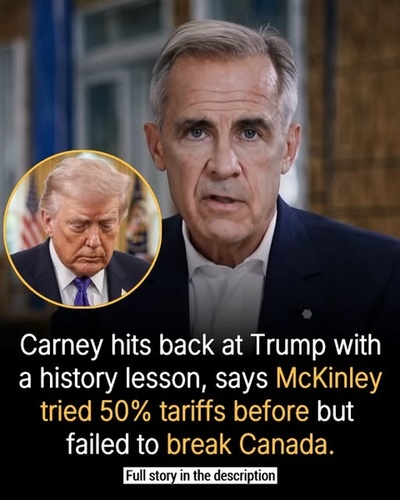
OTTAWA — Canadian Prime Minister Mark Carney is turning to history to push back against President Donald Trump’s escalating trade pressure, warning Canadians that the United States has tried similar tariff tactics before — and that they did not force Canada to surrender its economic independence.
In a national address this week, Carney pointed to the McKinley Tariff of 1890, when the United States sharply increased tariffs on imports, including Canadian goods.
His message was direct: Canada survived the pressure then, and he believes it can withstand Trump's tariff campaign today.
“History offers an important lesson,” Carney said, arguing that the earlier American tariff campaign was intended to increase Canada's dependence on the United States and ultimately encourage annexation. Instead, he said, Canada responded by strengthening its own economy and diversifying its trading relationships.
Carney Points to a 136-Year-Old Tariff Battle
The historical episode Carney referenced dates to 1890, when Republican Congressman William McKinley helped lead the legislation that became known as the McKinley Tariff.
According to the U.S. House of Representatives' historical record, the law raised protective tariff rates to nearly 50% on average for many American products.
Canadian historians have argued that the tariff policy was also connected to a broader debate over Canada's economic relationship with the United States and, at the time, ideas about possible American annexation of Canada.
Carney is now drawing a parallel between that historical confrontation and Trump's modern trade strategy.
His argument is that tariffs can pressure a smaller trading partner in the short term but can also encourage that country to reduce its dependence on the larger economy.
Trump Has Imposed 50% Tariffs on Canadian Goods
The historical comparison comes as the Trump administration has dramatically escalated its trade dispute with Canada.
In July, Trump imposed additional 50% tariffs on certain Canadian imports under Section 338 of the Tariff Act of 1930. The White House said the measures were designed to respond to what it described as discriminatory Canadian trade practices.
After negotiations collapsed in August, Washington proceeded with tariffs covering roughly $20 billion of Canadian goods, according to Reuters.
Canada responded with its own tariffs on approximately $20 billion of U.S. imports, with duties ranging from 15% to 50% on products including steel, agricultural goods, furniture and other manufactured items.
The confrontation has now moved beyond traditional tariff disputes.
On September 8, the Trump administration announced bans on certain Canadian dairy products, motorcycles and most alcoholic beverages entering the United States. The measures are scheduled to take effect September 29.
Carney Says Canada Will Not Be Pushed Into Dependence
Carney has increasingly framed the dispute as more than a fight over individual products.
He has argued that Canada's long-term response should be to reduce its dependence on the United States by expanding trade with Europe, Asia and other international markets.
In an earlier statement, Carney said Canada was already pursuing hundreds of billions of dollars in infrastructure projects and working to expand access to non-U.S. markets. He said Canada would determine its own economic future rather than allowing another country to dictate it.
Reuters reported that Carney's government is also seeking to use the current crisis to accelerate Canada's economic diversification.
More than two-thirds of Canada's exports currently go to the United States, making the American market extremely important to Canadian businesses. But Ottawa says it wants to reduce that dependence over the coming decade.
The Trade War Is Already Affecting Both Countries
The dispute is creating pressure on businesses on both sides of the border.
Canada's retaliatory tariffs have been deliberately targeted at products and industries with political importance in the United States. Reuters noted that some Canadian measures affect sectors in states such as Michigan, Ohio and Wisconsin, where the 2026 midterm elections could be closely contested.
At the same time, American companies and consumers face their own exposure to Canadian retaliation.
The two economies remain deeply integrated, particularly in automobiles, agriculture, energy, manufacturing and other cross-border industries.
That means a prolonged trade war could impose costs on businesses even when the tariffs are aimed primarily at foreign producers.
Trump Also Escalates Pressure Beyond Tariffs
The latest confrontation has become increasingly personal and political.
Trump has threatened Canadian aircraft manufacturer Bombardier, saying the company could lose access to the U.S. market unless it manufactures more aircraft in the United States.
Bombardier has responded by emphasizing the company's extensive American supply chain, including thousands of U.S. suppliers and more than 1,200 workers in Kansas alone.
Trump has also continued using provocative imagery and language about Canada.
Reuters reported that Trump recently shared a map of North America covered by the U.S. flag, including Canada and Mexico, while repeatedly reviving his argument that Canada should become the 51st U.S. state.
The imagery has added another layer of tension to what began primarily as a trade dispute.
Carney Is Now Taking a More Cautious Approach
Despite his forceful historical argument, Carney has recently signaled that Canada may not immediately respond to every new American measure with another round of tariffs.
On September 10, he described Trump's latest measures as “relatively modest” compared with earlier actions and said Ottawa was still assessing their impact.
Carney also stressed that Canada remains open to professional and respectful negotiations with Washington.
That suggests Ottawa may be trying to balance two objectives: demonstrating that Canada will resist American economic pressure while avoiding an uncontrolled escalation that could damage Canadian businesses.
Can History Repeat Itself?
Carney's comparison to the McKinley era is politically powerful, but the economic circumstances today are very different from those of the late 19th century.
The United States and Canada now operate one of the world's most deeply integrated trading relationships, with supply chains crossing the border multiple times before products reach consumers.
The current tariff dispute is also unfolding within the framework of the United States-Mexico-Canada Agreement, which replaced NAFTA and has governed much of North American trade for years.
Nevertheless, Carney's historical argument serves a clear political purpose.
His message is that Canada should not respond to American pressure by becoming more dependent on the United States. Instead, Ottawa wants to use the confrontation as a reason to expand Canada's economic options.
A New Test for the U.S.-Canada Relationship
The dispute now represents one of the most serious economic confrontations between the two longtime allies in decades.
Trump's administration says its tariffs are necessary to protect American businesses and obtain fair treatment for U.S. exporters. Canada argues that Washington's approach threatens a mutually beneficial trading relationship and risks damaging industries in both countries.
For Carney, the lesson from 1890 is straightforward: tariffs may create pressure, but they do not necessarily produce political submission.
Whether that strategy works in 2026 remains uncertain.
But as the trade conflict enters another stage, Canada's prime minister is making clear that Ottawa intends to resist pressure from Washington — and is willing to use America's own history of protectionism as part of the argument.
Comments (0)
Loading comments...
May You Like

Shocking news from Ohio: an unexpected development ahead of Trump's rally

OBAMA STUNS ON INSTAGRAM: MESSAGE MARKING 34-YEAR MILESTONE SPARKS A BUZZ

gfnhgmnghnmfgnbvvvvvvvvv












