
MASSIVE WAR SHOCKER
Trump Says Two Iran Targets Remain — Could One Final Strike Derail the Diplomatic Push?
The president says Washington retains a military option while his advisers keep diplomatic talks alive. What is known, what is disputed, and what comes next.
President Donald Trump has again put Iran's remaining nuclear infrastructure at the center of a high-stakes confrontation, saying the United States still has one or two sites to address even as negotiations aimed at preventing renewed fighting continue.
Speaking to reporters at his Mar-a-Lago estate in Florida on October 31, Trump asserted that previous American military operations had severely weakened Iran's military capabilities. But his remarks made clear that, in his view, Washington's work was not finished.
Photo unavailable on this network: Donald Trump, official presidential portrait.
Trump said the United States could deal with the remaining locations quickly, estimating that any operation could be accomplished in roughly ten minutes. That was a claim about American capabilities and planning, not an announcement that a new strike had been ordered.

The president specifically mentioned Pickaxe Mountain, a suspected underground facility near Iran's established nuclear infrastructure. American and Western observers have raised questions about the site's purpose, while Iranian authorities deny that prohibited nuclear work takes place there.
The distinction between a suspected site and a verified operating weapons facility is essential. Intelligence assessments, public satellite imagery and statements by officials can create serious concerns without establishing the exact activities occurring deep underground.
Photo unavailable on this network: Satellite photograph of the Natanz nuclear complex in Iran.
The latest comments came during an uneasy period following the United States and Israel's earlier military campaign against Iran. Although major attacks had eased, the political and security confrontation remained unresolved.
Trump portrayed Iran as militarily weakened and suggested Washington had little reason to rush into an agreement. That position was designed to emphasize American leverage, but it also placed additional pressure on a fragile diplomatic process.
The president nonetheless described negotiations as continuing. His account reflected a familiar strategy: publicly keep military options on the table while indicating that a negotiated outcome remains possible.
Secretary of State Marco Rubio offered a more measured description of the immediate decision. He said the president had not made a final choice about launching fresh strikes and that the administration remained open to a diplomatic solution.
Photo unavailable on this network: USS Abraham Lincoln aircraft carrier operating at sea.
Those two messages are not necessarily contradictory. Governments frequently discuss potential military action while diplomats continue talks, but the combination can generate confusion about how close either side may be to another confrontation.
Iran responded with warnings of retaliation. Iranian leadership has repeatedly signaled that any renewed American or Israeli attack could produce a wider response, increasing concern about escalation beyond the original targets.
The possible consequences extend far beyond the nuclear dispute. U.S. personnel and allied facilities across the Middle East could face heightened security risks if military operations resume, even if Washington describes an attack as limited.
Shipping is another major source of concern. The Strait of Hormuz connects Persian Gulf energy producers with international markets, and renewed uncertainty in the area can affect shipping insurance, vessel routes and oil-price expectations.
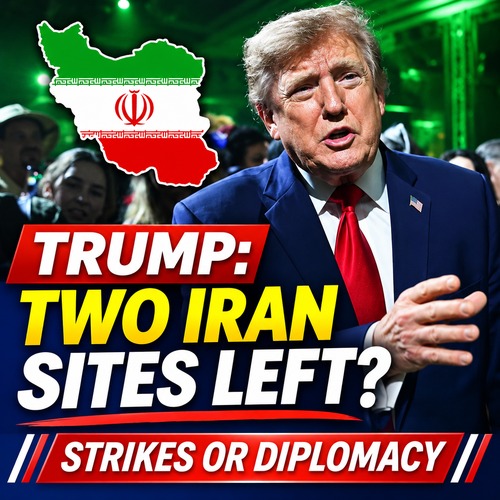
Photo unavailable on this network: Abbas Araghchi, Iran foreign minister.
A strike targeting a small number of sites would not necessarily remain a small conflict. Retaliatory decisions, uncertainty about damage, and domestic political pressure could produce consequences far beyond the initial military objective.
For American policymakers, the central question is whether further force would reduce Iran's capacity to pursue sensitive nuclear work or instead encourage Tehran to harden its position and abandon negotiated restrictions.
For Iranian officials, the choice is equally consequential. Agreeing to inspections or restrictions could create diplomatic openings, while rejecting them may keep economic and military pressure in place.
The immediate political timing also matters. Trump's remarks came just days before the November 3 U.S. midterm elections, making foreign policy and the prospect of another escalation part of an already intense domestic debate.
Photo unavailable on this network: Commercial tankers navigating the Strait of Hormuz.
Still, proximity to an election is not proof that military planning is driven by electoral calculations. Public reporting had not established that Trump had selected a post-election attack date when he made the October 31 comments.
Observers will be watching for more concrete indicators: changes in military deployments, formal diplomatic announcements, independently documented activity near suspect facilities, and any public decision from the White House.
For now, Trump's reference to one or two remaining Iranian sites leaves a clear but unresolved message. The United States is preserving the option of force, Iran is warning of retaliation, and diplomacy has not yet closed the gap between the two governments.
Comments (0)
Loading comments...
May You Like

IOWA EMERGENCY: TOXIC AIR, POLLUTED WATER, 3,000 FAMILIES FORCED OUT AFTER 5-TON WASTE BLAST!

TOLEDO I-75 TRUCK CRASH — POTENTIAL BRIDGE COLLAPSE AND MILLIONS IN DAMAGE!

BANGCHAK REFINERY DISASTER IN THAILAND—120,000 BARRELS A DAY SHUT DOWN, U.S. OIL PRICES SURGE 10%!

Latest Posts










Popular Posts



