
Maxine Waters “Loses Control” on House Floor? What Really Happened Next
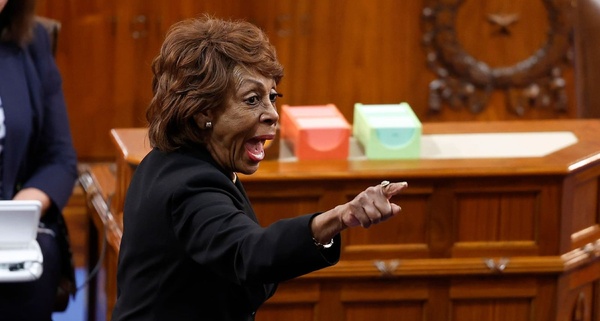
Verdict: MISLEADING — THE CONFRONTATION WAS REAL, BUT THE “LOSES CONTROL” FRAMING IS EXAGGERATED
A viral graphic featuring Rep. Maxine Waters claims she “loses control on the House floor” and promises that “what happened next will shock you.”
There was indeed a heated confrontation involving Waters on the House floor. But the incident happened on November 21, 2025, not as a new September 2026 event, and the official record shows something considerably more procedural than the graphic suggests.
Waters objected after Republican Rep. María Elvira Salazar accused her of having repeatedly visited Cuba and personally known Fidel Castro. Salazar then withdrew the disputed remarks, and the House moved on to vote on a resolution condemning socialism. The resolution passed 285–98, with 86 Democrats voting for it and Waters voting against it.
What actually happened on the House floor?
The confrontation occurred during debate over H.Con.Res. 58, the “Denouncing the Horrors of Socialism” resolution, sponsored by Salazar.
Salazar, a Republican from Florida whose family fled communist Cuba, used part of her floor time to directly address Waters.
She argued that Waters had personally witnessed the Cuban regime and said Waters had traveled to Cuba “dozens of times” to visit Fidel Castro, whom Salazar characterized as Waters' friend.
The remarks became sufficiently contentious that Waters sought parliamentary action.
According to the official Congressional Record, Waters rose and said:
“I move to take the words down.”
The presiding officer recognized her request, and the dispute temporarily interrupted the debate.
That is the crucial point missing from the viral graphic: Waters did not seize control of the House floor, get removed, get censured, or lose her position. She invoked a parliamentary procedure to have Salazar's remarks taken down.
What happened next?
Salazar requested unanimous consent to withdraw the remarks that had violated the House's rules.
The request was accepted, and the words were withdrawn from the congressional record. Salazar then continued her speech, shifting back to her broader argument about socialism and communism.
So the immediate aftermath was not some dramatic collapse of the House.
The debate resumed.
The House then proceeded to the vote on the socialism resolution.
The vote was much bigger than the Waters confrontation
Later that morning, the House passed H.Con.Res. 58 by a vote of:
285–98
There were also two members voting present and 47 members not voting.
The official House Clerk's tally shows that all 199 voting Republicans supported the resolution, while Democrats split sharply:
- 86 Democrats — Yes
- 98 Democrats — No
- 2 Democrats — Present
- 27 Democrats did not vote
Waters herself voted No.
That Democratic split was arguably the bigger political story than the Waters-Salazar exchange.
Why was the socialism resolution controversial?
The measure stated that Congress “denounces socialism in all its forms” and opposes implementing socialist policies in the United States.
Republicans presented it as a statement against an ideology they associated with authoritarian regimes and historical mass repression.
The timing was also politically significant.
The House vote occurred on the same day that then-New York City mayor-elect Zohran Mamdani, who identifies as a democratic socialist, was scheduled to meet President Donald Trump at the White House.
That made the vote part of a broader Republican effort to force Democrats to take a position on socialism.
Why did Waters oppose it?
Waters' own office provides a much different explanation from the viral graphic.
As the top Democrat on the House Financial Services Committee, Waters argued that the resolution was a political distraction from issues such as grocery prices, housing costs and health care.
She also argued that Republicans were using the word “socialism” to attack programs including Social Security, Medicare, Medicaid and the Affordable Care Act.
Her official statement urged Democrats to vote against the resolution.
So Waters' vote against the measure was not a secret or a consequence of the confrontation with Salazar. She had already publicly laid out her opposition to the resolution.
Was Salazar's claim about Waters and Cuba completely invented?
No — but it requires context.
Waters has in fact traveled to Cuba multiple times and met with Fidel Castro. Historical accounts document congressional delegations involving Waters, including visits during which she met Cuban officials and Castro.
Waters has also historically advocated closer U.S.-Cuba relations and criticized the U.S. embargo.
She has spoken positively about Castro in the past. In a 2017 interview with The Nation, Waters recalled seeing Castro at Nelson Mandela's 1994 inauguration and referred to him as a leader she considered a friend.
That makes Salazar's basic assertion that Waters had a relationship with Castro grounded in a real history.
But that does not automatically prove every characterization Salazar made about Waters' views or conduct in Cuba.
The official record also matters: Salazar ultimately withdrew the disputed remarks, meaning those specific words were not left in the Congressional Record.
Did Maxine Waters “lose control”?
That's where the graphic goes too far.
The footage and transcript support describing the exchange as heated and personal.
But “lost control” is an interpretation rather than an objective description.
Waters used a formal House procedure, the presiding officer recognized her, Salazar withdrew the challenged remarks, and the legislative business continued.
There was no:
- arrest,
- removal from the House,
- censure of Waters,
- loss of committee position,
- vote to punish Waters,
- or collapse of the proceedings.
The House simply continued with the debate and ultimately passed the resolution.
And this isn't new breaking news
This is another important problem with the graphic.
The confrontation happened on November 21, 2025.
The House Clerk's official roll-call record dates the vote to that day, and the Congressional Record documents the Waters-Salazar exchange.
As of September 2026, the measure's legislative history shows that it was received in the Senate on December 1, 2025, with no subsequent Senate passage recorded in the congressional calendar material.
In other words, the viral graphic is recycling an old political confrontation and presenting it in the style of a new bombshell.
What the viral graphic gets right — and wrong
What is true
- Maxine Waters and María Elvira Salazar had a heated exchange on the House floor.
- Salazar directly confronted Waters over her past dealings with Cuba and Fidel Castro.
- Waters objected and asked that Salazar's words be taken down.
- Salazar withdrew the disputed remarks.
- The incident temporarily interrupted the debate.
- The House subsequently passed the socialism resolution.
- Waters voted against it.
What's misleading
- “Loses control” — subjective and exaggerated.
- “What happened next will shock you” — clickbait; what happened next was that Salazar withdrew her remarks and debate resumed.
- The graphic makes the incident appear current, when it occurred in November 2025.
- It implies that Waters suffered some major political consequence. She did not.
- The larger political result was actually the passage of the resolution by a wide bipartisan margin.
The bigger political story
The most consequential part of the episode wasn't the shouting match.
It was the 86 Democrats who voted with Republicans.
The resolution passed despite opposition from 98 Democrats, demonstrating that a significant bloc of House Democrats was willing to formally support language condemning socialism — particularly at a moment when Mamdani's election had put democratic socialism at the center of national political debate.
Waters, meanwhile, remained one of the Democratic Party's most prominent progressive voices and continued serving as the ranking Democrat on Financial Services. Her subsequent House activity in 2026 shows no sign that the November confrontation cost her her position.
Bottom line
Maxine Waters did not “lose control” of the House floor in the sense suggested by the viral graphic.
She became involved in a genuinely heated confrontation with María Elvira Salazar during a November 2025 debate over socialism. Waters invoked House procedure to have Salazar's remarks taken down, and Salazar withdrew them. The debate resumed, and the House later passed the socialism resolution 285–98.
The real political fallout was the unusually large Democratic split over the resolution — 86 Democrats supported it while 98 opposed it.
So the graphic takes a real confrontation and wraps it in sensationalized language, while making an old event look like breaking news.
Final verdict: MISLEADING — REAL HOUSE FLOOR CLASH, BUT “LOSES CONTROL” AND “SHOCKING” ARE CLICKBAIT FRAMING.
Comments (0)
Loading comments...
May You Like

Shocking news from Ohio: an unexpected development ahead of Trump's rally

Russian Drone Strikes Kyiv Bridge as German Chancellor Arrives in Ukraine

Obama Steps Back Into the Political Spotlight as Democrats Target Trump’s












