
Melania Trump Deportation Petition Surpasses 13,700 Signatures — But Could the First Lady Actually Be Deported?
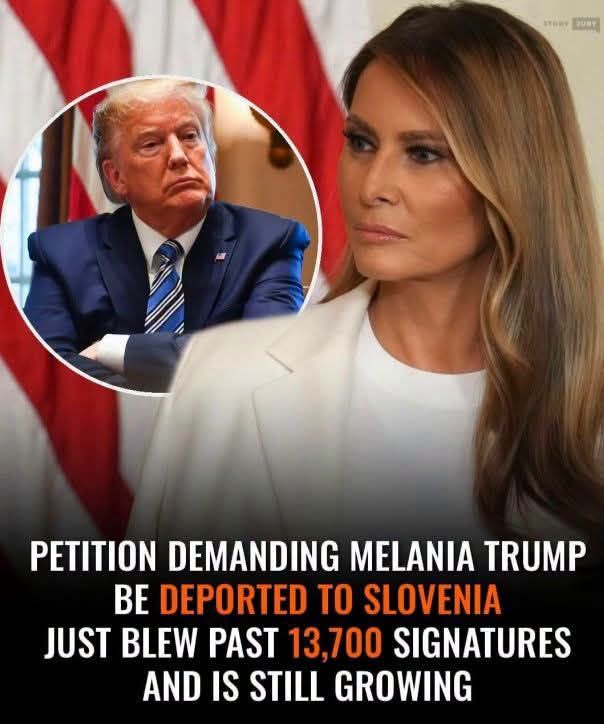
An online petition demanding that First Lady Melania Trump, her parents and her son Barron be deported to Slovenia has attracted renewed attention amid the Trump administration’s aggressive immigration agenda. The campaign has drawn more than 13,700 signatures, turning a provocative political challenge into a wider debate about citizenship, immigration enforcement and whether the president’s own family should be held to the standards his administration advocates.
But there is a crucial distinction between an online petition and an actual legal case. No court has ordered Melania Trump’s deportation, no government agency has announced proceedings to remove her, and the petition itself has no authority to revoke anyone’s citizenship.
The signature figure also needs context: reporting published on November 9, 2025, put the petition at 13,725 signatures, against a stated goal of 15,000. That is a documented snapshot from 2025, not confirmation of the petition’s live total today.
Where did the petition come from?
The petition, hosted on the MoveOn platform, was titled “Deport Melania, Melania's parents and Baron in the first round of deportations!” The spelling of Barron’s name was incorrect in the original title.
Its organizer framed the demand as a challenge to the Trump administration’s immigration policies. The argument was essentially that if the government intended to pursue aggressive immigration enforcement, members of the president’s own family should not be exempt from scrutiny.
The petition also invoked the administration’s efforts to expand the circumstances in which naturalized Americans could face denaturalization — the legal process through which citizenship obtained through naturalization can be revoked.
However, the platform hosting the petition made an important qualification. MoveOn said its volunteers had reviewed the submission and decided not to promote it further, explaining that the petition might not reflect the organization’s members’ values or that members might disagree with its contents. MoveOn also stated that hosting a petition did not mean endorsing it.
Could Melania Trump legally be deported?
The short answer is no — not under ordinary immigration law while she remains a U.S. citizen.
Melania Trump was born in Slovenia on April 26, 1970. She moved to New York in 1996 and became a naturalized U.S. citizen in July 2006. The White House identifies her as the first naturalized U.S. citizen to serve as first lady.
Once someone becomes a U.S. citizen through naturalization, they generally enjoy the same protection against deportation as someone who acquired citizenship at birth. The government cannot simply revoke that status because of political disagreement, a change in immigration policy or a petition demanding removal.
There is, however, a legal process called denaturalization. Under federal law, the government can seek to revoke naturalized citizenship in certain circumstances, including when citizenship was illegally obtained or secured through concealment of a material fact or willful misrepresentation.
That process requires evidence and judicial proceedings. It is not an automatic administrative punishment, and a political petition cannot initiate a successful revocation by itself.
There is no publicly established evidence in the reporting cited here that the government has filed denaturalization proceedings against Melania Trump.
What about the controversy surrounding her 1996 modeling visa?
One reason Melania Trump’s immigration history has attracted attention is the scrutiny surrounding her early modeling career in the United States.
She arrived in New York in 1996 and worked in the modeling industry before obtaining permanent residency in 2001. In 2016, an Associated Press investigation examined whether she had performed paid modeling work before receiving authorization to work in the United States.
The controversy became particularly prominent in 2018, when reports discussed her later receipt of an EB-1 immigrant visa, commonly associated with people who demonstrate extraordinary ability in their professional fields.
The distinction is important: questions about whether someone complied with the conditions of an earlier visa are not automatically proof that the person obtained citizenship through fraud. A denaturalization case would require the government to establish the relevant legal grounds and demonstrate that the alleged conduct was material to the naturalization process.
No publicly established finding cited in the reporting here shows that Melania Trump committed immigration fraud or that her citizenship was improperly granted. The history has generated scrutiny, but scrutiny is not a legal judgment.
Why Barron Trump cannot simply be deported
The petition also demanded the removal of Barron Trump, suggesting that his mother’s foreign birth somehow undermined his citizenship.
That argument conflicts with the constitutional rules governing birthright citizenship.
Barron was born in New York City on March 20, 2006. Under the Citizenship Clause of the 14th Amendment, people born in the United States and subject to its jurisdiction are generally U.S. citizens at birth, regardless of whether their parents were U.S. citizens.
The fact that Melania had not yet completed her naturalization process when Barron was born does not change that principle. His father, Donald Trump, was also a U.S. citizen at the time.
FactCheck.org has examined this specific claim and concluded that Barron’s citizenship is not invalidated by his mother’s immigration status when he was born.
The petition also used the phrase “anchor baby,” a politically charged and derogatory expression. It suggested that Barron should be deported because his maternal grandmother was born outside the United States. There is no general U.S. citizenship rule requiring a person's grandmother to have been born in the country.
What happened to Melania’s parents?
The petition also named Melania’s parents, Viktor and Amalija Knavs, who were born in Slovenia.
Their immigration history became politically significant because they obtained U.S. citizenship through a family-based immigration process after their daughter became a citizen.
The couple became naturalized U.S. citizens in 2018. Their route to citizenship was widely reported as an example of family-based immigration, sometimes described by critics as “chain migration” — a system Donald Trump has repeatedly criticized.
There is an important factual update concerning the petition’s demand: Amalija Knavs died in January 2024, aged 78. She therefore cannot be deported. Viktor Knavs became a U.S. citizen alongside his wife and has appeared publicly with the Trump family.
The political contradiction behind the campaign
The petition’s political argument rests on an apparent contradiction: Donald Trump has repeatedly advocated tougher immigration enforcement and criticized family-based immigration, while his wife and her parents obtained citizenship through legal immigration processes.
That contrast has become a recurring subject of criticism from opponents of the administration.
But the legal distinction matters. A person who obtained citizenship through a lawful immigration process does not become deportable simply because a political movement objects to the policy that allowed them to immigrate.
Likewise, the administration’s effort to prioritize certain denaturalization cases does not mean that every naturalized citizen is at risk of losing citizenship. The Department of Justice’s 2025 policy guidance identified categories of cases for attention, including allegations of fraud and certain serious misconduct. It did not establish a blanket rule allowing the government to strip citizenship from people simply because they were born abroad.
The debate therefore raises two separate questions: whether the administration’s immigration policies are fair and consistent, and whether the specific members of the Trump family named in the petition have any legal basis for deportation. The first is a political argument; the second must be answered through citizenship law and individual evidence.
What is confirmed — and what remains misleading?
|
Viral claim |
|---|
What the available evidence shows
The petition passed 13,700 signatures
Confirmed in reporting dated November 9, 2025; the current total has not been verified
A court ordered Melania’s deportation
False; no such ruling was identified
Melania is a U.S. citizen
Confirmed; she naturalized in July 2006
Barron could be deported because his mother was born abroad
False; he was born in New York and is a U.S. citizen
Melania’s parents were immigrants who became citizens
Confirmed; they naturalized in 2018
The petition can revoke citizenship
False; it has no legal authority to do so
Melania’s 1996 immigration history proves fraud
Not established by the available evidence
A viral petition, but no deportation case
The petition demanding that Melania Trump and members of her family be sent back to Slovenia has become a striking political symbol in the debate over immigration enforcement. Its supporters present it as a challenge to what they see as unequal treatment, while critics can reasonably question whether a petition targeting a family is a meaningful way to debate national immigration policy.
But the legal reality is much less dramatic than the viral headline suggests. Melania Trump is a naturalized American citizen. Barron Trump is a U.S. citizen by birth. Her parents also became U.S. citizens, and her mother has since died.
The government cannot deport these individuals simply because an online petition has collected thousands of signatures. Any attempt to revoke naturalized citizenship would require a legally valid case, evidence and due process.
The larger question is whether the Trump administration will apply its immigration principles consistently — including when those principles are examined against the president’s own family history. That is a legitimate subject for political scrutiny. It should not, however, be confused with an actual deportation order or a proven legal case against the first family.
Comments (0)
Loading comments...
May You Like

IRAN CLAIMS IT FIRED AT U.S. WARPLANES — WAS AN AMERICAN F-16 FORCED TO RETREAT?

TRUMP'S BIGGEST THANKSGIVING “PARDON”? WHY IS HE BACKING NVIDIA'S JENSEN HUANG?

BANGCHAK REFINERY DISASTER IN THAILAND—120,000 BARRELS A DAY SHUT DOWN, U.S. OIL PRICES SURGE 10%!












