
Michelle Wu’s Immigration Remark RESURFACES as America’s Border and Asylum Battle Intensifies
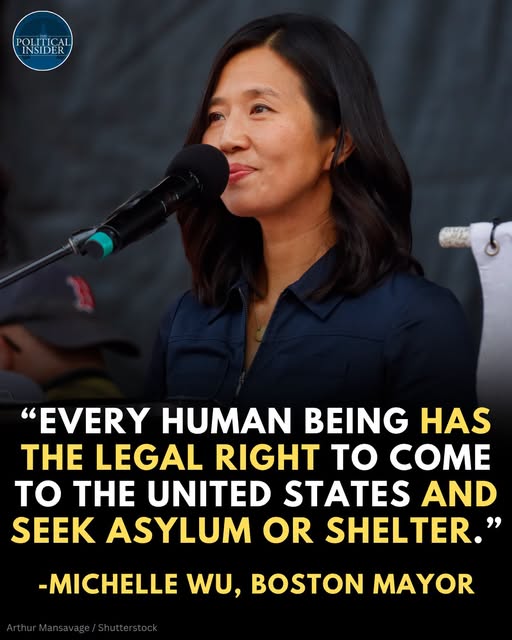
BOSTON — A years-old comment from Boston Mayor Michelle Wu is circulating again online, with a graphic quoting her as saying that “every human being has the legal right to come to the United States and seek asylum or shelter.”
The quote is genuine, but the viral graphic leaves out important context — including when Wu made the statement and what she said immediately afterward.
Wu made the remarks during a discussion about migrants and Boston’s growing shelter needs. In the fuller response, she was discussing the legal process for people seeking asylum and the delays that can leave migrants waiting for decisions and work authorization.
The resurfacing of the comment comes as Wu remains one of the country's most prominent Democratic mayors opposing the Trump administration's immigration-enforcement policies.
What Michelle Wu Actually Said
In the interview, Wu said:
“Every person, every human being has the legal right to come to the United States and seek asylum or shelter.”
She immediately continued by explaining that asylum and immigration policies have existed for many years and that people seeking protection can become stuck while their cases are processed.
Wu said migrants were looking to work, contribute and establish safe lives for their families, while cities were dealing with the consequences of delays in the federal immigration system.
That fuller context is significant because the viral graphic presents the statement as though Wu were declaring that any person automatically has an unrestricted legal right to enter the United States.
That is not what U.S. immigration law establishes.
Seeking Asylum Is Not the Same as Having an Automatic Right to Enter
Under U.S. immigration law, certain people who are physically present in the United States or arrive at the country can apply for asylum, subject to statutory requirements and exceptions.
But the ability to seek asylum does not mean that every person in the world has an unconditional legal right to enter the United States or remain there permanently.
An asylum application is a legal process. Applicants must establish that they meet the requirements for protection, and unsuccessful applicants can ultimately be ordered removed.
That distinction is particularly important when evaluating Wu's wording.
Her statement referred to the right to seek asylum or shelter, while critics have interpreted the sentence as a claim of an unrestricted right of entry.
Wu Has Long Defended Boston’s Approach to Immigration
The controversy is consistent with Wu's broader political position.
Boston has maintained policies limiting the city's involvement in federal immigration enforcement while continuing to cooperate with state and federal authorities on ordinary criminal matters.
Wu has repeatedly argued that immigration enforcement is primarily a federal responsibility.
In testimony before the House Committee on Oversight in March 2025, Wu said Massachusetts law and Boston's Trust Act make immigration enforcement the responsibility of federal authorities. She also argued that local police need residents — regardless of immigration status — to feel comfortable reporting crimes and calling 911.
Her central argument has been that cooperation between immigrant communities and local police is an important component of public safety.
Wu Became a Major Target of the Trump Administration
Wu's position has put her in direct conflict with President Donald Trump's immigration agenda.
During her 2025 congressional testimony, Wu sharply criticized the administration's immigration crackdown, saying it was creating fear among Boston residents.
She emphasized that immigrants make up a substantial part of the city's population and argued that Boston's immigrant communities contribute to the city's economy and civic life.
The confrontation did not end with the congressional hearing.
Wu has continued to criticize federal immigration operations in Boston and Massachusetts, while federal officials and immigration-enforcement supporters have accused sanctuary-city leaders of making it harder for ICE to remove people who are subject to deportation.
Boston’s Migrant Shelter Crisis Added to the Debate
Wu's original comments came amid a period when Massachusetts was struggling to accommodate a large influx of migrant families.
In early 2024, Massachusetts officials faced growing pressure to find emergency shelter for migrant families, with some people sleeping at Boston's Logan International Airport.
Boston and the state subsequently expanded efforts to provide temporary shelter and other services.
Wu's office had also sought federal funding to support services for migrants released from Department of Homeland Security custody, including shelter, food, transportation, medical care and case management.
That background helps explain why Wu was discussing both asylum law and the practical consequences of the federal processing system.
Wu’s Position Has Hardened as ICE Enforcement Expanded
Wu's opposition to the Trump administration has continued as federal immigration enforcement intensified.
In 2025, she criticized ICE's operations in the Boston area and called for greater transparency regarding people being detained. She argued that aggressive enforcement could undermine trust between immigrant communities and local police.
In 2026, the conflict has continued.
Wu has opposed efforts by federal immigration authorities to expand their operations in Boston and has urged local businesses and property owners to consider the public-safety consequences of cooperating with ICE operations.
The dispute has made Wu one of the most recognizable Democratic voices in the national sanctuary-city debate.
Republicans See the Quote Differently
Conservative critics have repeatedly circulated Wu's statement as evidence that Democratic leaders support effectively unrestricted immigration.
The argument is straightforward: if every person has a “legal right” to come to the United States, critics contend, then immigration restrictions would have little meaning.
But that interpretation leaves out the second half of Wu's answer.
Her comments specifically moved into the asylum process, including the waiting period for decisions and work authorization.
The legal distinction between applying for protection and being legally entitled to enter and remain in the United States is therefore central to understanding the controversy.
The Viral Graphic Is Based on a Real Quote — But It Is Misleading Without Context
The graphic circulating online attributes the statement directly to Wu.
What is confirmed:
- Wu did make the quoted statement.
- The statement dates back to an earlier discussion of immigration and asylum, rather than being a new announcement.
- Wu was discussing migrants seeking asylum or shelter and the lengthy federal processing system.
- Wu has consistently defended Boston's immigrant-friendly policies and opposed aggressive federal immigration enforcement.
What the graphic leaves out:
The image does not provide the date of the statement.
It also removes Wu's explanation that people seeking asylum can face lengthy processing and delays in obtaining authorization to work.
Most importantly, the graphic can give readers the impression that Wu was asserting an unconditional right for anyone to enter the United States. U.S. immigration law does not provide such a blanket right.
Why the Quote Is Resurfacing Now
The timing is politically significant.
Immigration remains one of the most divisive issues in American politics, and the Trump administration has made expanded deportation and immigration enforcement a central priority.
At the same time, Democratic mayors in cities such as Boston have defended policies designed to maintain cooperation between immigrant communities and local police.
That has produced a fundamental disagreement over the role of local governments.
The Trump administration argues that cities should cooperate more fully with federal immigration authorities.
Wu and other sanctuary-city leaders argue that local police should focus on criminal law enforcement and that immigrant residents should not be afraid to contact police because of their immigration status.
The Bottom Line
Michelle Wu did make the statement shown in the viral graphic, but it is not a new declaration that everyone in the world has an unrestricted legal right to enter the United States.
The original remarks were part of a broader discussion about asylum, migrant shelter and delays in the federal immigration process.
Wu's broader record makes her position clear: she supports Boston's role as a welcoming city for immigrants while arguing that immigration enforcement should remain primarily a federal responsibility.
The controversy ultimately comes down to a crucial legal distinction:
People who qualify under U.S. law may have the right to seek asylum — but seeking asylum is not the same thing as having an automatic right to enter or remain in the United States.
That distinction is largely absent from the viral graphic, which is why the image needs additional context before being treated as a complete representation of Wu's position.
Comments (0)
Loading comments...
May You Like

Obama Steps Back Into the Political Spotlight as Democrats Target Trump’s

OBAMA STUNS ON INSTAGRAM: MESSAGE MARKING 34-YEAR MILESTONE SPARKS A BUZZ

gfnhgmnghnmfgnbvvvvvvvvv












