Mike Johnson Claimed Trump Was an FBI Informant Against Epstein — Then Walked It Back
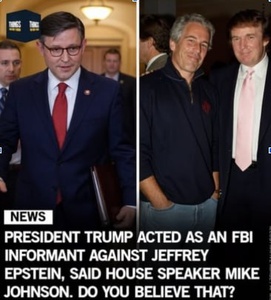
A viral graphic circulating on social media shows House Speaker Mike Johnson and a photo of President Donald Trump with Jeffrey Epstein, with the headline: "President Trump acted as an FBI informant against Jeffrey Epstein, said House Speaker Mike Johnson. Do you believe that?" The graphic cites PolitiFact as its source. The claim is real — Johnson said it. But within days, he clarified his remark, and fact-checkers found the known timeline does not support the description.
The viral graphic features three distinct elements: a photo of House Speaker Mike Johnson speaking to reporters, a photo of Trump and Epstein together, and the headline attributed to PolitiFact . The image is designed to provoke a strong reaction — either belief or disbelief — but the full context of what Johnson actually said, and what he meant, is more nuanced.
What Johnson Said
In September 2025, House Speaker Mike Johnson told reporters that President Trump had been an "FBI informant" who helped bring down Jeffrey Epstein . The remark was made during a discussion about the Epstein investigation and Trump's relationship with the disgraced financier.
The quote was striking — and immediately picked up by media outlets and social media users. If Trump had been an FBI informant against Epstein, it would represent a significant and previously unknown chapter in the long-running saga.
What Johnson Actually Meant
Within days, Johnson and his office walked back the description. According to PolitiFact and CNN, Johnson clarified that he was referring to comments from Brad Edwards, an attorney for Epstein survivors .
Edwards had said that Trump spoke with him in 2009 and provided information that helped his civil investigation into Epstein. Crucially, Edwards did not say Trump worked for the FBI, served as a confidential informant, or helped federal agents bring down Epstein .
The distinction is significant. Providing information to a private attorney during a civil lawsuit is not the same as being an FBI informant. PolitiFact noted that the known timeline of the FBI investigation does not support Johnson's original description .
The Attorney's Contradictory Role
The situation became more complicated because Edwards himself had publicly criticized Trump just days before Johnson's remark. Edwards appeared outside the Capitol alongside women accusing Epstein and criticized what he described as Trump's reversal on their cause, saying Trump seemed to have changed his position after someone influenced him .
Days later, Edwards appeared in a different context — creating a notable contrast between his public criticism and his subsequent testimony. The White House declined to comment on the matter, according to reports .
This contradiction has fueled further debate about the reliability of the accounts being shared and the motivations of those involved.
The Fact-Check Verdict
PolitiFact examined Johnson's claim and found that the known FBI timeline did not support the informant description . The fact-checking outlet concluded that turning "a vague account of cooperation into a heroic law enforcement story only creates more confusion around a case already buried beneath rumor, political spin, and incomplete disclosures" .
The verdict was clear: Johnson's original statement was not supported by the evidence he cited.
Why the Graphic Still Spreads
Despite the walk-back and the fact-check, the viral graphic continues to circulate. The reason is simple: it taps into a powerful narrative. For some, the idea that Trump helped take down Epstein is appealing — it casts the president as a hero in a story where clear heroes are hard to find. For others, the claim is evidence of political spin and deflection.
The graphic's question — "Do you believe that?" — invites readers to choose a side based on their priors rather than the evidence.
Comments (0)
Loading comments...
May You Like
Shocking news from Ohio: an unexpected development ahead of Trump's rally
TRUMP’S OHIO WARNING UNDER THE SPOTLIGHT
South Korea–Ukraine Rift Deepens Over North Korean POW Transfer as PURL Draws New Scrutiny