Mike Johnson Said Trump Was an 'FBI Informant' Against Epstein — Then Walked It Back. Here's What Actually Happened
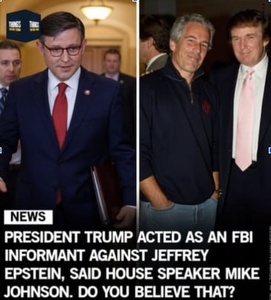
House Speaker Mike Johnson made headlines in September 2025 when he told reporters that President Donald Trump had been an "FBI informant" working to take down Jeffrey Epstein. Three days later, his office quietly walked the claim back. The episode offers a revealing look at how a single off-the-cuff remark can spiral into a full-blown media cycle — and what the public record actually shows about Trump's relationship with the disgraced financier.
WASHINGTON – It was the kind of statement that stops a press gaggle cold.
On September 5, 2025, House Speaker Mike Johnson was walking through the Capitol when a reporter asked about President Trump's past association with Jeffrey Epstein. Johnson, a Louisiana Republican and one of Trump's closest allies on Capitol Hill, didn't hesitate.
"He was an FBI informant to try to take this stuff down," Johnson said .
The comment was captured on camera and spread rapidly. MSNBC, Rolling Stone, The Daily Beast, and The Independent all reported on it . The term "informant" carries specific connotations — someone who provides information to authorities about criminal activity, often in exchange for leniency or immunity. Applied to a sitting president, it was a startling claim.
There was just one problem: there is no public record confirming it ever happened.
The Claim and the Context
Johnson's remark came during a broader defense of Trump against criticism over his relationship with Epstein. The speaker was pushing back against a discharge petition led by Rep. Thomas Massie (R-Ky.) aimed at forcing the release of the so-called Epstein files. Johnson dismissed the effort as "totally unfounded" and said the petition was "mooted" and "not necessary" .
The context mattered. Just days earlier, a group of Epstein victims' attorneys had held a press conference promoting the Epstein Files Transparency Act. During that event, attorney Brad Edwards — who represented several of Epstein's victims — said he had spoken to Trump in 2009, and that Trump "told me things that were helping our investigation" .
That was the kernel Johnson appeared to be referencing. But "helping an investigation" and being an "FBI informant" are not the same thing.
The Walk-Back
Three days later, Johnson's office issued a clarification.
"The Speaker is reiterating what the victims' attorney said, which is that Donald Trump — who kicked Epstein out of Mar-a-Lago — was the only one more than a decade ago willing to help prosecutors expose Epstein for being a disgusting child predator" .
Notably, the statement did not repeat the word "informant." It also did not explain why Johnson had used the term in the first place.
When asked directly about the discrepancy, Johnson later said he wasn't sure if he had used the right phrase, adding that Trump was "never a hindrance to the Epstein investigation" .
PolitiFact examined the timeline and found that Edwards' account — that Trump offered help in 2009 — did not line up with what is known about FBI investigations into Epstein at that time . The bureau's known investigative activity around Epstein had largely concluded by the late 2000s, before the 2009 conversation Edwards described.
What the Documents Actually Show
The walk-back did little to settle the broader questions about Trump's relationship with Epstein. Those questions intensified in December 2025, when the Justice Department released a new trove of documents tied to the Epstein case.
The release revealed several details that sharpened scrutiny on Trump's past association with Epstein :
Travel records. An internal January 2020 email from a New York prosecutor stated that flight records showed Trump took eight trips on Epstein's private jet between 1993 and 1996 — more than investigators had previously been aware of. Ghislaine Maxwell, Epstein's convicted co-conspirator, was aboard at least four of those flights. One flight listed only three passengers: Epstein, Trump, and an unidentified 20-year-old whose name was redacted .
A subpoena to Mar-a-Lago. Prosecutors issued a subpoena to Trump's south Florida club in November 2021, seeking records relevant to Maxwell's case. A letter on Mar-a-Lago letterhead dated February 2015 indicated the club did not have the requested employment records from 1999 to 2001 .
A photo reference. An email reviewing data from Steve Bannon's cellphone mentioned finding an "image of Trump and Ghislaine Maxwell." The photo itself was redacted from the release .
A disputed letter. A handwritten letter purportedly from Epstein to Larry Nassar referenced Trump. The Justice Department later stated the letter was fake — the postmark was three days after Epstein's death, the return address didn't match the jail, and the handwriting didn't appear to match Epstein's .
The documents also included a summary of a 2019 FBI interview with a Palm Beach police chief, in which Trump was described as calling the police chief in 2006 to say Epstein was a problem and that "everyone has known he's been doing this" .
Trump has consistently denied any knowledge of Epstein's crimes and says he broke off ties in the early 2000s, before Epstein's plea deal. He has denied ever flying on Epstein's plane, though flight records contradict that claim .
Comments (0)
Loading comments...
May You Like
TRUMP HIT WITH 26 ARTICLES OF IMPEACHMENT

Russian Drone Strikes Kyiv Bridge as German Chancellor Arrives in Ukraine
Jack Smith Defends His Integrity as Trump Investigations Face Renewed Political Firestorm