
Mike Johnson Said Trump Was an ‘FBI Informant’ Against Epstein — Then Walked It Back
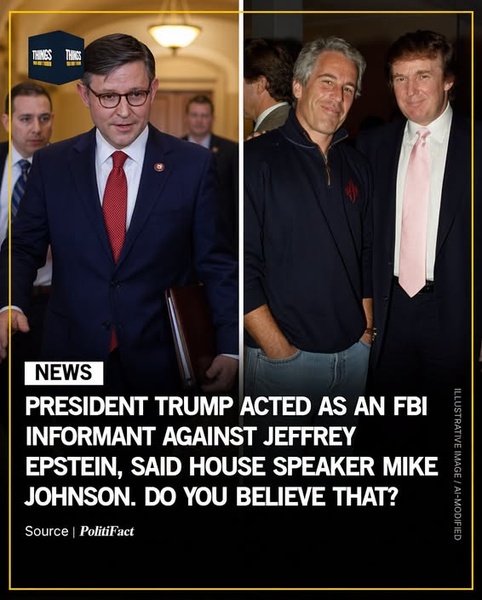

The House speaker’s striking claim about Donald Trump and Jeffrey Epstein quickly generated headlines, but subsequent clarifications, White House denials and a review of the timeline painted a considerably more complicated picture.
House Speaker Mike Johnson triggered national controversy in September 2025 after saying President Donald Trump had acted as an FBI informant against Jeffrey Epstein, a claim his office soon clarified.
Johnson made the remark while defending Trump against criticism over the administration’s handling of Epstein-related records, telling reporters that Trump had tried to help bring the convicted sex offender down.
The wording immediately drew attention because describing someone as an “FBI informant” suggests a formal relationship with federal investigators, something no publicly available evidence has established in Trump’s case.
Within days, Johnson backed away from that characterization, acknowledging that he might not have used the correct term and saying he was referring to accounts from attorneys representing Epstein’s victims.
Johnson later explained that he meant Trump had been willing to assist people investigating Epstein, not that he had verified Trump held any official status as an FBI confidential informant.
The White House went further, directly denying the claim. Press Secretary Karoline Leavitt said it was not true that Trump had served as an FBI informant in the Epstein investigation.
Johnson’s clarification appeared to draw heavily from comments by attorney Brad Edwards, who represented Epstein victims and has publicly described receiving useful information from Trump during a 2009 conversation.
Edwards has said Trump was willing to speak with him and provided information that helped his investigation, but he did not describe Trump as a formal FBI source or confidential informant.
That distinction is central to evaluating the viral claim. Cooperation with a private attorney or law-enforcement inquiry is not automatically equivalent to being formally registered or used as an FBI informant.
PolitiFact examined the timeline and found that Johnson’s initial wording did not align cleanly with what is publicly known about the FBI’s investigations of Epstein and Trump’s reported 2009 assistance.
Epstein had already faced a major Florida investigation years earlier, ultimately pleading guilty in 2008 to state charges involving prostitution and a minor under a controversial non-prosecution agreement.
Trump and Epstein were socially acquainted during the 1990s and early 2000s, and photographs and video documented them at social events before their relationship reportedly ended sometime in the mid-2000s.
Trump has said he later barred Epstein from Mar-a-Lago, although public reporting has offered differing accounts about exactly when the relationship ended and what event caused their falling-out.
The controversy emerged amid growing bipartisan pressure on federal authorities to disclose more Epstein-related material, including investigative records sought by lawmakers, survivors and members of the public.
At the time, Representatives Thomas Massie and Ro Khanna were pushing legislation designed to compel broader release of Justice Department records, while Johnson argued other congressional disclosure efforts were already underway.
The political stakes were unusually high because Epstein’s crimes, elite social connections and death in federal custody had generated years of public distrust, speculation and persistent conspiracy theories.
Trump has repeatedly denied wrongdoing related to Epstein. Being mentioned in Epstein-related documents, photographs or social records does not by itself establish participation in Epstein’s criminal activity or knowledge of specific crimes.
Johnson’s remarks therefore created two separate questions: whether Trump ever assisted efforts involving Epstein, and whether that assistance amounted to serving as an FBI informant in any formal sense.
Available reporting supports the narrower claim that Trump provided information considered helpful by an attorney for Epstein victims, while the broader assertion of a formal FBI-informant role remains unverified.
For readers encountering the claim in viral graphics today, the most accurate conclusion is that Johnson did use the phrase, then publicly retreated from it, and the White House denied it.
Comments (0)
Loading comments...
May You Like
Jack Smith Defends His Integrity as Trump Investigations Face Renewed Political Firestorm

South Korea–Ukraine Rift Deepens Over North Korean POW Transfer as PURL Draws New Scrutiny














