
Mr. Lavrov warns of a "very short" war with Europe; tensions are rising across the continent.
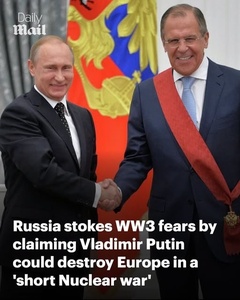
UNITED NATIONS — Russian Foreign Minister Sergei Lavrov has warned that a conflict between Russia and Europe could be “very short” if European countries attacked Russia, intensifying an already tense confrontation over Ukraine.
Lavrov’s Warning
Speaking in Yekaterinburg on September 16, Lavrov said Russia had no intention of attacking Europe but would respond differently if European countries initiated hostilities against Russia.
The comments were later amplified by reports highlighting the possibility of nuclear escalation, although Lavrov’s publicly documented remarks described the hypothetical conflict as short without explicitly announcing that Russia would use nuclear weapons.
The Daily Mail subsequently portrayed the remarks as a warning that Russia could destroy Europe in a short nuclear conflict, contributing to renewed discussion about the risks of escalation.
Lavrov has repeatedly accused European governments of preparing for confrontation with Moscow, while European officials have increasingly criticized Russia over its military campaign against Ukraine and alleged hybrid operations.
A Sharp Disagreement Over Who Is Escalating
The Russian foreign minister has argued that European military preparations and continued support for Ukraine could eventually create conditions for a direct confrontation between Russia and European states.
Germany, however, has accused Moscow of escalating tensions through what Berlin describes as hybrid attacks against countries supporting Ukraine, including alleged sabotage and drone-related incidents.
German Foreign Minister Johann Wadephul said at the United Nations that Russia’s hybrid attacks against countries supporting Ukraine and international law had reached a “new level.”
Wadephul later met Lavrov in New York, marking the first bilateral meeting between the German and Russian foreign ministers since Russia launched its full-scale invasion of Ukraine in 2022.
The German minister said the discussion was intense and that the two sides remained far apart on major issues, but argued that maintaining diplomatic communication remained necessary.
Europe Faces Growing Security Concerns
European governments have increased attention to Russian drone incursions, cyberattacks and suspected sabotage as the war in Ukraine continues into its fifth year.
Reuters reported that European officials viewed these activities as an expanding hybrid campaign intended to undermine support for Ukraine and test Western governments’ responses.
Recent incidents have included airspace violations and an alleged attempted drone attack near Leipzig/Halle Airport in Germany, which Berlin has attributed to Russia.
Russia has denied accusations that it is conducting sabotage operations against NATO countries, while European governments continue assessing how to respond without triggering a broader military confrontation.
Putin’s Different Message
President Vladimir Putin has publicly rejected suggestions that Russia is preparing to attack Europe, creating an important distinction between Moscow’s official position and the warnings issued by Lavrov.
On September 25, Putin said Russia was not preparing for military conflict with Europe and maintained that Moscow had no plans for such a confrontation.
That statement came shortly after Lavrov’s repeated warnings about the consequences of a hypothetical European attack, highlighting the conditional nature of Russia’s public threats.
The Kremlin’s messaging therefore combines assurances that Russia does not seek direct war with Europe alongside warnings that Moscow would respond forcefully if it believed Russia itself had been attacked.
NATO Watches the Situation
NATO has also acknowledged the growing number of hybrid incidents while emphasizing that the alliance has measures designed to respond to threats against member states.
NATO Secretary General Mark Rutte said the alliance was prepared for hybrid attacks and urged European countries to remain calm while strengthening their defensive capabilities.
Reuters reported separately that NATO was increasing intelligence-sharing following a series of incidents apparently connected to Russia, while officials said there was no evidence of an imminent Russian attack on NATO.
Estonian Foreign Minister Margus Tsahkna similarly told Reuters that European governments should distinguish between Russia’s hybrid activities and preparations for an immediate conventional attack against NATO.
The Nuclear Dimension
Russia and the United States remain the world’s two largest nuclear powers, making any direct confrontation between Moscow and NATO particularly consequential for international security.
However, Lavrov’s latest remarks do not establish that Russia has decided to use nuclear weapons against Europe, and the reported “nuclear war” framing comes primarily from media interpretation of his warning.
The immediate challenge for European governments is therefore managing heightened security risks while preventing rhetoric, military incidents or hybrid operations from escalating into a direct Russia-NATO confrontation.
What Happens Next?
The war in Ukraine remains the central source of tension between Russia and Europe, while diplomatic efforts continue alongside military operations and increasingly frequent accusations of hybrid warfare.
For now, there is no confirmed evidence of an imminent Russian decision to launch a conventional attack against NATO, although European governments are strengthening defenses and monitoring potential threats.
Lavrov’s warning nevertheless illustrates how quickly the language surrounding the Ukraine conflict can move from conventional warfare toward discussions of a much broader confrontation.
The coming months will depend heavily on developments in Ukraine, European military policy, Russian-Western diplomacy and whether ongoing hybrid incidents remain below the threshold of direct armed conflict.
Comments (0)
Loading comments...
May You Like

South Korea–Ukraine Rift Deepens Over North Korean POW Transfer as PURL Draws New Scrutiny
TRUMP HIT WITH 26 ARTICLES OF IMPEACHMENT
OBAMA STEPS BACK INTO THE POLITICAL SPOTLIGHT














