
Mr. Trump called the figure of 278,000 an alarming systemic failure
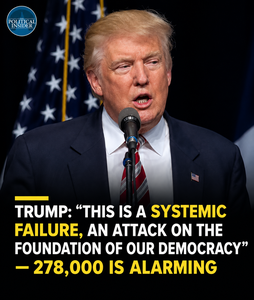
WASHINGTON — President Donald Trump has renewed his demand for congressional action on election rules after the White House said a federal review identified approximately 278,000 noncitizens on voter rolls.
The figure has become central to Trump’s argument for the SAVE America Act, legislation that would require documentary proof of U.S. citizenship for federal voter registration and photo identification when voting.
However, the number does not establish that 278,000 noncitizens illegally voted in federal elections. The distinction between registration records and ballots actually cast is central to the controversy.
The 278,000 Figure
The White House says a Department of Homeland Security review identified approximately 278,000 people it classified as noncitizens who appeared on voter-registration records in four states that cooperated with federal requests.
The administration argues that the figure could be substantially higher because, according to the White House, other states declined to provide comparable voter-file information.
That assertion has been challenged by election experts and independent analyses, which emphasize that appearing on a voter roll does not necessarily mean someone voted illegally.
Reuters reported in July that investigations into alleged noncitizen voting have produced far fewer confirmed cases than the administration’s broader claims about widespread illegal voting suggest.


Registration Is Not the Same as Voting
Federal law already prohibits noncitizens from voting in federal elections, meaning the SAVE America Act would not create the basic prohibition against noncitizen voting.
The administration instead argues that stronger documentation requirements would make it easier to prevent ineligible registrations before they reach election officials.
Trump has repeatedly linked the issue to election security, saying Congress should require citizenship verification and identification procedures for federal elections.
The White House maintains that its 278,000 figure demonstrates weaknesses in existing voter-registration systems, while critics argue that database matches can produce false positives.
A person identified as a potential noncitizen through government databases may still be a U.S. citizen whose records contain outdated, incomplete or mismatched information.
What the SAVE America Act Would Do
The SAVE America Act would amend federal election law to require documentary proof of U.S. citizenship when registering to vote in federal elections.
The legislation also includes a requirement for voters to present photo identification when casting ballots in federal elections, making it broader than citizenship verification alone.
Republican lawmakers supporting the bill argue that citizenship and identity requirements would strengthen election administration and prevent people who are legally ineligible from participating.
Democratic lawmakers and voting-rights organizations have raised concerns that documentation requirements could create additional obstacles for eligible citizens who lack passports, birth certificates or other accepted documents.
The Brennan Center has estimated that roughly 21 million eligible American citizens may lack readily available documents that could be used to satisfy some proof-of-citizenship requirements.


Senate Has Not Passed the Measure
Despite Trump’s repeated demands, the SAVE America Act has not become federal law, and the Senate has not secured enough votes to overcome the chamber’s legislative hurdles.
A related Senate vote on a standalone photo-identification bill, S. 5271, failed to invoke cloture on August 8, with senators voting 52-46.
The Senate subsequently adjourned for its August recess without advancing Trump’s broader voting legislation, despite pressure from the president and Republican leaders.
The failed vote demonstrated the difficulty of moving the administration’s preferred election changes through a Senate where legislation generally requires 60 votes to overcome a filibuster.
Trump has also urged Senate Republicans to reconsider the chamber’s filibuster rules, but changing those rules would itself require significant political support among senators.
The Legal and Data Questions
The controversy extends beyond Congress because federal and state governments are separately conducting investigations into voter-registration records and alleged noncitizen voting.
The Justice Department and Department of Homeland Security have pursued voter-roll investigations, while several states have faced federal pressure to provide registration data.
Some states have also adopted their own proof-of-citizenship requirements, creating separate legal disputes over how federal election law interacts with state-administered registration systems.
Meanwhile, courts are considering challenges involving federal efforts to obtain and compare voter information, adding another layer to the national dispute over election administration.
The central factual question remains important: identifying someone as a potential noncitizen on a voter roll is different from establishing that the person knowingly registered illegally or cast a ballot.
What Comes Next?
Trump continues pressing Republicans in Congress to advance the SAVE America Act, while supporters and opponents remain divided over how citizenship should be verified before federal elections.
The White House is using the 278,000 figure as evidence for stronger verification, but independent reporting indicates that the figure should not be interpreted as 278,000 confirmed illegal voters.
As the 2026 midterm elections approach, disputes over voter databases, citizenship documentation, identification requirements and federal authority are likely to remain prominent.
For now, the SAVE America Act remains legislation rather than law, while the underlying 278,000 figure continues to face scrutiny over methodology, database accuracy and the difference between registration records and actual voting.
Comments (0)
Loading comments...
May You Like

South Korea–Ukraine Rift Deepens Over North Korean POW Transfer as PURL Draws New Scrutiny

OBAMA STUNS ON INSTAGRAM: MESSAGE MARKING 34-YEAR MILESTONE SPARKS A BUZZ
Jack Smith Defends His Integrity as Trump Investigations Face Renewed Political Firestorm













