
Musk's 1-Billion Robot Prediction: A Future Where Machines Outproduce All of Humanity
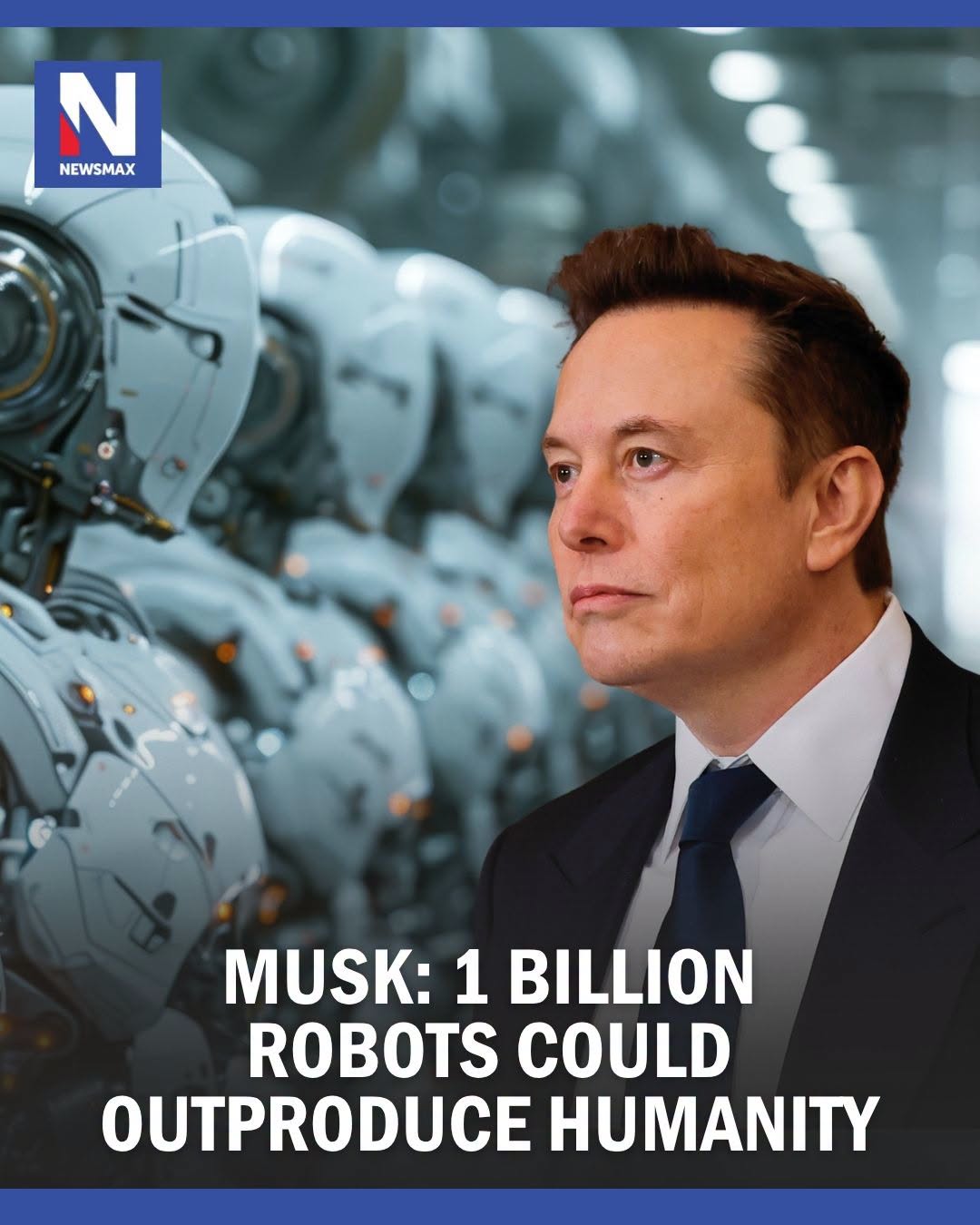
Elon Musk has made a characteristically bold prediction: within the next decade, more than one billion humanoid robots will exist, each capable of being five times more productive than a human. Speaking at the G20 summit, he claimed this robotic workforce would ultimately "outproduce all humans combined" and potentially expand the global economy by a staggering $20 to $30 trillion annually .
WASHINGTON – The viral image is short and striking: "MUSK: 1 BILLION ROBOTS COULD OUTPRODUCE HUMANITY." It's a headline that sounds like science fiction, but it's based on comments made by Elon Musk at the 2026 G20 summit.
On September 1, 2026, the Tesla and SpaceX CEO addressed world leaders and finance ministers via video link . He laid out a vision for an automated future that is both ambitious and, by his own admission, incredibly disruptive.
The Core Prediction: A 'Conservative' Estimate
The headline's central claim is accurate. Musk predicted that the global installed base of humanoid robots would exceed one billion units within a decade. Crucially, he stated he believes this to be a "conservative estimate" and said he would be "willing to put serious money betting on that there will be at least a billion robots in 10 years" .
His reasoning is based on a self-accelerating loop: "when robots can manufacture other robots, the development process will form a self-accelerating loop" . This "recursive effect" means that "it starts off very slowly but then grows at an explosive rate" .
Outproducing Humanity: The Math
The most striking part of his claim is the productivity math.
-
Individual Productivity: Musk estimates the productivity per humanoid robot will be at least five times that of a human .
Total Output: This leads to his headline-grabbing conclusion: a billion robots, each five times more productive than a person, would be "more productive than all humans combined" .
He has framed this as an overwhelming economic boon, suggesting that AI and robotics could increase the global economy by 20% to 30% , adding roughly $20 trillion to $30 trillion annually .
The 'Universal High Income' Future
This massive shift in production power comes with a major societal implication: the end of traditional employment as we know it.
When asked by The Economist about how people would live in such a world, Musk argued that "work becomes optional" . He compared it to growing vegetables: no one must grow their own food, but some might choose to do it for enjoyment.
To ensure people can live in this automated world, he advocates for a "universal high income" , a step beyond Universal Basic Income (UBI) . He argued that government checks could distribute the immense wealth generated by AI and robots, and that the enormous increase in goods and services produced would prevent this from causing inflation .
The Physical Bottleneck: Power
However, Musk also flagged a major hurdle to realizing his vision: electricity.
He warned that the rapid growth of AI is straining the power grid. He cited an estimate that AI systems could face an electricity shortfall of at least 15 gigawatts by 2027 . He noted that while AI chip production is increasing by 40-50% annually, power supply outside China is only growing by 10-20% .
This bottleneck is already driving action. Musk disclosed that companies like Google and Anthropic are renting compute capacity from SpaceX to meet their demands, and SpaceX has had to build its own power generation facilities . He urged governments to take a relatively permissive regulatory approach and expand power generation to support this future .
The Bottom Line
| What the graphic says | What actually happened |
|---|---|
| Musk says 1 billion robots could outproduce humanity | Musk predicted 1 billion humanoid robots in 10 years, each 5x more productive than a human, which would outproduce all humans combined . |
| It's a minor prediction | He called this a "conservative estimate" and said he would bet on it . |
| There are no downsides | He acknowledged a major risk: the electricity power shortage needed to support this AI-driven future . |
The viral image accurately captures the scale and ambition of Elon Musk's latest prediction. However, the full context reveals a vision that is as complex as it is bold. It forecasts a future of unimaginable abundance but also warns of a profound societal transition and a critical bottleneck in global energy infrastructure
Comments (0)
Loading comments...
May You Like

Obama Steps Back Into the Political Spotlight as Democrats Target Trump’s














