
Nancy Mace Says Postpartum Depression Is Not an Excuse for Killing Children as Lindsay Clancy Case Sparks Debate
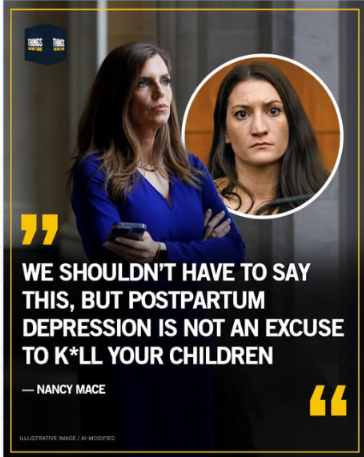
Rep. Nancy Mace is facing renewed attention after saying that postpartum depression should not be used as an excuse for a mother killing her children, a remark made as the high-profile murder case involving Massachusetts mother Lindsay Clancy reaches a dramatic turning point.
The graphic circulating online features Mace alongside an image of Clancy and quotes her as saying: “We shouldn’t have to say this, but postpartum depression is not an excuse to k*ll your children.”
The statement is genuine in substance. Mace recently posted the remark on social media while commenting on the Clancy case.
Mace's comments came amid the Lindsay Clancy murder trial
Mace has been outspoken about the case involving Clancy, a former labor-and-delivery nurse accused of killing her three children — 5-year-old Cora, 3-year-old Dawson and 8-month-old Callan — at the family's Massachusetts home in January 2023.
Clancy's defense did not dispute that she killed the children. Instead, her attorneys argued that she was suffering from severe postpartum mental illness, particularly postpartum psychosis, and therefore should not be held criminally responsible.
In a Sept. 2 social-media post, Mace argued that if postpartum mental illness became a “get-out-of-jail-free card” for murdering children, then, by her logic, anyone diagnosed with such a condition could face custody consequences. She also said the murders could not be blamed on the illness or another factor.
The comments quickly became part of the wider debate surrounding the case and the distinction between mental illness, criminal responsibility and postpartum psychiatric disorders.
The trial ended in a mistrial
The timing of Mace's comments is significant.
On Sept. 4, a Massachusetts judge declared a mistrial after the jury failed to reach a unanimous verdict following seven days of deliberations. The jury was reportedly divided over whether Clancy was criminally responsible for the killings.
Clancy's defense maintained that postpartum psychosis had fundamentally altered her perception of reality. Prosecutors, meanwhile, argued that she understood what she was doing and had deliberately planned the killings.
The case remains unresolved, and prosecutors could seek a retrial. A hearing is scheduled for Sept. 29 to consider the next steps.
Postpartum depression and postpartum psychosis are not the same condition
This is an important distinction missing from much of the online debate.
Postpartum depression is a relatively common condition that can cause persistent sadness, anxiety, exhaustion, difficulty bonding with a baby and, in severe cases, thoughts of suicide or harming oneself or the baby. The National Institutes of Health says people experiencing such thoughts should seek professional help immediately.
Postpartum psychosis, however, is much rarer and is considered a psychiatric emergency. It can involve hallucinations, delusions, paranoia, confusion and a loss of contact with reality. The American College of Obstetricians and Gynecologists says it can be extremely dangerous and requires immediate psychiatric treatment.
Experts estimate postpartum psychosis occurs in roughly 1 to 2 women per 1,000 births. Most women with the condition do not harm their children, but severe psychotic episodes can carry risks of suicide or harm to others.
That distinction matters because Clancy's defense centered primarily on postpartum psychosis, not ordinary postpartum depression.
Experts disagreed sharply during the trial
The psychiatric evidence presented at trial was contested.
Defense experts testified that Clancy suffered from bipolar disorder and postpartum psychosis and that she experienced a command hallucination — reportedly a male voice telling her to kill her children. One defense psychologist testified that she did not appreciate the wrongfulness of her actions at the time.
Prosecution experts challenged that interpretation and questioned whether Clancy was experiencing psychosis when the killings occurred. The prosecution argued that her actions demonstrated planning and an understanding of what she was doing.
The disagreement ultimately left the jury unable to reach a unanimous verdict.
What the viral graphic gets right — and what it leaves out
The graphic is based on a real statement by Nancy Mace, rather than an entirely fabricated quotation.
But it simplifies a much more complicated issue.
- Mace did make the statement.
- The comment was made in connection with the Lindsay Clancy case.
- Clancy's defense relies on severe postpartum mental illness as a central argument.
- The specific condition at the center of the legal dispute is postpartum psychosis, not simply postpartum depression.
- The jury did not reach a verdict, so Clancy's criminal responsibility has not been conclusively determined.
- Medical authorities recognize postpartum psychiatric disorders as legitimate medical conditions and emphasize urgent treatment when psychosis or thoughts of harming oneself or a baby emerge.
The broader question is therefore not whether killing a child is acceptable. It is how severe mental illness should be understood and treated, and how the criminal justice system should determine responsibility when a person is alleged to have been psychotic at the time of a crime.
The Clancy case is likely to continue fueling that debate if prosecutors pursue another trial.
Comments (0)
Loading comments...
May You Like


FIGHT OVER OBAMA’S IRAN POLICY

Russian Drone Strikes Kyiv Bridge as German Chancellor Arrives in Ukraine












