New Jersey Governor Mikie Sherrill Faces Backlash After ICE Pursuit Injures Mayor’s Wife
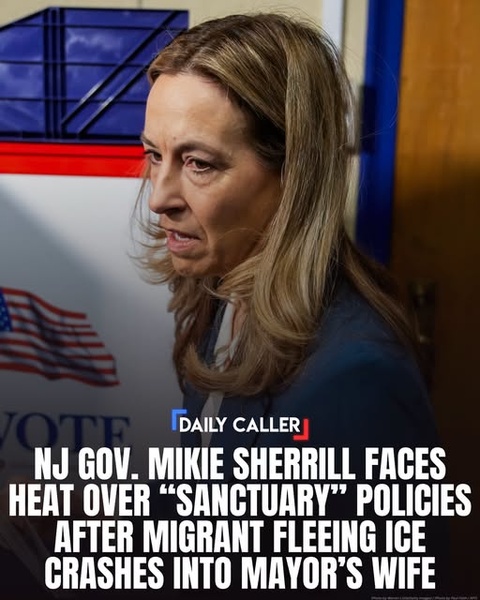
New Jersey Gov. Mikie Sherrill is facing renewed political pressure over immigration policy after a man fleeing an ICE operation crashed into a vehicle driven by a Democratic mayor’s wife.
The September 2 crash occurred on Route 130 in North Brunswick, where authorities said the driver fled an attempted federal detention and subsequently collided with another vehicle.


The other vehicle was driven by Dr. Penelope Cohen, the wife of East Brunswick Mayor Brad Cohen, who was injured and transported to a nearby hospital following the collision.
According to local authorities, the driver was stopped by federal immigration agents before accelerating away, running a red light and striking Cohen’s Tesla from behind.
The driver then reportedly abandoned the vehicle and fled on foot before being apprehended by federal authorities, according to accounts from law enforcement and ICE.
Cohen suffered a leg injury, but officials said the injuries were not life-threatening. The crash nevertheless quickly became a flashpoint in New Jersey’s immigration debate.
Republican lawmakers have seized on the incident to criticize Sherrill’s immigration policies, arguing that restrictions on cooperation with federal authorities can create public-safety concerns.
State Sen. Mike Testa and Assemblyman Paul Kanitra have argued that New Jersey’s sanctuary policies make it harder for federal immigration officers and local police to coordinate.
Their criticism centers on the Immigrant Trust Directive, a policy originally established in 2018 that limits how state and local law enforcement agencies cooperate with federal immigration authorities.


Sherrill signed legislation in March codifying the Immigrant Trust Directive into state law, making the restrictions more difficult for future administrations to remove unilaterally.
The law generally restricts state and local police from assisting federal immigration enforcement, including providing certain resources or participating in immigration raids without appropriate legal authority.
Supporters of the policy argue that separating local policing from federal immigration enforcement encourages immigrant residents to cooperate with police without fearing immigration consequences.
Immigrant-rights advocates also say the directive strengthens relationships between communities and law enforcement while protecting access to essential public services.
Republicans, however, maintain that the policy can interfere with federal enforcement and potentially make it more difficult to identify and detain people who are subject to removal.
The dispute intensified because the crash occurred only days before a federal court ruling involving another major Sherrill immigration policy.
A federal judge dismissed the Trump administration’s challenge to Sherrill’s executive order restricting ICE access to nonpublic areas of state property without a judicial warrant.
The ruling allowed New Jersey to maintain restrictions preventing federal immigration officials from using state property as staging areas for immigration operations.
Sherrill welcomed the ruling, arguing that New Jersey has the authority to protect state property and its residents while challenging what she considers federal overreach.
Her administration has repeatedly portrayed its immigration policies as efforts to protect constitutional rights, public safety and trust between immigrant communities and local authorities.


Federal officials have taken the opposite position, arguing that New Jersey’s restrictions improperly interfere with the federal government’s responsibility to enforce immigration law.
The Justice Department previously sued New Jersey over Sherrill’s executive order, accusing the state of obstructing federal immigration enforcement.
The latest crash has therefore become part of a much larger national argument over the boundaries between federal immigration authority and state and local law enforcement.
For Sherrill, the controversy comes as her administration continues to position New Jersey as a state willing to challenge President Donald Trump’s immigration agenda.
For Republicans, the incident provides an opportunity to argue that Democratic immigration policies have consequences for public safety beyond the immigration system itself.
Democrats and immigrant-rights advocates have countered that responsibility for the crash rests with the individual driver and should not automatically be attributed to New Jersey’s broader immigration policies.
The incident also highlights the political difficulty of balancing federal immigration enforcement with local concerns about community trust, policing and public safety.
As the debate continues, Sherrill faces pressure from Republicans to explain how her administration intends to maintain cooperation with federal authorities while preserving New Jersey’s restrictions on immigration enforcement.
The crash has transformed an individual traffic incident into another major political battle over sanctuary policies, ICE enforcement and the future of immigration policy in New Jersey.
For now, the broader question remains unresolved: Do sanctuary policies make communities safer by building trust—or do they create dangerous gaps in cooperation between local police and federal immigration authorities?
Comments (0)
Loading comments...
May You Like
FIGHT OVER OBAMA’S IRAN POLICY
Jack Smith Defends His Integrity as Trump Investigations Face Renewed Political Firestorm