
New Orleans Officer Shot 16-Week-Old Puppy Apollo
New Orleans Officer Shot 16-Week-Old Puppy Apollo — Years Later, the Case Is Still Not Over
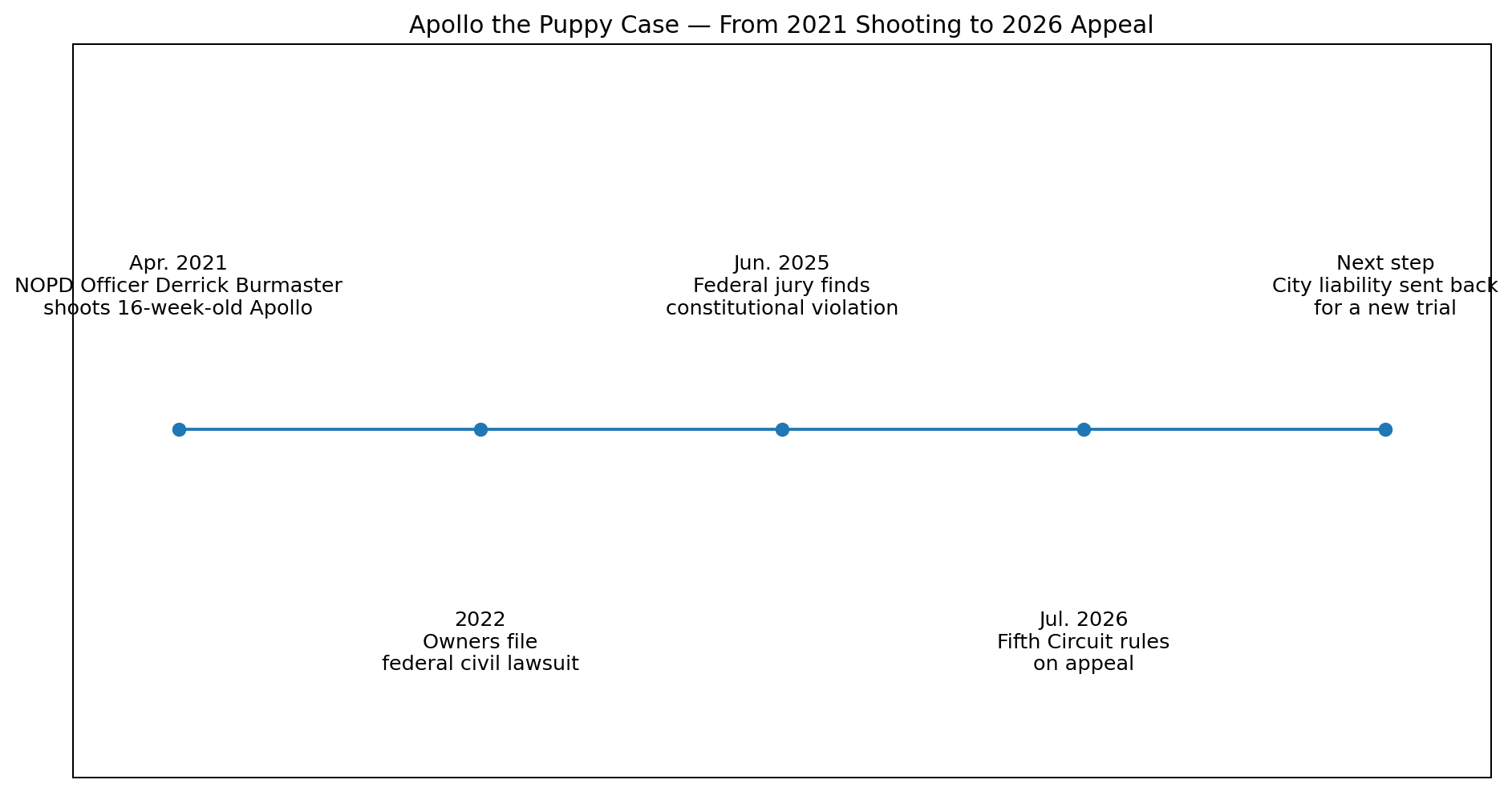
The death of a 16-week-old puppy named Apollo became far more than a brief police incident in New Orleans.
What happened in a fenced yard in 2021 eventually turned into years of internal reviews, a federal civil-rights lawsuit, a jury trial and an appellate ruling that left one major question unresolved.
Apollo was a young Catahoula puppy owned by Derek Brown and Julia Barecki-Brown.
New Orleans Police Officer Derrick Burmaster fired three shots after Apollo ran toward officers who had entered the yard while responding to a reported disturbance.
Apollo died from the gunfire.
Five years later, the legal fight over the shooting was still continuing.
The Incident Happened in 2021 — Not as a New Breaking Story
The shooting occurred in April 2021 in New Orleans’ Lower Garden District.
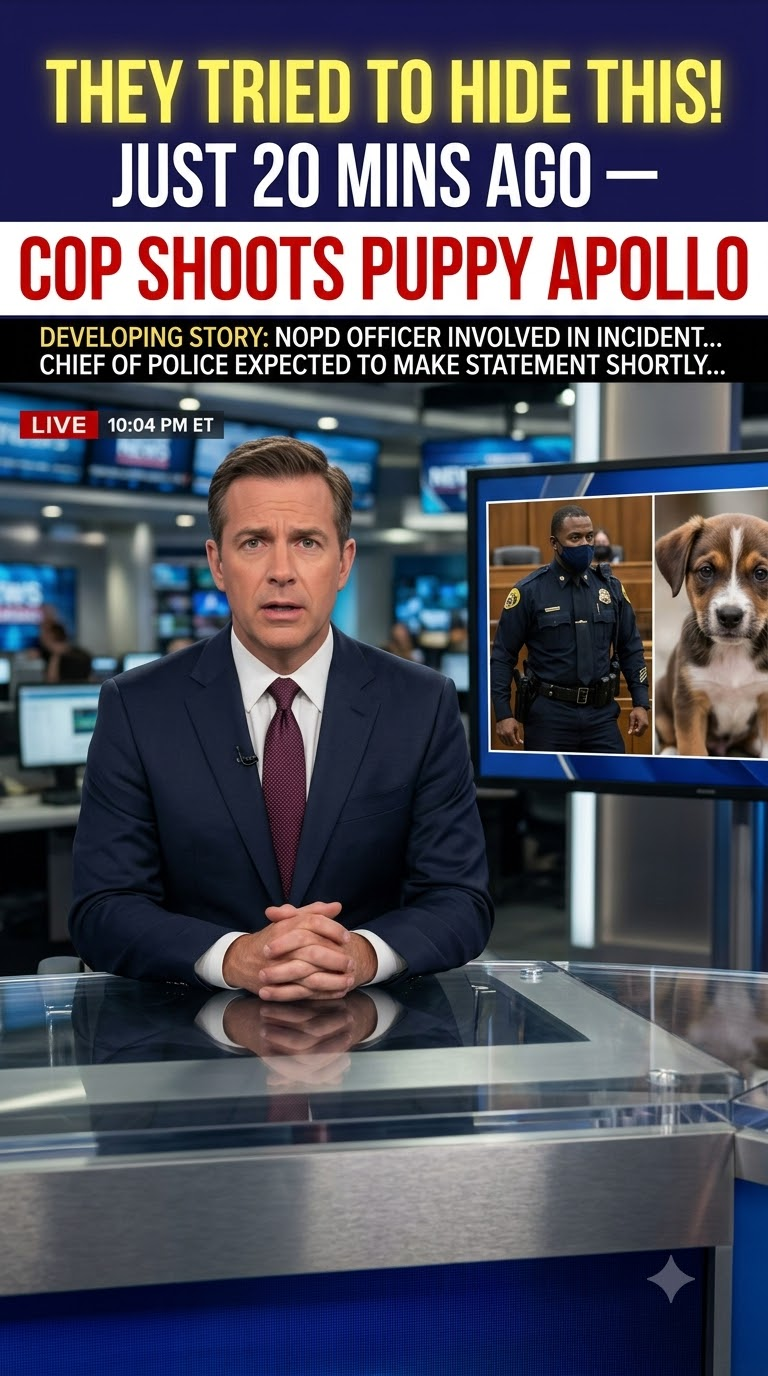
That timing matters because social-media graphics and reposts have sometimes presented the case as if it had just happened.
It did not.
The reason the story continued resurfacing is that the civil case moved through several major stages afterward, including a 2025 federal jury trial and a 2026 appeals-court decision.
The underlying shooting is old. The legal consequences are much more recent.
What Happened in the Yard
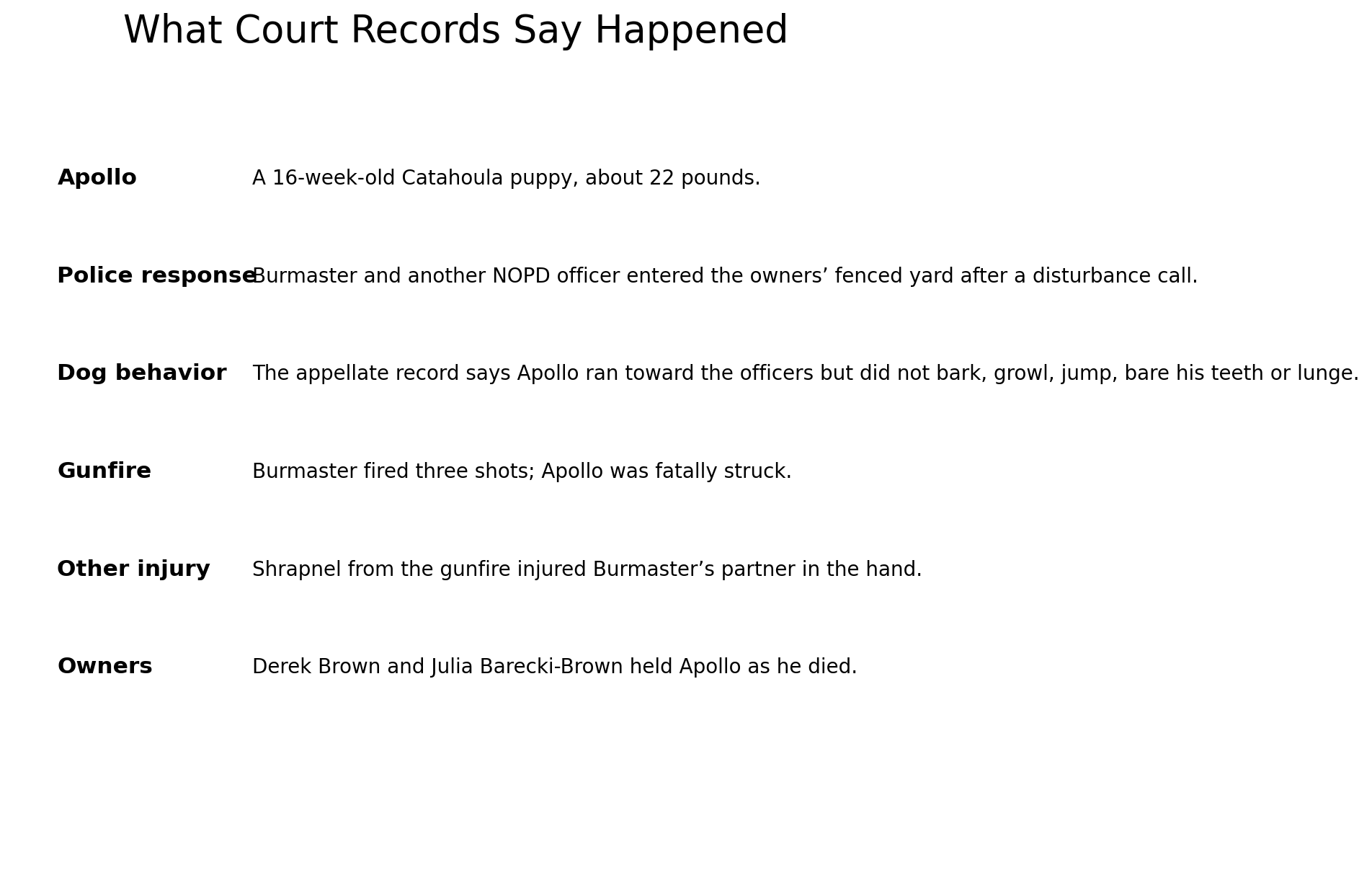
Court records describe Burmaster and another officer entering the owners’ fenced property after police were called to the home.
The officers encountered two dogs coming down into the courtyard.
Apollo, the smaller dog, ran toward them.
The Fifth Circuit’s 2026 opinion states that Apollo did not bark, growl, jump, bare his teeth or lunge.
Burmaster had already drawn his firearm.
His partner moved back through the gate, while Burmaster remained inside and fired three shots.
Apollo Was Fatally Hit — and Another Officer Was Hurt
At least one shot struck Apollo.
Court records describe a wound to the back of his neck and injuries that caused his lungs to fill with blood.
Shrapnel from another shot struck Burmaster’s partner in the hand.
The owners came outside after hearing the gunfire and found Apollo bleeding.
They held the puppy as he died.
That scene later became central to their claims for emotional distress.
The Owners Said the Shooting Never Had to Happen
Brown and Barecki-Brown argued that the officer had other options.
Their lawsuit pointed to the fact that Burmaster was carrying a Taser and that his partner had simply backed out through the gate.
They also argued that Apollo’s behavior did not present the kind of immediate threat that justified deadly force.
The officer, through the litigation, maintained that he feared being bitten.
That disagreement — whether the shooting was objectively reasonable in the moment — became one of the central issues in the federal case.
Internal Police Reviews Did Not All Reach the Same Conclusion
The shooting also exposed disagreement inside the New Orleans Police Department.
An early Public Integrity Bureau investigation and a Use of Force Review Board assessment found the shooting unjustified and criticized the failure to use appropriate de-escalation.
Later, however, an NOPD hearing panel exonerated Burmaster on the improper-use-of-force allegations.
The department sustained a separate violation related to his failure to carry a baton.
That reversal became another major issue for the owners, who argued that the department had failed to hold the officer accountable.
The Case Moved Into Federal Court
The owners filed suit against Burmaster, the City of New Orleans and other officials.
They argued that killing Apollo amounted to an unreasonable seizure of their property under the Fourth Amendment.
Under federal law, pets are treated as property for that constitutional analysis.
The lawsuit also included state-law claims tied to negligence and emotional harm.
Years of pretrial litigation followed before the case finally reached a jury in June 2025.
The Jury Reached a Complicated Verdict
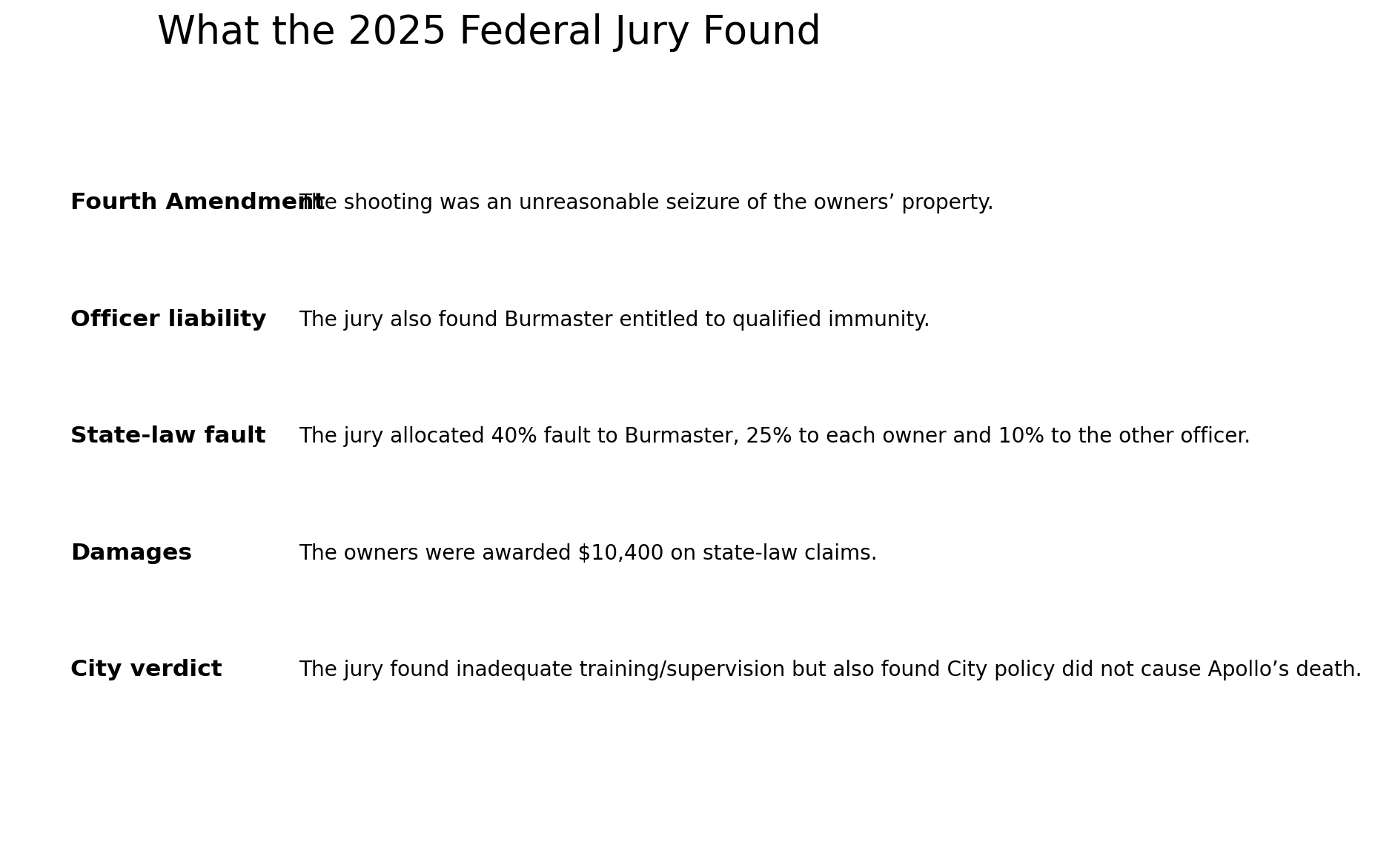
The federal jury found that the shooting of Apollo was objectively unreasonable and violated the owners’ Fourth Amendment rights.
But the same jury found that Burmaster was protected by qualified immunity.
That meant the officer was not personally liable on the federal constitutional claim despite the finding that the shooting was unreasonable.
The jury separately found negligence under state law and awarded the owners $10,400.
It also allocated fault among Burmaster, the owners and the other officer.
Why Qualified Immunity Changed the Result
Qualified immunity can protect government officials from personal civil liability even when a constitutional violation occurred.
The doctrine asks whether the right at issue was clearly established in a sufficiently specific way at the time of the conduct.
In the Apollo case, the jury was instructed on the governing law and then asked to resolve the disputed facts.
It concluded that the shooting was unreasonable but that Burmaster was still entitled to qualified immunity.
That combination can appear contradictory to people unfamiliar with the doctrine, but the Fifth Circuit later said the process was legally permissible.
The City Verdict Had a Different Problem
The jury’s findings against the City of New Orleans created a separate issue.
Jurors found that the City was liable for inadequate training, supervision or discipline involving Burmaster’s use of force on dogs.
But they also found that the City’s policies did not cause Apollo’s death.
Those two answers did not fit together.
Municipal liability requires a causal connection between the City’s policy or failure and the constitutional injury.
That inconsistency eventually became the central issue on appeal.
The Fifth Circuit Stepped In During 2026
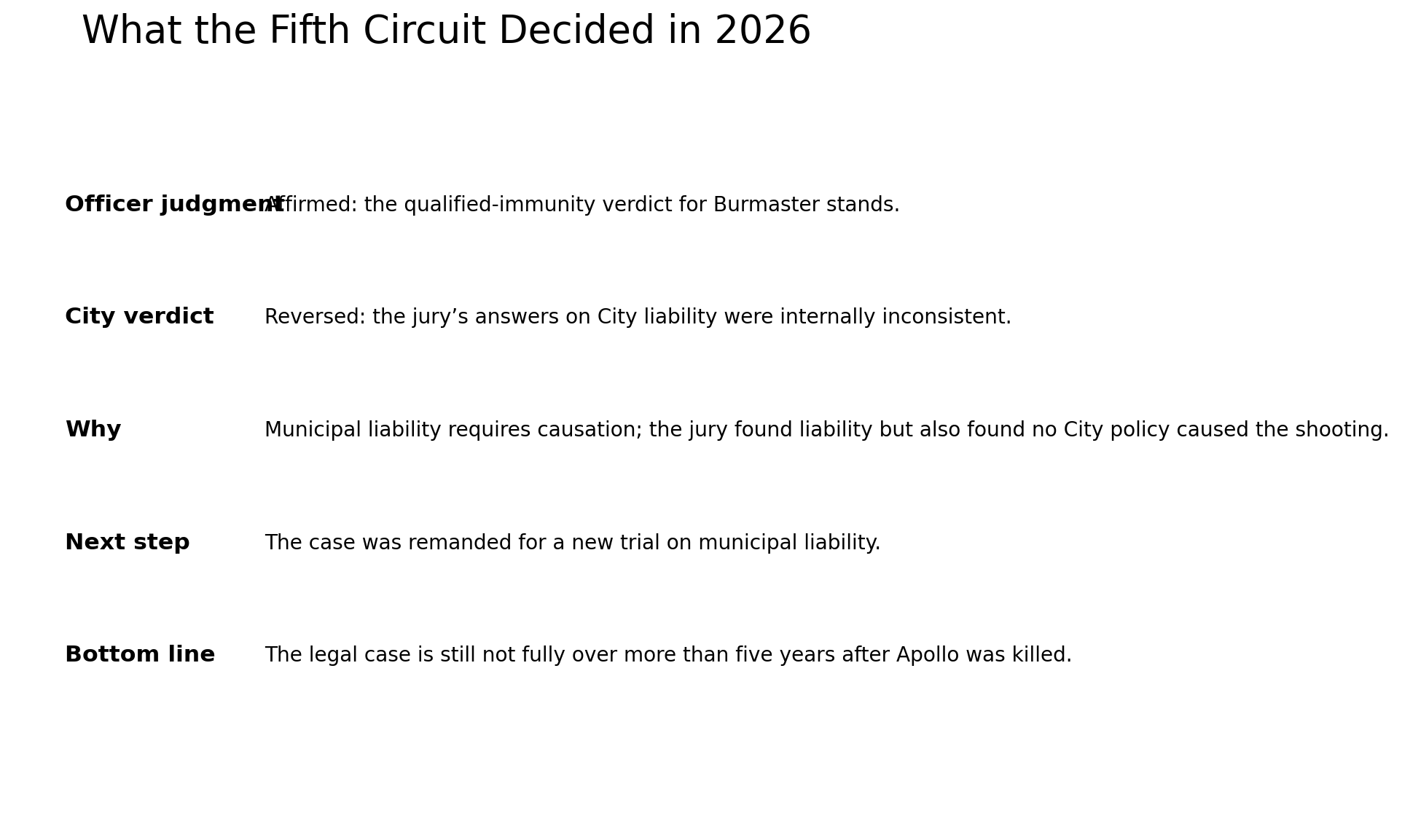
On July 14, 2026, the U.S. Court of Appeals for the Fifth Circuit issued its ruling.
The appeals court left the qualified-immunity result for Burmaster in place.
But it said the jury’s answers concerning the City could not be reconciled.
A jury could not logically say both that the City was liable and that the City’s policies did not cause the killing.
The appellate court therefore reversed that portion of the judgment and sent the case back for a new trial on municipal liability.
That Means the Case Is Still Not Fully Finished
The 2026 ruling did not reopen every part of the case.
The officer’s qualified-immunity judgment remained intact.
The state-law verdict was not the subject of the appellate dispute.
What remains is the question of whether the City of New Orleans can be held constitutionally liable for failures involving training, supervision or discipline and whether those failures caused Apollo’s death.
That issue must be tried again.
Why the Case Drew Such an Emotional Reaction
Dog shootings by police often produce unusually strong public reactions because the facts are easy to visualize.
Apollo was a small puppy in his owners’ yard.
The officer was armed with a gun and had other equipment.
Another officer moved away rather than shoot.
The puppy died in front of the people who owned him.
Those facts do not answer every legal question, but they explain why the case attracted attention far beyond a routine civil lawsuit.
The Case Also Raised Questions About Police Training Around Dogs
The lawsuit became part of a wider debate about how officers are trained to respond to dogs during calls at private homes.
Police officers regularly encounter animals in yards, homes and streets.
Departments have to prepare officers to distinguish between a dog that is merely approaching and a dog that is posing an immediate threat.
The owners argued that better training and discipline could have prevented Apollo’s death.
The City has disputed that its policies caused the shooting.
That disagreement is exactly what the new municipal-liability trial is expected to address.
The Viral Version Leaves Out the Most Important Timing
Online versions of the story sometimes use phrases such as “just happened,” “developing story” or “they tried to hide this.”
Those descriptions can distort the timeline.
The puppy was killed in 2021.
The jury trial occurred in 2025.
The latest major legal development came in July 2026, when the Fifth Circuit ordered a new trial on the City-liability issue.
The case is compelling without pretending the original shooting happened minutes ago.
Apollo’s Death Became a Five-Year Legal Story
Apollo lived only a few months.
The case created by his death has lasted for years.
A police officer fired three shots. Internal reviews disagreed over whether the force was justified. A federal jury found a constitutional violation but also qualified immunity. An appeals court then found the City portion of the verdict impossible to reconcile.
That sequence is why the story continues to matter.
The shooting itself is settled history.
The question of how much legal responsibility the City of New Orleans carries for it is not.
Comments (0)
Loading comments...
May You Like


Obama Steps Back Into the Political Spotlight as Democrats Target Trump’s













