
North Korea’s “$6 Billion in 24 Hours” Claim: The Real Story Behind Kim Jong Un’s $22 Billion Windfall
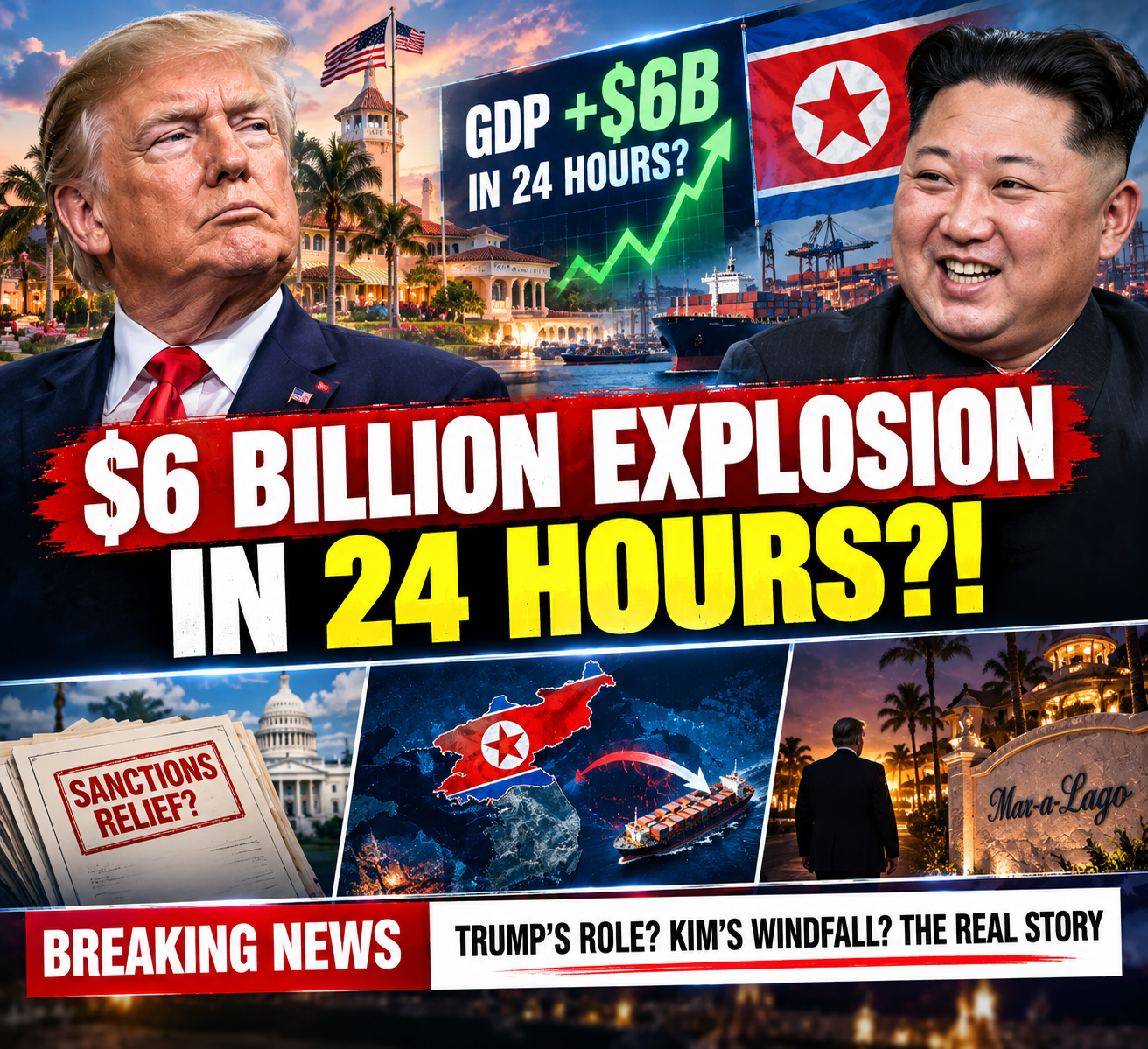
A startling claim is circulating online: North Korea supposedly added $6 billion to its economy in just 24 hours, creating an extraordinary financial windfall for Kim Jong Un and raising questions about whether President Donald Trump is preparing to ease sanctions behind closed doors.
The underlying story is real, but the headline is misleading. North Korea has experienced a significant economic recovery, and a major Bloomberg Economics investigation estimated that the country generated as much as $22 billion in foreign revenue between 2022 and 2025. That figure represents an estimated accumulation over four years—not a sudden increase in gross domestic product in a single day.
The distinction matters. The reporting points to a combination of Russian payments for military support, expanding trade with China, overseas labor, cybercrime and other revenue streams. It does not establish that Trump secretly authorized sanctions relief, that North Korea received $6 billion in one day, or that the money came from a new agreement negotiated at Mar-a-Lago.
Where the $22 billion estimate comes from
The central source behind the viral claim is a Bloomberg Economics investigation published in August 2026. It estimated that North Korea generated up to $22 billion in foreign revenue from 2022 through 2025—nearly four times the amount estimated for the preceding four-year period.
The largest component was military cooperation with Russia. According to the investigation, North Korea supplied ammunition, artillery equipment and other military assistance to Moscow after Russia launched its full-scale invasion of Ukraine. It also sent troops to support Russian forces.
Bloomberg's high-end estimate attributed approximately $14 billion of the total to revenue associated with Russia. More than 90% of that Russia-related estimate came from arms sales, according to the analysis. The figures are estimates assembled from trade records, intelligence assessments and research by outside organizations, rather than audited accounts released by Pyongyang.
That qualification is especially important because North Korea does not publish comprehensive, independently verifiable national financial accounts. Some payments may also take the form of goods, technology or other transfers rather than money entering the country's banking system. Bloomberg explicitly cautioned that its estimates could understate or overstate the actual amounts.
Russia has become a major financial and strategic partner
The relationship between Kim and Russian President Vladimir Putin has changed considerably since the war in Ukraine began. Their strategic partnership has developed into military and economic cooperation that provides benefits to both governments.
For Moscow, North Korean ammunition and other military supplies have helped support its war effort. For Pyongyang, the relationship has provided an important source of revenue, diplomatic support and potential access to military technology.
Bloomberg's analysis estimated that North Korea deployed between 16,000 and 22,000 troops in connection with the Russian war effort, citing South Korean estimates and research from the Center for Strategic and International Studies. The investigation also described payments connected to deployed personnel and additional compensation reportedly associated with battlefield casualties. These estimates are not equivalent to independently verified public accounts of payments made by either government.
The implications extend beyond money. North Korea's military relationship with Russia may give Kim additional resources to strengthen weapons programs while reducing the pressure that international isolation was intended to impose.
China remains essential to North Korea's economic recovery
Russia is not the only explanation for the recovery. China remains North Korea's most important conventional trading partner and a critical source of goods, commercial activity and economic support.
Bloomberg's investigation estimated that trade with China generated approximately $8 billion in foreign revenue over the 2022–2025 period. The figure is part of its broader estimate of North Korean revenue, not a separate sudden cash transfer.
South Korea's central bank provides another measure of the recovery. On July 31, 2026, the Bank of Korea estimated that North Korea's economy expanded by 3.5% in 2025, following growth of 3.7% in 2024 and 3.1% in 2023.
The bank attributed the expansion to stronger economic cooperation with Russia, increased trade with China and domestic policy projects. It estimated that mining and manufacturing grew by 4.9% in 2025, construction by 6.3%, and services by 1.8%.
These are annual growth estimates—not evidence of a $6 billion increase within 24 hours.
What about sanctions relief from Trump?
The image's reference to Mar-a-Lago invites speculation that Trump may be quietly arranging a deal with Kim. There is, however, an important difference between asking whether diplomacy could eventually change sanctions policy and claiming that a secret agreement has already delivered billions of dollars to North Korea.
The economic reporting identified Russia-related military cooperation and Chinese trade as major sources of the country's recent gains. It did not establish that the Trump administration had approved a new sanctions-relief arrangement responsible for the estimated windfall.
The historical record also shows that Trump and Kim have engaged in direct diplomacy before. Their meetings in Singapore in 2018, Hanoi in 2019 and the Korean Demilitarized Zone in 2019 raised hopes of an agreement over North Korea's nuclear program and international sanctions. The Hanoi summit ended without a comprehensive agreement.
That history makes renewed diplomatic engagement a relevant subject for analysis, but it cannot substitute for evidence of a current deal. A credible claim of sanctions relief would need documentation of a policy change, an official announcement, a specific exemption or evidence of a negotiated arrangement.
It is also important to remember that sanctions are not controlled by Washington alone. United Nations sanctions involve decisions by the Security Council, while the United States and other governments maintain their own restrictions. A change in one country's policy would not automatically eliminate every international restriction.
The money has not necessarily improved ordinary North Koreans' lives
A stronger national economy does not necessarily mean that ordinary citizens are sharing in the gains.
The Korea Economic Institute of America noted in September 2026 that North Korea's recovery has been driven substantially by arms production for Russia and trade with China. It also highlighted continuing problems, including limited energy supplies, sanctions-related constraints, depreciation of the North Korean currency and rising food prices.
The institute reported that the North Korean won had lost roughly three-quarters of its value against the U.S. dollar since May 2024, while the price of rice had risen to more than five times its earlier level.
A September analysis published by 38 North similarly described a recovery accompanied by instability in exchange rates and market prices. It noted that the government faces serious challenges in securing foreign currency, allocating electricity and keeping newly constructed factories operating productively.
This creates a major divide between the resources available to the state and the living conditions of the population. Revenue from military exports and strategic partnerships can strengthen the government's ability to finance priority projects, but it does not automatically translate into better household purchasing power, reliable electricity or adequate food supplies.
Cybercrime and other revenue streams complicate the picture
The Bloomberg investigation also identified other sources of foreign income, including overseas labor, information-technology workers, gold exports, illicit coal trading and cybercrime.
North Korean-linked hacking operations have repeatedly been identified by governments and cybersecurity researchers as a significant threat to cryptocurrency platforms and financial institutions. Such activity is difficult to measure precisely, and estimates of its contribution to national revenue vary. It nevertheless forms part of the wider sanctions-evasion challenge.
This means that the country's financial recovery cannot be explained by a single political decision or one diplomatic meeting. It reflects multiple channels that have developed over several years, including a closer military relationship with Russia and renewed commercial activity with China.
What the evidence actually establishes
The viral graphic combines a real economic development with a misleading time frame and an unverified political suggestion.
|
Viral claim |
|---|
What the available evidence shows
North Korea's GDP rose $6 billion in 24 hours
No verified evidence supports this.
Kim's regime gained up to $22 billion
Bloomberg estimated up to $22 billion in foreign revenue over 2022–2025.
Russia helped finance the recovery
Supported by economic analysis and South Korean estimates.
China contributed to the recovery
Supported by trade data and economic assessments.
Trump secretly granted sanctions relief
Not established by the cited economic reporting.
The entire population benefited
Not supported; serious living-cost and currency pressures remain.
The underlying economic shift is significant, but the most important finding is not a miraculous overnight GDP explosion. It is that North Korea has found ways to generate substantial foreign revenue despite years of international sanctions, with military cooperation with Russia and trade with China playing central roles.
For Washington, Seoul and other governments concerned about North Korea's nuclear and missile programs, this creates a difficult policy challenge: sanctions may remain in place while Pyongyang develops alternative sources of money, technology and diplomatic support.
The question now is not whether North Korea suddenly became $6 billion richer in a single day. The better-supported question is how much longer its expanding relationship with Moscow and Beijing can sustain its economic and military ambitions—and what that means for the balance of power in Northeast Asia.
Comments (0)
Loading comments...
May You Like

AMERICA'S TRADE DEFICIT SURGES — WHAT DOES IT MEAN FOR AMERICAN FAMILIES?

IRAN DEFIES WASHINGTON — SUPREME LEADER CLAIMS U.S. MILITARY ATTACKS FAILED!














