
“Obama, Abdul, and Zohran”: The Viral Claim About America’s Greatest Political Speakers—and Why It’s More Than Just a Meme
“Obama, Abdul, and Zohran”: The Viral Claim About America’s Greatest Political Speakers—and Why It’s More Than Just a Meme
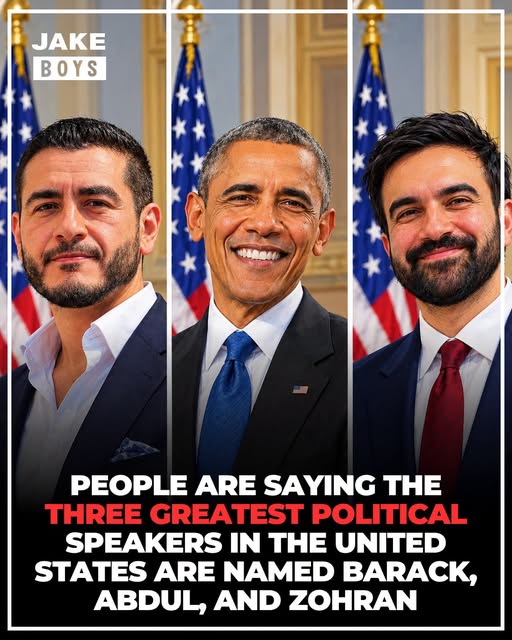
The image is a bold, almost audacious piece of political branding. It features three smiling men, each framed by the American flag: Barack Obama, Abdul El-Sayed, and Zohran Mamdani. The text below is a declarative statement that has ignited fierce debate online: “PEOPLE ARE SAYING THE THREE GREATEST POLITICAL SPEAKERS IN THE UNITED STATES ARE NAMED BARACK, ABDUL, AND ZOHRAN.”
For many, the inclusion of Obama is a given. He is, after all, widely regarded as one of the most gifted orators in modern American history. But placing two younger, far less established politicians—a Michigan Senate candidate and the Mayor of New York City—alongside a former two-term president is a provocative claim. It is a meme, yes, but it is also a reflection of a very real shift in the Democratic Party’s political talent pool, and a testament to the power of a new generation of communicators who are channeling the Obama legacy in their own way.
This is the story behind the viral graphic, the three men it elevates, and what their rise tells us about the future of American political rhetoric.
The Verdict: A Subjective Claim, But a Real Phenomenon
Unlike many viral political headlines, this one is not a factual claim that can be easily fact-checked. “Greatest political speakers” is an inherently subjective judgment. What is undeniable, however, is that all three men have generated genuine, widespread acclaim for their oratorical skills, and that the comparison is not as far-fetched as it might initially appear.
The meme captures a moment of convergence. Obama remains the gold standard—the "Obama cadence," the measured delivery, the ability to inspire. But El-Sayed and Mamdani are not mere imitators. They are politicians who have absorbed the stylistic lessons of the Obama era while adapting them to a new, more combative, and more digitally native political environment.
Barack Obama: The Gold Standard
There is no need to litigate Obama’s place in the pantheon of American political speakers. From his 2004 Democratic National Convention keynote to his “Obama Out” mic drop, he has consistently demonstrated a mastery of the craft that is, by any measure, generational.
In the current political moment, Obama has re-emerged as a potent force on the campaign trail. His speeches in support of Democratic candidates have drawn thousands, and his ability to articulate a coherent, values-based critique of the Trump administration has provided a sharp contrast to the chaos of the current era. During a recent rally for Abdul El-Sayed in Detroit, Obama drew on his own experience to defend the candidate against attacks on his faith, saying, “We have seen this movie before. I starred in it”. It was a moment that demonstrated why he remains the benchmark for political communication.
Abdul El-Sayed: The Heir Apparent?
Abdul El-Sayed, the Democratic nominee for the U.S. Senate in Michigan, has been repeatedly compared to Obama. A former public health official and progressive activist, El-Sayed has impressed observers with his ability to communicate complex policy ideas with clarity and conviction.
One recent commentator, watching him being interviewed on MSNOW, wrote: “He is extremely impressive. He was on point on every question they asked him. That man reminds me of President Obama when it comes to the ability to communicate and explain his message”. Another observer noted that he is “brilliant and has a solid understanding of his values, not a made up position to please voters”.
His speeches, particularly his closing remarks in debates and his final campaign rallies, have focused on themes of economic justice and the promise of America. As he said in his final pitch to voters, “Because I want America, the America I got to experience, to be America for all of her kids”. It is a message that resonates with the Obama tradition, but it is delivered with a raw, confrontational energy that is very much El-Sayed’s own.
Zohran Mamdani: The New York Firebrand
Zohran Mamdani, the Mayor of New York City, has been the most surprising addition to this trio. A democratic socialist and the first Muslim mayor of a major American city, Mamdani has built a reputation as a fiery, off-the-cuff speaker who can command a room.
His speeches have gone viral for their emotional power. One observer described his Knicks Parade speech as one that “stunned” the crowd, and his acceptance speech, where he declared, “I am young … I am Muslim. I am a democratic socialist” , was seen as a defining moment for a new generation of left-wing politics. Pundits have noted his ability to “inspire people to come together” and have drawn comparisons to the rhetorical skills of figures like Nelson Mandela.
However, his style has also drawn criticism. Some argue that he lacks the polish of Obama, with one commentator noting that while he is “very good” , he can sometimes come across as “shrill, arrogant & angry”. But even his critics acknowledge his effectiveness. As one analysis put it, his ability to speak “off-the-cuff when being questioned by reporters” is “even more amazing” than Obama’s.
The Broader Context: A Party in Transition
The viral graphic is not just a celebration of three individuals. It is a snapshot of a Democratic Party in transition. Obama represents the established, institutional wing—the coalition that twice elected him. El-Sayed and Mamdani represent a rising, progressive, and more confrontational generation. They are the product of the Obama era, but they are also its sharpest critics from the left.
El-Sayed’s Senate race is a crucial test of this new politics. If he wins, he would become the first Muslim U.S. senator and a major victory for the progressive movement. Mamdani’s mayoralty in New York is already a proving ground for a brand of democratic socialism that was once considered fringe.
Their rise, and the praise they receive for their oratorical skills, suggests that the Obama legacy is not just about a single man. It is about a style of politics—one that prizes eloquence, empathy, and the ability to inspire—that is being adapted and reimagined for a new era.
The Bottom Line
The viral graphic is a meme, and it is a product of the internet’s love for rankings and hyperbole. But it captures a real and important phenomenon. Barack Obama remains the standard against which all other political speakers are measured. Abdul El-Sayed and Zohran Mamdani are not yet at his level, but they are the most compelling inheritors of his rhetorical tradition.
Whether they will achieve his political success remains to be seen. But for a party searching for its next generation of leaders, the fact that people are even having this conversation is a sign of something significant. The “greatest political speakers” may still be a subjective category, but the names Barack, Abdul, and Zohran are increasingly being spoken in the same breath—and that, in itself, is a story.
📸 Suggested Images
-
The Viral Graphic: The original image featuring Obama, El-Sayed, and Mamdani, with the text of the viral claim.
The Rally: A photo of Barack Obama and Abdul El-Sayed at the Detroit rally, with a quote overlay of Obama’s line: “We have seen this movie before. I starred in it.”
The Mayor: A photo of Zohran Mamdani delivering a speech, with a caption noting his viral Knicks Parade speech and his identity as the first Muslim mayor of New York City.
The Contrast: A split image of Obama’s measured delivery and El-Sayed’s more confrontational style, illustrating the evolution of Democratic political rhetoric.
The Future: A photo of El-Sayed and Mamdani together, with a caption noting their roles as rising stars in the progressive movement.
Comments (0)
Loading comments...
May You Like

BANGCHAK REFINERY DISASTER IN THAILAND—120,000 BARRELS A DAY SHUT DOWN, U.S. OIL PRICES SURGE 10%!


FCC CLEARS SPACEX FOR ONE MILLION AI SATELLITES AS ASTRONOMERS SOUND ALARM
Latest Posts









Popular Posts



