
Obama Accuses Trump of “Chaos and Cruelty” as Midterm Campaign Fight Intensifies
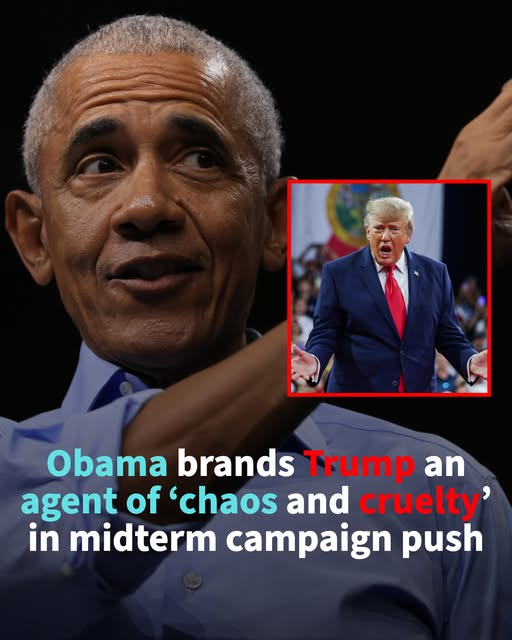
Former President Barack Obama has returned to the campaign trail with a forceful indictment of President Donald Trump’s second administration, accusing it of fostering “chaos and cruelty and corruption and incompetence” as Democrats seek to make the November 3, 2026, midterm elections a referendum on the president’s leadership.
Speaking at a Democratic rally in Cleveland, Ohio, on October 24, Obama criticized Trump’s economic decisions, foreign policy, approach to government and highly publicized White House renovation projects. He argued that rising living costs were placing pressure on American households and blamed the administration’s decisions, including its war against Iran, for worsening economic conditions. The comments marked one of Obama’s sharpest campaign interventions of the 2026 election cycle.
“After two years of chaos and cruelty and corruption and incompetence, the likes of which we have not seen in the modern era, you get a chance to say, ‘Enough is enough,’” Obama told the crowd, urging Ohio voters to support Democratic candidates.
His appearance was designed to energize Democrats in a state where the party is fighting for key statewide offices. Obama campaigned alongside former Democratic senator Sherrod Brown, who is seeking a political comeback, and Amy Acton, the Democratic candidate for governor. The rally also gave Obama an opportunity to connect national controversies with issues affecting Ohio voters, from energy prices and housing costs to the tone of political campaigning.
The former president’s remarks were political arguments, not independent findings that every administration decision had caused the economic problems he described. But they made clear that Democrats are seeking to link the administration’s domestic and foreign policies into a single message about accountability ahead of Election Day.
Rising costs and the war with Iran become central targets

Economic pressures formed a central part of Obama’s speech. He pointed to higher fuel prices and the rising cost of everyday goods, arguing that the administration’s decisions had made life more difficult for households already struggling with affordability.
“The current president chose to make a series of bad decisions,” Obama said. “Most importantly, he decided to start an unnecessary war that nobody asked for and nobody voted for.” He linked the conflict to higher oil and diesel prices, as well as the broader cost of living.
Obama’s argument centers on the relationship between geopolitical instability and household finances. Disruptions to oil shipments, concerns about the security of shipping routes and uncertainty over the duration of a conflict can push energy prices higher, potentially affecting transportation, food distribution and other sectors.
The Strait of Hormuz is particularly important to global energy markets because a substantial share of internationally traded oil passes through the narrow waterway. Obama argued that the conflict had increased Iran’s leverage over shipping and energy supplies, undermining claims that the administration had secured a decisive strategic victory.
The precise contribution of the conflict to US inflation, however, must be assessed using economic data rather than campaign rhetoric alone. Energy prices are affected by multiple factors, including global supply and demand, production decisions, shipping costs, market expectations and government policy. Establishing how much of a price increase is attributable to a particular decision requires examining those factors over the relevant period.
For Democrats, the political argument is straightforward: voters who are concerned about gasoline, groceries, housing and healthcare should consider whether the administration’s choices are addressing those concerns. Republicans can contest that interpretation by pointing to their own policy priorities and explanations for economic conditions. The competing claims will be tested not only through campaign speeches but also through the economic experience of voters.
“Not serious people”: Obama challenges the administration’s priorities

Obama also questioned the seriousness of officials serving in the Trump administration, arguing that the country faced major challenges that demanded sustained attention. He referred to the rapid development of artificial intelligence, the need to expand housing, the cost of childcare and healthcare premiums, and concerns about the influence of wealthy donors over politics.
In his Ohio remarks, Obama said the economy was changing quickly and warned that the benefits of artificial intelligence should not accrue only to billionaires. He called for education reform suited to the new technological environment and argued that the country needed to build millions of homes while making essential services more affordable.
The criticism broadened the speech beyond a direct attack on Trump. Obama presented affordability and government accountability as interconnected problems, arguing that political institutions were not responding adequately to the needs of ordinary households.
He also accused the Republican Party of abandoning its traditional emphasis on limited government in favor of what he described as corrupt, inept or ineffective governance. Those are his characterizations of the party’s direction, rather than neutral descriptions accepted by all political observers.
The argument reflects a larger dispute in American politics over the role of government, the influence of private wealth and how public resources should be allocated. Democrats have emphasized affordability and oversight, while Republicans have advanced their own positions on economic policy, immigration, national security and government spending. Voters will ultimately judge those competing claims against the candidates’ records and proposals.
White House renovations become a symbol in the campaign

One of the most memorable parts of Obama’s speech concerned Trump’s renovations at the White House. Obama joked that the president should appear on HGTV, the home-improvement television network, before comparing the gold-heavy decoration to a Cheesecake Factory opened by former Iraqi leader Saddam Hussein. The line drew attention because it reduced a highly visible presidential project to a pointed political punchline.
Obama argued that Trump appeared focused on the ballroom project, changes to the Rose Garden and other construction plans at a time when voters were concerned about economic pressures. He also accused the president of prioritizing personal and political interests.
Trump has defended the work, arguing that the White House required maintenance and restoration. In a separate response on October 26, he said the building had been in poor condition and criticized Obama’s presidency directly. That exchange illustrates how the renovations have become a proxy for a broader argument about leadership, public priorities and the use of presidential power.
The political significance of the dispute does not settle the practical questions surrounding the projects. Their cost, funding arrangements, preservation implications and legal requirements should be assessed through official records and independent reporting. Obama’s joke and Trump’s defense reveal their competing positions, but neither statement alone establishes the full merits of the renovation program.
Obama takes the fight to Michigan

After the Ohio rally, Obama traveled to Detroit, Michigan, where he campaigned for Democratic Senate candidate Abdul El-Sayed and gubernatorial candidate Jocelyn Benson. There, he framed the November 3 election as a chance for voters to constrain the administration’s actions and challenged what he described as corruption and the selling of political favors.
Obama also defended El-Sayed against criticism of his progressive positions, name and Muslim faith. Drawing a parallel with false claims about his own birthplace that dogged his presidential campaigns, Obama told the Detroit audience that he had seen similar political tactics before.
The Michigan appearance underscored the dual purpose of Obama’s campaign role. He is trying to motivate Democratic voters to participate in the election while also helping candidates in competitive races define their opponents and explain their own agendas. His appearances have provided Democrats with a nationally recognizable messenger in the final stretch of the campaign, but the effect of those appearances on voting behavior cannot be established from crowd reactions or media attention alone.
The Ohio and Michigan rallies also showed that Obama’s message is aimed at different audiences within the Democratic coalition: voters worried about household costs, people concerned about political ethics, and supporters who believe the administration’s rhetoric and policies have undermined democratic norms.
A controversial Ohio attack ad adds to the political tensions
Another major target of Obama’s Ohio speech was a campaign advertisement by Republican gubernatorial candidate Vivek Ramaswamy that featured the estranged mother of his Democratic opponent, Amy Acton. The ad disputed Acton’s account of a difficult childhood involving abuse and homelessness, drawing criticism from Obama and others who argued that the campaign had crossed a line by bringing a family dispute into the race.
Acton has said she has not seen her mother since 1978, and her brother has supported her account of childhood abuse. Obama criticized the advertisement as an example of increasingly aggressive campaign tactics. President Trump defended Ramaswamy’s ad, according to contemporaneous reporting, adding another national dimension to the Ohio contest.
The controversy demonstrates how personal attacks and family disputes can become central to political campaigning, sometimes overshadowing debates about policy. It also illustrates the importance of distinguishing between a campaign’s allegations, a candidate’s account of personal experiences and independently established facts.
What Obama’s intervention means for the final days of the campaign
The midterms will determine the balance of power in Congress and shape the political environment for the remainder of Trump’s term. Obama’s appearances in Ohio and Michigan were intended to support Democratic candidates, mobilize voters and argue that the administration’s record should be judged at the ballot box.
His central message was that economic hardship, foreign-policy decisions and concerns about government ethics are connected—and that voters have an opportunity to respond through the electoral process. Trump and Republican candidates have their own arguments about the administration’s priorities and achievements, and those claims should be assessed against policy outcomes, public records and the experiences of voters.
Obama’s sharp language has ensured that the dispute is receiving national attention, but campaign rhetoric is not a substitute for examining the evidence. The effects of the Iran conflict on energy prices, the costs and oversight of White House construction, and allegations of corruption each require their own factual scrutiny.
With Election Day approaching on November 3, the contest is becoming a test of how voters interpret the administration’s record and which issues they consider most urgent. Obama has made his position unmistakable: he wants voters to reject what he calls a period of chaos and cruelty. Whether that argument changes the outcome of individual races remains to be determined by voters.
Comments (0)
Loading comments...
May You Like

BOMBSHELL NEW JERSEY FLOOD — 112 KM/H WINDS, SEAWATER FLOODING INLAND, 120,000 HOMES AT RISK!

WWE BRONSON REED—INSPIRED—SUDDEN COLLAPSE, MYSTERIOUS STIMULANTS, DEAD AT 38!











Popular Posts



