
Obama and JD Vance Clash Over Immigration and the Meaning of American Identity
Former President Barack Obama has sharply criticized Vice President JD Vance’s views on immigration and national identity, accusing him of advancing a narrow definition of who belongs in America. The dispute has fueled renewed political debate as Vance increasingly emerges as a leading figure in the post-Trump Republican Party.
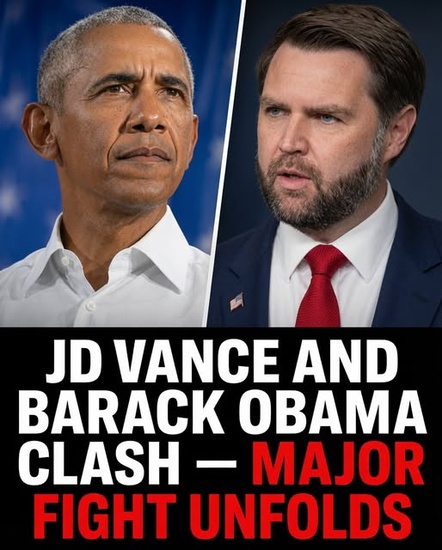
A viral graphic circulating online claims that “JD Vance and Barack Obama clash — major fight unfolds.” The image depicts Obama and Vance side by side, suggesting a dramatic new confrontation between the two politicians.
The underlying dispute, however, is more nuanced. Obama did publicly criticize Vance in July, but there is no evidence of a new direct confrontation or physical “fight” between the two men. Instead, their clash has played out through sharply opposing arguments over immigration, citizenship and the definition of American identity.
Obama Takes Aim at Vance’s Immigration Views
Obama’s criticism came during a conversation with author Malcolm Gladwell about the legacy of Reconstruction and the continuing debate over race, citizenship and American democracy.
Obama argued that some contemporary political rhetoric echoes historical arguments over who should be considered a full member of American society.
He specifically referred to Vance, saying the vice president was promoting what he described as a “blood-and-soil” version of “We the People” — a phrase Obama used to characterize an emphasis on ancestry, family background and length of residence in America.
Obama also highlighted the fact that Vance is married to Usha Vance, whose parents immigrated from India.
The former president argued that the contrast illustrated a political contradiction. He and Gladwell discussed the idea that such contradictions represented a change from the more explicit exclusionary politics of the past.
Obama ultimately described the contradiction as “hypocrisy,” but added that hypocrisy itself could represent a form of progress because it suggested people might recognize, at some level, the gap between their principles and behavior.
What Vance Has Said About American Identity
Obama's comments were connected to several statements Vance has made about immigration and citizenship.
Vance has argued that the United States should not be understood exclusively as a nation based on abstract political ideals. In a speech discussed during the controversy, he questioned the idea of America as a “purely creedal nation” and emphasized ancestry, history and a shared national culture.
He also argued that Americans whose ancestors fought in the Revolutionary War or Civil War have a stronger historical connection to the country than people who reject the country's traditional institutions and values.
Those arguments have become part of a broader Republican debate over nationalism, immigration and what it means to be American.
For Obama and other Democrats, the rhetoric raises concerns about defining American belonging according to ancestry rather than citizenship and constitutional principles.
For Vance and his supporters, however, emphasizing national history and cultural cohesion is part of a broader argument that American identity requires more than simply agreeing with abstract democratic ideals.
Birthright Citizenship Is at the Center of the Dispute
The disagreement also comes as the Trump administration has attempted to restrict birthright citizenship.
In June, the Supreme Court rejected the Trump administration's effort to broadly end birthright citizenship through executive action. Vance subsequently described the ruling as a “major, major mistake” and argued that the administration should continue fighting to change the policy.
Vance has argued that the existing system can encourage what he calls “birth tourism,” in which foreign nationals travel to the United States to give birth.
The administration's position has put birthright citizenship — historically rooted in the 14th Amendment — at the center of one of America's most contentious immigration debates.
Obama's criticism therefore extends beyond Vance personally. It reflects a larger disagreement over whether American citizenship should be understood primarily through constitutional and civic principles or through ancestry, national culture and historical ties.
No Evidence of a New “Major Fight”
The wording of the viral graphic requires an important clarification.
There is no credible reporting showing that Obama and Vance recently engaged in a direct confrontation or “major fight.” Their most notable exchange occurred through public commentary in July, when Obama criticized Vance's immigration rhetoric.
The two men are, however, expected to be in the same location for the 25th anniversary of the September 11 attacks. Vance is scheduled to represent the White House at the Ground Zero ceremony in New York, while Obama and former presidents Joe Biden, George W. Bush and Bill Clinton are expected to attend.
Vance even joked publicly about meeting the former presidents during the ceremony, saying he expected to have “intense intellectual conversations” with them.
That upcoming appearance may help explain why images depicting Obama and Vance together are attracting renewed attention, but it should not be confused with evidence of an actual confrontation.
Vance's Growing Role in the Republican Party
The dispute also comes at a politically significant moment for Vance.
With President Donald Trump constitutionally barred from seeking a third consecutive term, Republicans are already debating who will define the party after Trump. Reuters reported this week that Vance is increasingly emerging as one of the party's potential future leaders, although Secretary of State Marco Rubio is viewed as another major contender for the 2028 nomination.
Vance's increasingly prominent role means that his arguments over immigration, nationalism and American identity are likely to remain part of the national political debate.
Obama, meanwhile, continues to speak publicly about threats to multiracial democracy and the historical consequences of exclusionary politics.
What the Viral Graphic Gets Right — and What It Leaves Out
What it gets right:
- Obama has publicly criticized JD Vance.
- The criticism focused on immigration, citizenship and American identity.
- Obama specifically pointed to Vance's marriage to Usha Vance, whose parents immigrated from India.
- Vance has strongly supported restricting birthright citizenship.
What it leaves out:
- There is no evidence of a literal confrontation between Obama and Vance.
- The major Obama-Vance exchange occurred in July 2026, not as a newly documented September “fight.”
- The disagreement is fundamentally ideological and political.
- Vance's position is part of a broader Republican debate about nationalism and immigration, while Obama's criticism reflects a competing vision of multiracial American democracy.
The Bigger Picture
The Obama-Vance dispute is less about a personal feud than about two competing visions of American identity.
Obama argues that the United States should continue expanding the meaning of citizenship and belonging within a multiracial democracy. Vance emphasizes national cohesion, ancestry, cultural continuity and stricter immigration controls.
As Vance becomes increasingly central to the Republican Party's future and immigration remains one of the defining issues heading into the 2026 midterm elections, their contrasting views are likely to receive even more attention.
The viral graphic captures that political tension — but calling it a “major fight” overstates what has actually happened.
Comments (0)
Loading comments...
May You Like

OBAMA STUNS ON INSTAGRAM: MESSAGE MARKING 34-YEAR MILESTONE SPARKS A BUZZ

Shocking news from Ohio: an unexpected development ahead of Trump's rally













