
Obama Did Not Call Trump’s Ballroom a “Graveyard” — What He Actually Said, and How the White House Fired Back
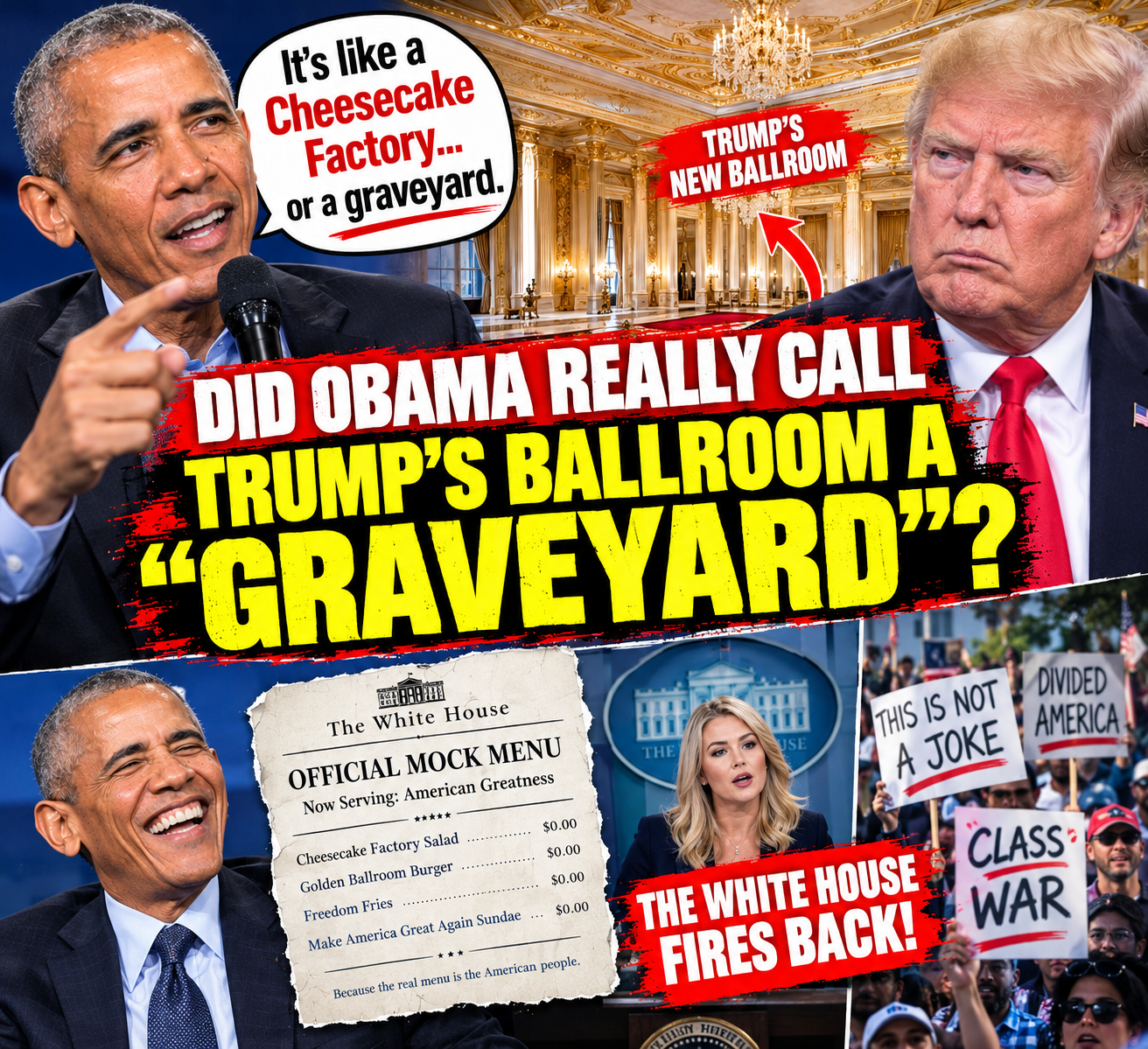
A provocative headline has added a new twist to the growing dispute between former President Barack Obama and President Donald Trump over the White House’s renovations. Social media posts have suggested that Obama described Trump’s planned ballroom as a “graveyard,” but that wording does not appear in the verified remarks at the center of the controversy.
What Obama actually said was different — and still sharply critical. During a Democratic campaign rally in Ohio on October 24, he compared the White House’s gold-heavy redesign to a place where Saddam Hussein had opened a Cheesecake Factory. The joke targeted the building’s increasingly elaborate appearance, not the ballroom specifically as a “graveyard.”
The distinction matters. The viral headline turns a broader satirical comparison into a dramatic quotation that the available reporting does not substantiate. The documented remarks, however, were enough to trigger a public exchange involving Trump, White House officials and Treasury Secretary Scott Bessent.
The real Obama quote: a Cheesecake Factory comparison
Obama’s remarks came as he criticized Trump’s attention to White House renovations during a rally supporting Democratic candidates, including Ohio Senate candidate Sherrod Brown and gubernatorial nominee Amy Acton.
He questioned whether the president was sufficiently focused on issues affecting ordinary Americans, then listed several changes to the presidential residence: the construction of a large ballroom, the paving of the Rose Garden, a new helicopter landing area and the addition of extensive gold-colored decoration.
“He seems very focused on home renovations. He should be on HGTV,” Obama said before delivering the line that quickly spread across social media:
“He’s got the White House looking like Saddam Hussein opened a Cheesecake Factory.”
The comparison was a joke about the ornate, gold-heavy appearance of the renovations. It was not a statement that Trump’s ballroom was a graveyard.
Trump’s response turns the joke into a political confrontation
Trump responded publicly on October 26, defending the renovations and arguing that Obama did not understand the work required to maintain the White House.
At a campaign stop in Mississippi, Trump said the building had to remain “clean, pristine, beautiful” and criticized Obama for comparing its appearance to a restaurant. He also defended the Cheesecake Factory itself, describing it as a successful company and suggesting that Obama did not appreciate successful businesses.
Trump further argued that the White House had been in poor condition before his improvements, citing issues such as damaged ornaments, cracks and deteriorating features. He dismissed the renovation spending as “peanuts” during his remarks.
The exchange quickly became more than a disagreement over interior design. Trump’s supporters argued that Obama’s comparison was disrespectful to a popular restaurant chain, while Democrats and other commentators maintained that the joke was aimed at the White House’s elaborate décor rather than the restaurant or its customers.
The White House’s mock menu: what was actually posted?
One of the most unusual developments came when the White House’s official social media account joined the dispute with a parody Cheesecake Factory-style menu.
Rather than publishing a genuine restaurant menu, the account used the joke as an opportunity to promote Trump’s political agenda. The post featured mock menu items, including references to border security and American energy, alongside a message suggesting that the list of the president’s accomplishments was even larger than the restaurant’s famously extensive menu.
White House spokesperson Davis Ingle also issued a statement defending Trump’s renovation work. He praised the president’s efforts to improve the appearance of the White House and criticized Obama’s record.
The mock menu was therefore a real political communications response, but it should not be confused with an official restaurant menu or evidence that the White House had literally opened a Cheesecake Factory inside the presidential residence.
Treasury Secretary Scott Bessent gets pulled into the controversy
The response did not stop with Trump and the White House communications team. Treasury Secretary Scott Bessent also entered the debate.
Bessent visited a Cheesecake Factory restaurant near the White House and spoke to reporters about Obama’s comments. He defended the restaurant and criticized the former president, making a reference to the Obama Presidential Center in Chicago, which he compared to Darth Vader’s tomb.
Obama later used Bessent’s appearance as another part of his criticism. At a rally in Morrow, Georgia, on October 28, he argued that the administration had devoted an extraordinary amount of attention to answering a joke while Americans were still concerned about inflation and affordability.
“They mobilized a whole-of-government response to that joke,” Obama told the crowd, adding that the response was directed at his restaurant comparison rather than the economic pressures facing households.
He also joked about his own family’s familiarity with the restaurant, saying that raising two daughters meant he had spent plenty of time at the Cheesecake Factory.
The ballroom itself remains at the center of the dispute
Behind the jokes is a substantial construction project with implications for the appearance and operation of the White House.
Trump has promoted plans for a large ballroom, alongside other changes to the presidential complex. The project has attracted attention because of its scale, the demolition and redevelopment of parts of the East Wing area, and questions about its cost and funding.
The ballroom has been described by Trump as a major addition to the White House. Reporting by Fortune said the project was being funded largely by private donors, including major technology and defense companies. The precise overall cost has been disputed: Trump has cited a figure of up to $400 million, while a contractor estimate reviewed by The Washington Post reportedly put the figure higher.
Those figures should not be treated as interchangeable or as a final audited cost. The funding arrangements and the distinction between private contributions and public expenses are important when assessing claims about the financial burden on taxpayers.
Why the Cheesecake Factory became part of the midterm debate
The controversy has also developed into a debate about class, taste and political identity.
Some Trump supporters accused Obama of sounding elitist by using a restaurant familiar to many American families as the basis for a joke. Others argued that the comparison was clearly directed at the ornate design of the White House, not at the people who eat at the restaurant.
The Guardian noted that the backlash had turned the restaurant into an unexpected culture-war symbol, with commentators arguing over whether Obama’s remarks were condescending or simply a joke about excessive decoration. The restaurant’s own elaborate interiors became part of the discussion.
The argument has also given both political camps an opportunity to return to familiar themes. Republicans have emphasized presidential stewardship, national symbolism and the importance of maintaining the White House. Democrats have focused on the cost of living and questioned whether the administration is giving sufficient attention to economic concerns.
Obama’s criticism that Trump’s priorities are misplaced is a political argument, not proof that the renovations themselves caused inflation. Similarly, Trump’s defense of the project does not resolve questions about its final cost, financing or public oversight.
What the viral headline gets wrong
The central facts can be separated from the more dramatic claims circulating online:
-
Did Obama call the ballroom a “graveyard”? The available reporting does not support that quotation. His documented comparison was that Trump’s White House looked like Saddam Hussein had opened a Cheesecake Factory.
Was the ballroom part of his criticism? Yes. Obama specifically mentioned the ballroom as one of the renovation projects he was criticizing.
Did the White House respond with a mock menu? Yes. Its official social media account used a parody menu to promote Trump’s accomplishments.
Did Trump respond personally? Yes. He publicly defended the renovations and criticized Obama’s remarks.
Did Bessent join the dispute? Yes. The Treasury secretary visited a Cheesecake Factory and made remarks criticizing Obama.
The image’s “graveyard” wording should therefore be understood as a provocative headline, not a verified direct quotation from the former president.
A renovation dispute becomes another Obama–Trump showdown
The exchange demonstrates how a single campaign joke can become a much larger political story. Obama used the White House’s changing appearance to criticize Trump’s priorities. Trump defended the work as necessary improvements to an important national building. The White House then turned the restaurant reference into a social-media response, while Bessent added another public intervention.
With the November 3 midterm elections approaching, both sides have reasons to keep the disagreement alive. For Democrats, the controversy offers another way to raise questions about economic priorities. For Republicans, it provides an opportunity to challenge Obama’s tone and defend Trump’s approach to the presidency.
But the factual answer to the question in the viral headline is straightforward: Obama did not publicly call Trump’s ballroom a “graveyard” in the documented remarks. He made a Cheesecake Factory comparison about the White House’s elaborate redesign — and the administration responded with a political counterattack that included a mock menu.
Comments (0)
Loading comments...
May You Like

AMERICA'S ECONOMY IS GROWING — SO WHY ARE AMERICAN FAMILIES STILL STRUGGLING?

BLACK FRIDAY TENSIONS IN NYC — DID PROTESTERS CROSS THE LINE AT A DISNEY STORE?

TRUMP'S BIGGEST THANKSGIVING “PARDON”? WHY IS HE BACKING NVIDIA'S JENSEN HUANG?












