
Obama Challenges Corporate America Over Deals With Trump Administration, Urging Businesses and Universities to Stand Their Ground
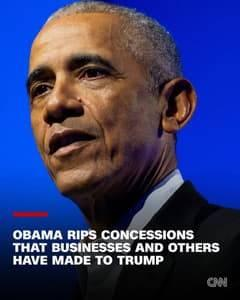
Former President Barack Obama has criticized major businesses, law firms and universities that reached agreements or made concessions to President Donald Trump’s administration, arguing that powerful institutions should be prepared to defend their principles rather than yield to political pressure. His remarks, published in October 2025, renewed a debate over the relationship between government power, corporate decision-making and institutional independence in the United States.
Speaking in an interview with comedian Marc Maron for the final episode of the long-running WTF with Marc Maron podcast, Obama said organizations had the capacity to resist demands they considered improper. He acknowledged that confronting the administration could carry financial and operational risks, but argued that institutions should not automatically abandon their commitments simply to avoid conflict with the federal government.
“We all have this capacity, I think, to take a stand,” Obama said, according to CNN’s report on the interview. He also challenged organizations to resist being “bullied” into hiring or promoting people according to criteria he criticized as politically imposed. In that part of the discussion, he referred to White House adviser Stephen Miller, a prominent figure in Trump’s policy operation.
The interview was not a response to a single corporate deal announced that day. Rather, Obama was addressing a broader pattern of agreements between the administration and institutions that faced pressure over federal funding, legal disputes, diversity policies and other politically sensitive issues. His criticism was directed at what he saw as the cumulative effect of those decisions on institutional independence.
The deals and concessions behind Obama’s criticism


The disputes involved several different types of institutions and should not be treated as one identical set of arrangements. Some universities faced pressure connected to federal grants and the administration’s handling of allegations of antisemitism on campus. Law firms negotiated agreements with the administration amid concerns about potential executive action. Businesses also confronted pressure around diversity, equity and inclusion policies and other corporate practices. The terms, legal circumstances and consequences varied from case to case.
These negotiations unfolded in an environment in which federal agencies and the White House can exercise substantial influence through funding decisions, regulatory authority, executive directives and government contracts. For an institution dependent on federal support, resisting an administration can involve significant uncertainty. For a corporation, a dispute with the government may also create legal expenses, regulatory complications or disruption to its business.
Obama’s argument was that these risks should be weighed against the long-term costs of surrendering institutional autonomy. In his view, if organizations respond individually to pressure without coordinating around shared principles, they may find it increasingly difficult to defend those principles later.
He nevertheless acknowledged that the choice was not simple for every organization. During the interview, Obama expressed sympathy for leaders trying to protect employees, students, clients and their institutions from retaliation. His criticism was not that every agreement was necessarily identical or that every executive had the same options, but that institutions should consider whether a concession could weaken their independence or establish a precedent for future demands.
Why universities and law firms became part of the political dispute
Universities occupy a particularly sensitive position because they depend on a mix of tuition, private donations, research grants and public funding. Federal action can affect their research budgets and operations, while disputes over campus protests, antisemitism, admissions and diversity policies can trigger competing demands from students, faculty, donors and government officials.
The administration’s pressure on universities therefore raised questions extending beyond any single policy disagreement: How much influence should the federal government have over academic institutions? When does an agreement resolve a legitimate dispute, and when might it compromise academic freedom or independent governance? Those questions require examination of each agreement’s actual terms rather than assuming that every settlement represents the same kind of capitulation.
Law firms face a different set of pressures. Their work can involve federal agencies, government investigations and clients whose interests depend on the administration’s decisions. Agreements with the government can potentially reduce immediate exposure, but they can also attract scrutiny from lawyers and civil-liberties advocates concerned about professional independence and the ability of attorneys to represent clients without political interference.


Obama’s remarks placed these institutions within a larger argument about how democratic systems function. In his view, elected officials are not the only actors responsible for defending democratic norms. Universities, law firms, companies and other influential organizations also make choices that can either reinforce or weaken the independence of civil society.
That argument does not automatically establish that every agreement with the Trump administration was improper. Institutions may have different legal obligations, financial circumstances and reasons for settling disputes. The central issue raised by Obama was whether they were making those decisions on their own terms—or primarily to avoid political or financial consequences.
Obama also criticized the limits of political absolutism
The podcast conversation covered more than corporate concessions. Obama also reflected on the challenges facing Democrats, the changing media environment and the importance of communicating across political differences.
He cautioned progressives against presenting themselves as morally superior or treating people who disagree with them as beyond persuasion. Obama argued that political communication becomes less effective when it lectures people without acknowledging complexity or the possibility of being wrong.
That part of the interview provides important context for his comments about business leaders. His broader message was not simply that organizations should oppose Trump. He also argued that political actors need integrity, humility and a willingness to engage with people who hold different views.
In discussing political communication, Obama praised the value of long-form conversations that allow candidates to explain their positions and respond to disagreement. He singled out Texas state Representative James Talarico as a politician whose appearance on The Joe Rogan Experience demonstrated the potential of engaging audiences outside traditional political media.
These remarks suggest that Obama’s approach involved two related but distinct concerns: institutions should not abandon core principles merely to avoid pressure, and political leaders should communicate in ways that invite engagement rather than relying on condemnation alone.
The economic and democratic stakes
The controversy highlights a tension facing companies and other institutions operating under any administration: maintaining a constructive relationship with government can be important to their work, but excessive dependence on political goodwill can raise concerns about their independence.
For businesses, decisions involving government agreements can affect shareholders, employees, customers and future regulatory relationships. For universities, they can shape research funding and academic governance. For law firms, they can raise questions about professional obligations and the freedom to represent clients. There is no single formula that resolves these competing responsibilities, and the details of each agreement matter.
Obama’s warning was that short-term protection may come with longer-term consequences if institutions become accustomed to changing policies or practices in response to political pressure. He urged influential organizations to consider not only the immediate cost of resisting a demand, but also the precedent established when they choose not to resist.
At the same time, determining whether a particular agreement undermines democratic norms requires more than political rhetoric. It requires examining the demands made, the legal basis for government action, the concessions accepted and the practical consequences for the institution involved. Those details are essential to distinguishing a voluntary settlement from a concession made under improper pressure.
The October 2025 interview was notable because Obama directly challenged influential organizations to consider their responsibility in a political environment where government decisions can carry significant financial consequences. His remarks placed corporate America, universities and law firms at the center of a wider discussion about institutional independence and accountability.
Ultimately, Obama’s message was that protecting an institution’s long-term credibility may sometimes require accepting short-term discomfort. Whether individual organizations should have rejected particular agreements remains a question to be judged on the evidence surrounding each case. But his comments made clear that, in his view, the decisions of private and nonprofit institutions can have consequences far beyond their immediate balance sheets or legal disputes.
Comments (0)
Loading comments...
May You Like

BOMBSHELL NEW JERSEY FLOOD — 112 KM/H WINDS, SEAWATER FLOODING INLAND, 120,000 HOMES AT RISK!

EAST COAST DISASTER—179 THOUSANDS OF HOMES AT RISK, CAUSING $50 BILLION IN DAMAGE!

STAR DIED AT 38, $10M LIFE INSURANCE INCREASED JUST 30 DAYS BEFORE WWE BRONSON REED'S DEATH!










Popular Posts




