
Obama Challenges Trump’s Tariff Strategy, Warning That America Risks Alienating Its Closest Allies
Former President Barack Obama's renewed criticism of Donald Trump has brought a fundamental question about American foreign policy back into the national debate: How should the United States balance economic pressure, national interests and the relationships it has built with its closest allies over generations?
As the November 3 midterm elections approach, Obama has challenged the direction of Trump's second administration, criticizing its handling of international security and questioning whether the United States is weakening the partnerships that have long supported its global influence.
The disagreement extends beyond diplomatic language. Trump's use of tariffs, his demands for concessions from trading partners and his confrontations with allied governments have raised questions about the future of international economic cooperation.
Obama's criticism reflects a different understanding of American power—one in which alliances are not merely arrangements to be renegotiated for immediate advantage, but institutions that provide lasting security, economic and diplomatic benefits.
Trump and his supporters offer a competing argument. They maintain that previous administrations accepted trade arrangements that disadvantaged American industries and failed to demand sufficient contributions from countries benefiting from U.S. security guarantees.
The dispute therefore involves more than whether Washington should be tough or conciliatory. It concerns how the United States defines its interests, measures the costs of international commitments and uses its economic influence.
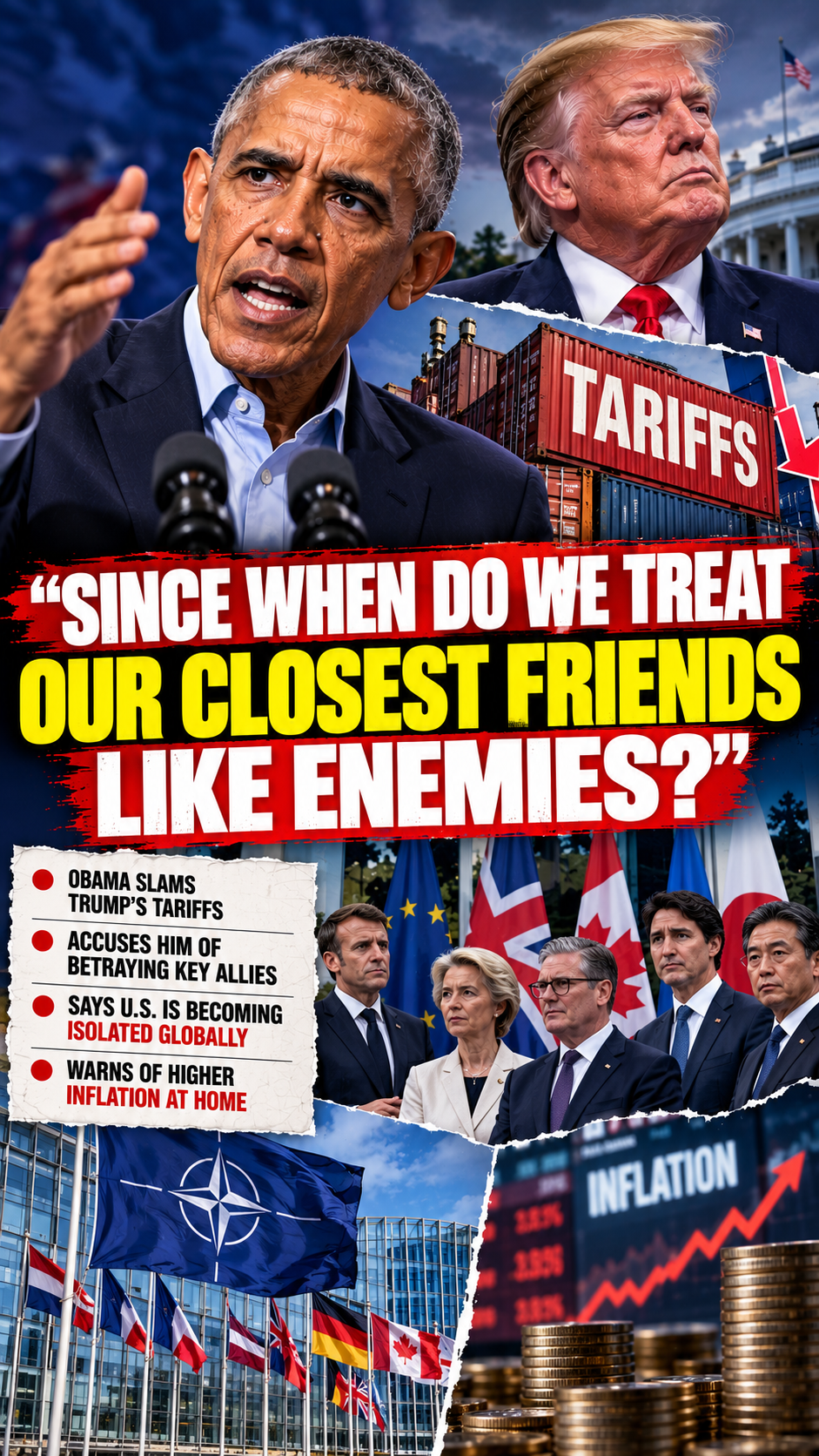
A viral graphic accompanying the latest discussion attributes a particularly pointed question to Obama: “Since when do we treat our closest friends like enemies?”
That exact wording should not be presented as an authenticated quotation from his October campaign speeches without a verified transcript or recording. The broader criticism of Trump's foreign-policy approach is consistent with Obama's documented public positions, but the graphic combines multiple arguments into a single dramatic message.
The distinction is important because the underlying policy dispute is substantial even without an unverified quotation.

The most revealing part of Obama's latest criticism came during his October 24 campaign appearances in Cleveland and Detroit, where he turned a complex trade dispute into a pointed question about America's relationship with Canada.
In Cleveland, Obama mocked Trump's confrontation with the United States' northern neighbor, sarcastically describing Canada as a “well-known evil empire.”
The remark drew attention because Canada is not a conventional American geopolitical adversary. It is a NATO ally, a major trading partner and a country whose manufacturing supply chains are closely integrated with those of the United States.
During his Detroit appearance, Obama continued the joke, referring to Canada as America's supposed historical adversary before reminding the audience that the country was just across the border.
He also highlighted Canada's cultural contributions, mentioning comedian Martin Short and maple syrup.
The humor served a political purpose: Obama was questioning why the administration was escalating trade tensions with a country that maintains extensive economic and security ties with the United States.
The dispute has immediate relevance to Michigan.
The state's automobile industry depends on production networks extending across the U.S.–Canada border. Vehicles assembled in Michigan may contain engines, transmissions, electronic components and other parts manufactured in Ontario or elsewhere in Canada.
Some components cross the international border multiple times before a finished vehicle reaches a dealership.
When tariffs apply to those movements, manufacturers may face higher expenses, additional paperwork or pressure to reorganize production.
Those costs can be absorbed by companies, passed along to buyers, negotiated with suppliers or offset through changes in production. The precise outcome depends on the product, tariff rules and competitive conditions.
Obama's argument was that American consumers and manufacturers could ultimately bear part of the cost of tariffs ostensibly directed at foreign trading partners.
He emphasized that the consequences extend beyond imported consumer goods to products assembled in the United States using imported components.

The trade confrontation has intensified throughout 2026.
According to reporting by The Canadian Press, Trump imposed tariffs of 50% on billions of dollars' worth of Canadian goods, including motor vehicles.
Canadian Prime Minister Mark Carney responded in September with retaliatory tariffs on American products.
Trump has indicated that some existing tariffs could be lifted at the end of October, while other categories of Canadian goods could face new restrictions.
The resulting uncertainty affects businesses attempting to plan investment, production and supply contracts.
For manufacturers, the final tariff rate is only one consideration. Companies also need to know how long a tariff will remain in force, whether exemptions will apply and whether the neighboring country will respond with additional measures.
Those questions can influence decisions about factory expansion, hiring, sourcing and inventory management.
Trump has defended tariffs as an instrument of economic policy.
His administration argues that higher duties can discourage imports, strengthen domestic production, protect strategically important industries and provide leverage in trade negotiations.
Supporters of this approach also contend that American companies have faced unfair competition from countries using subsidies, trade barriers or other policies to favor domestic producers.
These arguments are not unique to Trump. American policymakers from both parties have supported targeted trade restrictions in certain industries.
The disagreement concerns the scale, design and consequences of the administration's tariff program, especially when it targets close trading partners.
Critics argue that broad tariffs can raise costs for American firms, invite retaliation and weaken supply chains built over decades.
The economic evidence must be evaluated by examining specific tariff schedules, changes in import prices, company expenses and consumer prices.
A tariff does not automatically increase every retail price by the full percentage of the duty. But it creates an additional cost at the point of importation, and some portion of that cost may be transmitted through the economy.

Obama made that distinction central to his criticism.
In Cleveland, he argued that tariffs contribute to rising prices because manufacturers often depend on components sourced internationally.
The former president also connected the issue to broader concerns about the cost of living, federal borrowing and the administration's economic priorities.
His speeches came amid a national debate over inflation, energy prices and the economic effects of the conflict involving Iran.
These pressures have different causes. Oil-market disruption can influence transportation and energy expenses, while tariffs affect the cost of particular imported goods and inputs.
Housing expenses, labor costs, interest rates and domestic supply conditions also contribute to household budgets.
Consequently, it would be inaccurate to attribute all inflation to tariffs alone.
It would be equally misleading to assume tariffs have no domestic economic cost simply because they are imposed on foreign products.
Obama's claim was that tariffs were one contributing factor in a wider affordability problem.
The former president's criticism also raised the diplomatic consequences of treating trade relationships primarily as instruments of pressure.
Canada and the United States share extensive defense cooperation through NATO and the North American Aerospace Defense Command, known as NORAD.
They also cooperate on border security, intelligence, transportation infrastructure and emergency management.
Those arrangements have developed over decades and involve interests that extend beyond the trade balance.
A dispute over automobile tariffs does not automatically end defense cooperation. Governments routinely disagree on economic policy while continuing to collaborate on security.
Nevertheless, repeated economic confrontations can complicate diplomatic relationships and create incentives for countries to diversify trade and investment.
Canada has sought to strengthen economic relationships beyond the United States, while European governments have also debated how to reduce exposure to unpredictable trade measures.
The extent to which such policies amount to a lasting separation from the American economy remains uncertain.

The dispute with Canada is part of a wider discussion among U.S. allies about economic security.
European governments have faced their own disagreements with Washington over tariffs, defense spending and strategic policy.
Some have sought negotiated arrangements intended to preserve market access and limit economic disruption.
Others have emphasized the need to protect domestic industries and develop alternative trading relationships.
These responses are not identical, and it would be inaccurate to describe all American allies as following one coordinated policy against Washington.
The European Union, Canada, Britain and Japan have different economic structures, security commitments and negotiating priorities.
Their governments may cooperate with the United States on defense while opposing specific American trade measures.
The existence of such disagreements does not establish that Washington has become completely isolated internationally.
The United States continues to participate in major diplomatic and military partnerships, including NATO.
What is being debated is the reliability and direction of those relationships under a more confrontational trade policy.

Obama's comments also reflect a longstanding difference between his approach to international cooperation and Trump's.
During his presidency, Obama emphasized multilateral institutions, diplomatic agreements and cooperation with established allies.
His administration pursued international climate negotiations, the Iran nuclear agreement and trade arrangements intended to strengthen American economic influence.
Those policies attracted criticism of their own.
Opponents argued that some agreements imposed insufficient restrictions on foreign governments, disadvantaged certain American workers or placed too much faith in international institutions.
Trump has instead emphasized bilateral leverage, tariffs, national sovereignty and greater allied responsibility for defense spending.
He has argued that previous administrations were too willing to accept arrangements that did not adequately serve American interests.
Both approaches involve trade-offs.
Multilateral cooperation can make collective action easier but may require compromises among participating countries.
Unilateral economic pressure can create negotiating leverage but may also prompt retaliation and uncertainty.
The results depend on the objectives being pursued, the responses of other governments and the durability of any agreements reached.
Obama's latest speeches criticized the administration's choices within that broader policy debate.
They did not provide a comprehensive alternative trade agreement or a detailed tariff schedule.

The political setting of Obama's remarks is equally important.
He appeared in Ohio to support Democratic Senate candidate Sherrod Brown and gubernatorial candidate Amy Acton.
He then traveled to Michigan to campaign for Senate candidate Abdul El-Sayed and gubernatorial candidate Jocelyn Benson.
The events were part of the Democratic Party's final campaign effort before the November 3 midterm elections.
Obama's speeches covered a wide range of issues, including federal spending, political conduct, the Iran war and the administration's economic record.
His criticism of tariffs was one part of that larger argument.
In Detroit, the Canada dispute carried particular resonance because of Michigan's close economic relationship with Ontario.
The Detroit–Windsor corridor is a major route for cross-border commerce, making changes in U.S.–Canada trade policy directly relevant to regional businesses.
That local context helps explain why Obama emphasized Canada rather than speaking only about tariffs in abstract terms.
The campaign setting also means his remarks should be understood as political advocacy.
He was criticizing Republican policies and supporting Democratic candidates, not delivering an official economic forecast or speaking on behalf of allied governments.
Trump has responded to Obama's broader criticism by defending his administration's policies and attacking the former president's record.
The White House maintains that its trade approach is intended to protect American workers and industries.
The administration has also linked economic security with national security, arguing that dependence on foreign production can expose the United States to strategic vulnerabilities.
Those concerns can be examined separately from the question of whether a particular tariff improves economic outcomes.
For example, strengthening domestic production of a strategically important component may be a policy objective even if it increases some short-term costs.
The relevant analysis would consider the security benefits, financial costs, available alternatives and effects on consumers.
Similarly, negotiating concessions from a trading partner may be valuable, but the result should be assessed against any retaliatory measures or economic disruption incurred during the dispute.
Neither a president's stated intention nor a critic's warning is sufficient by itself to establish the outcome.

The longer-term issue is whether tariffs will produce lasting changes in North American production.
Automakers and suppliers make investment decisions over many years. New factories, equipment and supply relationships require substantial capital.
If companies expect tariffs to remain in place, they may change where they manufacture components.
If they expect tariffs to be negotiated away, they may delay investment or continue using existing supply chains.
Retaliatory tariffs can also affect American exporters, including manufacturers and agricultural businesses that sell products in Canada.
The economic consequences are therefore distributed across multiple industries and communities.
For some domestic producers, import restrictions may create opportunities to expand output.
For companies dependent on foreign inputs, the same restrictions may increase expenses.
Consumers may face higher prices for certain products, although the size and timing of those increases vary.
This complexity is why economists often distinguish between targeted measures intended to address specific trade problems and broad tariffs applied across entire categories of imports.
Obama's criticism emphasized the costs to consumers and integrated industries. Trump's defense emphasizes protection, leverage and domestic production.
The policy debate turns on evidence about those competing objectives.

The midterm elections will influence how Congress approaches that debate.
Lawmakers can conduct oversight of tariff policy, examine the economic effects of trade measures and consider legislation affecting presidential authority over international commerce.
Congress also has responsibilities involving federal spending, taxation and the regulation of interstate and foreign trade.
The precise balance of authority between Congress and the executive branch depends on existing statutes and judicial interpretations.
Changes in congressional control may affect the intensity of oversight and the likelihood of legislative proposals, but they do not automatically reverse tariffs already imposed.
Trade negotiations also involve foreign governments whose decisions cannot be dictated by American electoral outcomes.
The November election therefore represents one part of a larger policy process rather than a single referendum capable of resolving every international dispute.
Obama's comments have drawn attention because they connect a practical economic concern—what tariffs cost American households and manufacturers—with a broader diplomatic question about how Washington treats its allies.
His sarcastic description of Canada as an adversary was intended to highlight that tension.
The verified quotation is not the dramatic question printed across the viral image. It is his reference to Canada as a “well-known evil empire,” a joke aimed at Trump's decision to escalate trade pressure against a longstanding partner.
That distinction does not diminish the substance of the disagreement.
It makes the reporting more precise.
As the United States approaches November 3, the debate over tariffs will continue to involve competing arguments about manufacturing, prices, national security and the country's relationships with its trading partners.
Obama has argued that the administration's approach imposes costs on American consumers and creates unnecessary conflict with Canada.
Trump has defended tariffs as a means of securing better economic arrangements and strengthening domestic industry.
The available reporting establishes those opposing positions and documents the latest U.S.–Canada trade tensions.
It does not establish that America has lost every major ally, that tariffs alone explain all domestic inflation or that Obama used the exact quotation featured in the supplied illustration.
The central development is a renewed public dispute over whether Washington's trade strategy is protecting American interests or placing unnecessary strain on the economic partnerships that support them.
That question will remain important after the midterm campaign ends, regardless of the election results.
Comments (0)
Loading comments...
May You Like

DAVENPORT AIRBNB HORROR — “SHOTS AT THE DOOR” GAME, 1 DEAD, 6 INJURED!

WWE BRONSON REED DEAD AT 38, STIMULANTS DETECTED, $10M INSURANCE PAYOUT FROZEN!

FLORIDA AIRBNB NIGHTMARE — 50 TEENS, 7 SHOOTING VICTIMS LINKED TO “SHOTS AT THE DOOR”!









Popular Posts



