
Obama Condemns “Deeply Troubling” Political Rhetoric After Trump Shares Offensive Video Depicting the Obamas
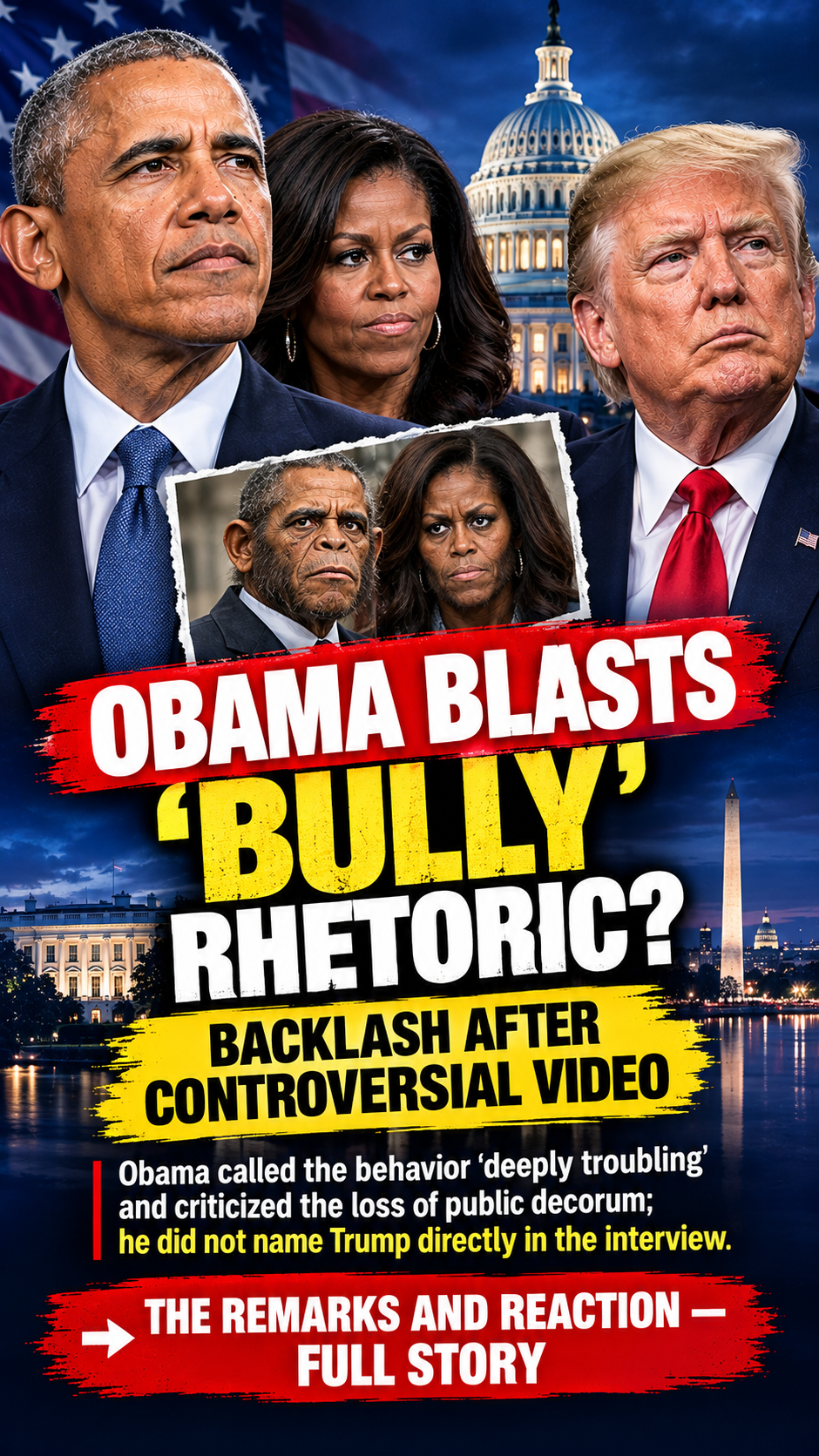
Former President Barack Obama criticized what he described as a troubling decline in political discourse after President Donald Trump’s social media account shared a video depicting Obama and former first lady Michelle Obama as apes, setting off a bipartisan backlash and renewed debate over the standards expected of the country’s highest public officials.
The controversy erupted in February 2026, when a video posted to Trump’s Truth Social account promoted false claims about the 2020 presidential election before briefly showing the Obamas’ faces superimposed on the bodies of primates. The imagery was widely condemned as racist and offensive, including by some Republicans. The post was subsequently removed, but the episode drew fresh scrutiny to the political consequences of inflammatory online content and the responsibility of public figures for material shared through their accounts.
Obama addressed the controversy in an interview with political commentator Brian Tyler Cohen, released on February 14. He did not directly name Trump in his response. Instead, he spoke more broadly about the deterioration of public discourse, the role of social media in amplifying provocative material and what he viewed as a weakening commitment to dignity and restraint in public office.
The distinction matters: while the viral graphic frames the episode as Obama personally branding Trump a “bully,” the documented remarks focused on the broader political climate. Obama said most Americans found the behavior “deeply troubling” and described the spectacle dominating social media and television as a “clown show.” Those comments conveyed his criticism of the conduct and the wider culture surrounding it, rather than a direct, quoted accusation that Trump was a bully.
The video that sparked the backlash


The video was shared late on February 5, according to reporting by ABC News. Most of the clip promoted claims about alleged fraud in the 2020 election—claims that have been repeatedly rejected by courts and election officials. Near its end, however, it showed an apparently AI-generated sequence depicting the Obamas as apes, accompanied by the song “The Lion Sleeps Tonight.” The imagery was brief, but it quickly became the central focus of the controversy.
The White House initially defended the post as an internet meme, with press secretary Karoline Leavitt criticizing what she called “fake outrage.” Later, a White House official said a staff member had posted the video erroneously, and the clip was removed after roughly 12 hours online.
Trump offered a different account of his role. Speaking to reporters, he said he had watched the beginning of the video but had not seen the portion depicting the Obamas. He maintained that he had not made a mistake and declined to apologize, while also saying he condemned the offensive imagery. The differing explanations—an erroneous staff post on one hand and Trump’s account that he had passed along a video without viewing it in full on the other—became an additional point of criticism.
The episode also illustrated how a short segment within a longer online post can overtake the original subject. Although the video focused largely on election-fraud allegations, its depiction of the Obamas dominated public discussion and prompted questions about the review process for material shared from a sitting president’s account.
Obama’s criticism centered on public standards—not a direct personal attack
In the interview, Obama argued that provocative rhetoric can attract attention while distracting the public from more substantive issues. He also expressed concern that conduct once considered unacceptable in public life was increasingly being tolerated or rewarded.
“There doesn’t seem to be any shame about this,” Obama said, referring to what he saw as the erosion of expectations around decorum, propriety and respect for public office. He also emphasized that the behavior visible on television and social media did not necessarily reflect the character of the broader American public.
His response was measured, but it addressed a consequential question: whether political leaders and their teams should be held to different standards when sharing or amplifying material that targets opponents. The controversy was not simply about the content of one video; it also raised questions about accountability, editorial judgment and the influence of online platforms on political debate.


Obama’s comments did not amount to a direct declaration of a personal feud with Trump over the incident. Rather, he connected the episode to what he described as a broader deterioration in political discourse. That distinction is important when assessing social-media posts and headlines that present his remarks as a direct, personal denunciation.
Bipartisan criticism intensified the controversy
The reaction extended beyond Democratic politicians. Republican Senator Tim Scott of South Carolina condemned the post, calling it racist and urging Trump to remove it. Other Republican lawmakers also criticized the video, with some calling for an apology. Their responses demonstrated that objections to the imagery crossed party lines, even as political figures disagreed over how the incident should be interpreted and addressed.
The historical context added to the seriousness of the backlash. Depicting Black people as apes has a long history as a racist form of dehumanization. For critics, the fact that the video appeared on the account of a sitting president made the incident particularly troubling, regardless of whether the imagery was intended as a meme or was shared without reviewing the full clip.
The White House’s initial defense and subsequent removal of the post also raised questions about how controversial content is reviewed before publication. Trump’s statement that he had not watched the entire video did not settle those questions, and his refusal to apologize left the dispute unresolved in the immediate aftermath.
What the controversy says about political communication
The episode underscores the speed with which online content can reshape a political news cycle. A video that primarily promoted election-related allegations became a national controversy because of a brief segment involving the Obamas. The resulting debate covered race, political responsibility, the role of staff in managing official social-media accounts and the standards expected of public figures.
It also highlights the need to distinguish documented statements from interpretations added by viral posts. Obama did criticize the behavior as “deeply troubling” and lament what he saw as a loss of decorum. But the available reporting does not support presenting “Obama calls Trump a bully” as a direct quotation from the interview. That phrasing is an interpretation used in the supplied graphic and caption, not a verified verbatim statement.
The same care is needed with claims about public reaction. The episode drew criticism from politicians in both parties and extensive media coverage, but those reactions alone do not establish that the country was uniformly divided or that the incident changed voters’ views. Assessing such effects would require reliable polling or other evidence specifically measuring public opinion.
For Obama, the central message was that the loudest and most provocative moments in political media should not be mistaken for the values of the entire country. He argued that many Americans still value decency, courtesy and kindness—and suggested that the public, rather than the online outrage cycle, would ultimately help determine the standards of political life.
The controversy therefore remains a case study in the consequences of presidential social-media activity: how a post can generate scrutiny well beyond its original subject, how responsibility can become contested when material is shared through an official account, and why precise reporting matters when a viral headline turns broader criticism into a personal confrontation.
Reporting note: The underlying incident and Obama’s interview took place in February 2026. The supplied image is a political illustration, not a photograph of the incident. Its “bully” framing should be treated as commentary rather than a direct quote from Obama.
Comments (0)
Loading comments...
May You Like


BOMBSHELL NEW JERSEY FLOOD — 112 KM/H WINDS, SEAWATER FLOODING INLAND, 120,000 HOMES AT RISK!

WEYMOUTH HORROR—80-MPH WIND GUSTS, FIRE TRUCK FLIPS, 3 FIREFIGHTERS CRITICAL!









Popular Posts




