
Obama Criticizes Trump’s Iran Deal — But the Viral “Pure Evil” Graphic Goes Far Beyond the Facts
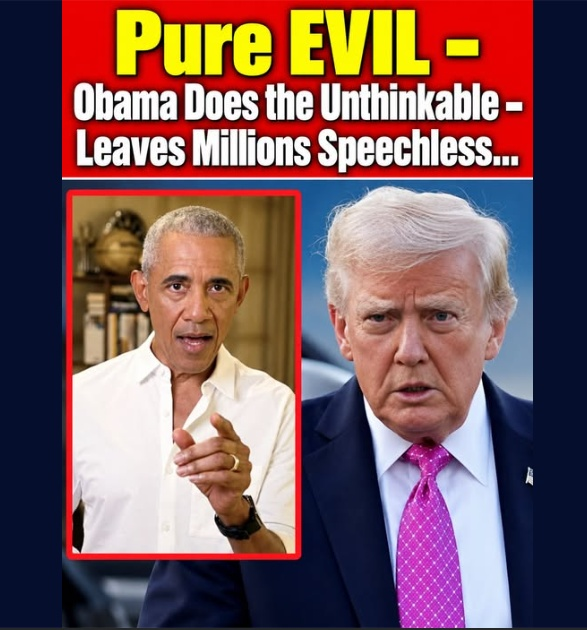
A sensational viral graphic accusing Barack Obama of doing something “unthinkable” and calling him “pure evil” appears to be referring to his June 2026 criticism of President Donald Trump’s handling of the Iran conflict.
The underlying event is real: Obama publicly questioned whether Trump’s Iran agreement had actually left the United States in a better position.
But there is no evidence that Obama did anything “unthinkable,” nor that the episode involved some shocking action against Trump. The graphic turns a political disagreement over foreign policy into an inflammatory personal accusation.
What Obama actually said
Obama discussed Trump's Iran policy in two interviews in June.
On June 13, in an interview with ABC's Robin Roberts that aired June 15, Obama was asked about the Trump administration's handling of Iran.
Obama said he was doubtful that the emerging agreement would be significantly different or better than the 2015 nuclear agreement negotiated during his presidency. He also said he hoped the bombing would stop and civilians would no longer suffer.
His broader argument was that difficult foreign-policy problems cannot necessarily be solved through military force alone and that diplomacy should be pursued before resorting to war.
That was criticism of Trump's strategy — not an extraordinary action against the president.
Obama went further after the agreement was signed
A few days later, Obama gave another interview to NBC's Today.
Asked about the preliminary U.S.-Iran agreement, Obama said he was glad there was a ceasefire but questioned the results of the conflict.
He argued that the United States had spent enormous amounts of money, placed significant strain on the military and suffered loss of life, only to arrive at a position that he believed might be no better — and potentially worse — than before the war.
NBC reported Obama saying that the country felt as though it was “back where we were before we started the war, except maybe a little bit worse off.”
The Guardian similarly reported that Obama welcomed the ceasefire while arguing that the United States could now be worse off than before the conflict.
Why the Iran deal became so controversial
The dispute was partly about the legacy of the 2015 Joint Comprehensive Plan of Action (JCPOA), the nuclear agreement negotiated during Obama's presidency.
Trump withdrew the United States from the JCPOA during his first term and had long criticized it as inadequate.
Trump's 2026 agreement with Iran was presented by his administration as a fundamentally different and superior arrangement.
But the initial agreement was a memorandum of understanding and framework, rather than a fully detailed permanent nuclear treaty. Reuters noted that the 2026 framework launched a 60-day negotiation process and contained considerably less detail about nuclear verification than the Obama-era agreement.
That distinction became important as both supporters and critics debated whether Trump had actually achieved a better deal.
The agreement did not ultimately settle the conflict
This is where the later record makes the viral graphic even more misleading.
The June agreement did not produce a lasting resolution.
By August, the U.S.-Iran memorandum had expired amid stalled negotiations and disagreements over its implementation. Al Jazeera reported that the agreement's ambiguous language contributed to its breakdown.
By September, the situation had deteriorated much further.
Reuters reported on Sept. 6 that the conflict remained unresolved, diplomatic efforts had stalled and military retaliation had resumed after the June ceasefire collapsed.
So Obama's June warning that the United States could end up worse off was ultimately part of a much broader debate about whether the agreement had produced a durable strategic result.
Did Obama attack Trump personally?
Not in the way the graphic suggests.
Obama criticized the policy and consequences of Trump's Iran strategy. He defended the basic logic behind the Obama-era nuclear agreement and questioned whether the war and subsequent agreement had improved America's position.
But his publicly reported remarks did not contain the sort of extraordinary act suggested by “Obama Does the Unthinkable.”
The “Pure EVIL” language is the graphic's characterization, not a finding by a court, government agency or other authoritative body.
What the viral graphic gets right — and wrong
What is accurate:
- Obama publicly commented on Trump's Iran policy in June 2026.
- He expressed skepticism about Trump's emerging agreement with Iran.
- He defended important aspects of the 2015 nuclear deal.
- He later said the United States could be “worse off” after the war.
- Trump and Obama represented sharply different approaches to Iran.
What is misleading or unsupported:
- There is no evidence Obama committed some “unthinkable” act against Trump.
- “Pure evil” is inflammatory political rhetoric, not an established fact.
- Obama did not announce a shocking betrayal or personal attack on Trump.
- The June agreement was not a final, comprehensive resolution of the Iran conflict.
- The subsequent collapse of the memorandum shows why the original dispute was more complicated than the graphic suggests.
Bottom line
The viral graphic is built around a genuine political dispute but radically sensationalizes it.
Obama really did criticize Trump's Iran strategy and question whether the resulting agreement left America better off. He also defended the diplomatic approach of the 2015 nuclear agreement.
But the available evidence does not support the graphic's claim that Obama did something “unthinkable” or establish that he was “pure evil.” The real story was a contentious foreign-policy argument — one that became even more consequential after the June agreement later broke down and U.S.-Iran hostilities resumed.
Comments (0)
Loading comments...
May You Like
Jack Smith Defends His Integrity as Trump Investigations Face Renewed Political Firestorm

TRUMP’S OHIO WARNING UNDER THE SPOTLIGHT














