
Obama Defends Iran Nuclear Deal, Says Diplomacy Worked — What the Viral Quote Leaves Out
Obama Defends Iran Nuclear Deal, Says Diplomacy Worked — What the Viral Quote Leaves Out
U.S. Politics • Iran Nuclear Policy • Fact Check
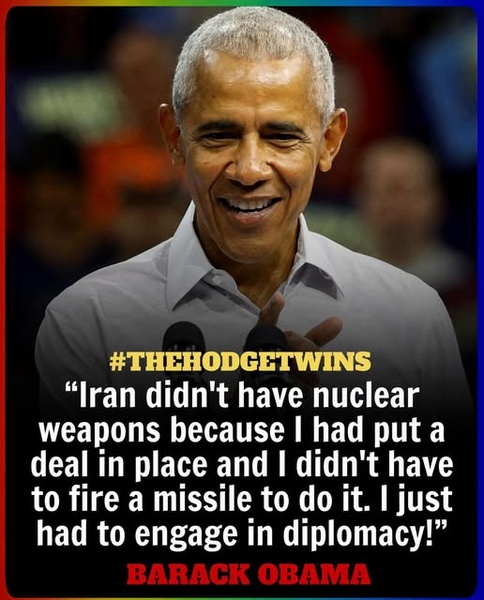
Former President Barack Obama has renewed his criticism of President Donald Trump’s approach to Iran, arguing that the 2015 nuclear agreement helped prevent Iran from obtaining a nuclear weapon without launching a military attack. The viral image captures the central point of Obama’s argument, but its quotation is shortened and the broader history is more complicated than the graphic suggests.
In remarks at a Democratic campaign rally in Cleveland on October 24, 2026, Obama argued that the original rationale for the current conflict — stopping Iran’s nuclear ambitions — overlooked the agreement his administration negotiated. He said Iran had not obtained a nuclear weapon while the deal was in effect and criticized Trump for withdrawing the United States from it in 2018.
The graphic attributes the following statement to Obama:
“Iran didn't have nuclear weapons because I had put a deal in place … I just had to engage in diplomacy!”
The wording conveys his argument, but it should not be treated as a complete transcript of his remarks. The key issue is whether the nuclear deal actually constrained Iran’s program, what it did not cover, and what happened after the United States withdrew.
What Obama’s Iran deal actually did
The agreement, formally known as the Joint Comprehensive Plan of Action (JCPOA), was negotiated by the Obama administration and signed in 2015 by Iran, the United States and five other world powers: China, France, Germany, Russia and the United Kingdom.
According to The Washington Post, the agreement placed limits on Iran’s uranium enrichment, reduced its stockpile of enriched uranium, restricted its centrifuges and established extensive international inspections. In exchange, Iran received relief from certain economic sanctions.
Obama’s argument was that diplomacy could limit Iran’s ability to develop a nuclear weapon without immediately resorting to military force. The agreement did not mean Iran had no nuclear program; rather, it imposed restrictions intended to make producing weapons-grade material more difficult and detectable.
Why Trump withdrew from the agreement
In May 2018, Trump withdrew the United States from the JCPOA and restored sanctions on Iran. His administration argued that the agreement was inadequate, including because some restrictions had expiration dates and it did not resolve other concerns about Iran’s missiles and regional activities.
However, the withdrawal did not end Iran’s nuclear ambitions or eliminate the underlying dispute.
A March 2026 analysis by FactCheck.org, citing nuclear-policy experts, reported that Iran expanded its nuclear activities after the U.S. withdrawal. Experts interviewed by the outlet argued that the agreement’s enrichment limits and inspection requirements had constrained Iran’s program, while its collapse allowed Tehran to move closer to producing weapons-grade uranium.
That does not prove what would have happened if the United States had remained in the agreement. It does, however, challenge the claim that withdrawing from the deal necessarily prevented Iran from moving toward a nuclear weapon.
What the latest nuclear concerns mean
The dispute remains significant because international inspectors have not been able to verify the full status of Iran’s nuclear material following military strikes on nuclear facilities.
In a report published on October 28, 2026, the Associated Press reported that International Atomic Energy Agency chief Rafael Grossi told the United Nations there was no evidence Iran had attempted to repair or reconstruct nuclear facilities damaged by U.S. and Israeli strikes. But the agency still could not verify the status of Iran’s stockpile of highly enriched uranium because inspectors lacked access to the affected sites.
The distinction matters: having enriched uranium is not the same as possessing a completed nuclear weapon. Producing a weapon would require additional steps, and outside observers need reliable access and evidence to assess Iran’s capabilities.
This uncertainty is central to the debate over whether diplomacy, sanctions, military action or some combination can best prevent Iran from acquiring nuclear weapons.
What the viral image gets right — and what it leaves out
What it gets right:
-
Obama negotiated an international nuclear agreement intended to restrict Iran’s nuclear program.
The agreement relied on diplomacy, inspections and limits on nuclear activities rather than a U.S. military strike to enforce its nuclear provisions.
Trump withdrew the United States from the deal in 2018, and Iran subsequently expanded its nuclear activities, according to experts cited by FactCheck.org.
What it leaves out:
-
The text on the image is a shortened version of Obama’s argument, not a complete transcript.
Iran still had a nuclear program under the agreement; the deal was designed to restrict that program, not erase it.
The agreement faced criticism over its time limits and its failure to address all of Iran’s regional and security activities.
The current status of Iran’s nuclear material remains difficult to establish because international inspectors have not been able to verify the stockpile at affected sites.
Bottom line
Obama’s central point — that diplomacy and inspections can constrain Iran’s nuclear program without immediately resorting to war — is supported by the design of the 2015 agreement and by assessments from nuclear-policy experts. But the image simplifies a complicated, ongoing dispute into a political sound bite.
The most important question is not whether Obama or Trump can claim a political victory. It is whether any future agreement can verifiably prevent Iran from developing a nuclear weapon and provide enough transparency to establish whether its commitments are being met.
Comments (0)
Loading comments...
May You Like

1,000+ MILITARY FAMILY RECORDS BREACHED, 200+ MILITARY SITES AT RISK!

STAR DIED AT 38, $10M LIFE INSURANCE INCREASED JUST 30 DAYS BEFORE WWE BRONSON REED'S DEATH!

COASTAL DISASTER — 112 KM/H WINDS, SEAWATER FLOODING, 79,000 NEW JERSEY HOMES AT RISK!









Popular Posts




